Kusanagi-no-Tsurugi — The Mightiest Divine Sword Born of Japanese Mythology and the Truth Behind the Three Imperial Treasures
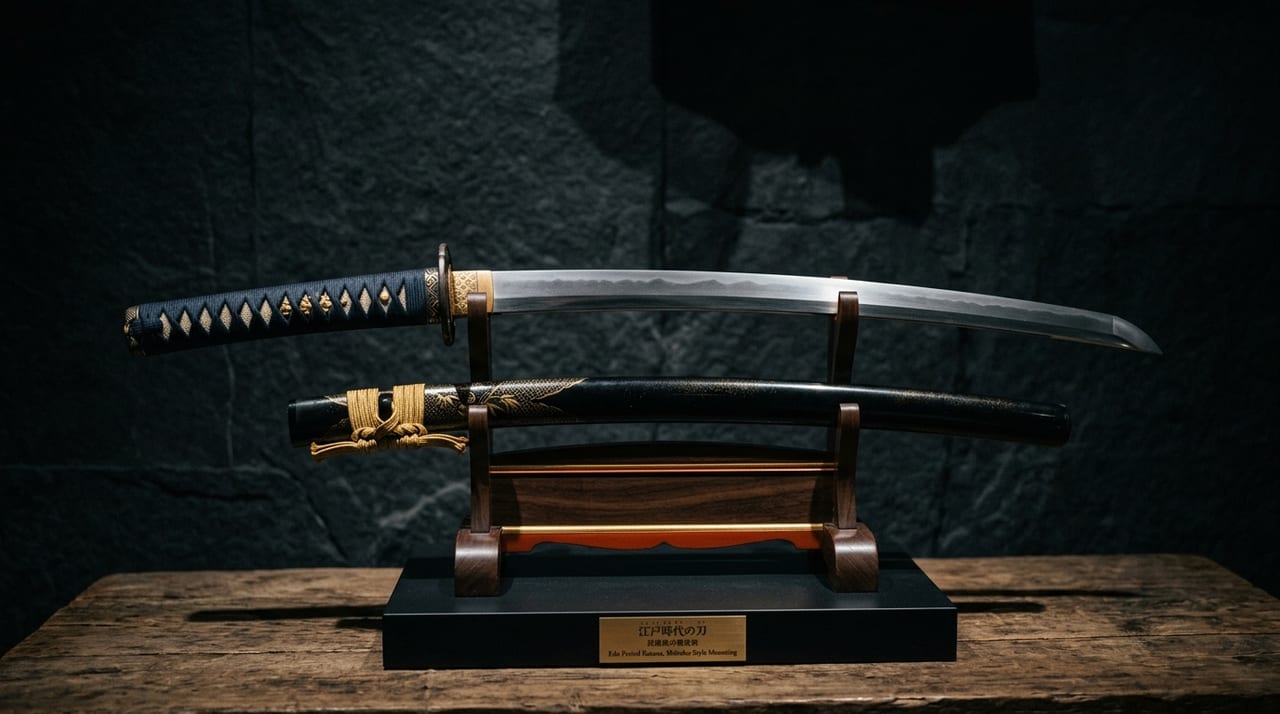 * Image is for illustrative purposes only.
Table of Contents
The Three Imperial Treasures and Kusanagi-no-Tsurugi
In Japanese mythology and the traditions of the imperial household, the objects that have been passed down as the most important treasures are the "Sanshu no Jingi" (Three Imperial Treasures). The three sacred regalia that have long been regarded as symbols of the imperial throne are as follows.
- Yata no Kagami
- Ame-no-Murakumo-no-Tsurugi
- Yasakani no Magatama
Among these, "Ame-no-Murakumo-no-Tsurugi" later came to be known as "Kusanagi-no-Tsurugi." The name, derived from the legend of cutting through grass, has become established as the most widely recognized sword name in Japanese mythology and history. While it is often translated into English as "Grass-Cutting Sword," the Japanese romanization "kusanagi-no-tsurugi" is itself understood worldwide.
Mythological Origins — Yamata no Orochi and the Defeat of the Eight-Headed Serpent
The first appearance of Kusanagi-no-Tsurugi is recorded in the Kojiki (compiled in 712) and the Nihon Shoki (compiled in 720).
The story goes as follows. Susanoo-no-Mikoto, banished from Takamagahara, descends to Izumo Province (present-day Shimane Prefecture), where he learns of the fearsome Yamata no Orochi, a serpent that devoured a maiden every year. To defeat the monster, Susanoo-no-Mikoto prepares strong sake, makes the serpent drunk, and then cuts off all eight of its heads.
When Susanoo-no-Mikoto attempts to cut through the serpent's tail, the blade of his sword chips. Puzzled, he splits the tail open, and from inside a single radiant sword appears — that was Ame-no-Murakumo-no-Tsurugi. It is also said that the sword received its name because it emitted a light resembling a sword appearing from within the clouds. Susanoo-no-Mikoto presented this divine sword to his elder sister deity, Amaterasu Ōmikami.
Yamato Takeru and the Naming of "Kusanagi"
Kusanagi-no-Tsurugi came to be called "Kusanagi" from the legend of Yamato Takeru-no-Mikoto. According to the Kojiki and the Nihon Shoki, Yamato Takeru, during his campaign to conquer the eastern provinces, found himself in a desperate situation on the plain of Sagamu (present-day Shizuoka Prefecture), where enemies had set the grass ablaze to trap him.
Cornered amid the spreading flames, Yamato Takeru drew Ame-no-Murakumo-no-Tsurugi, which had been bestowed upon him by his aunt Yamato-hime-no-Mikoto, and cut down the grass around him. The direction of the wind then shifted, and the flames spread toward the enemy, allowing Yamato Takeru to escape. It is said that from this heroic act, the sword came to be called "Kusanagi-no-Tsurugi (the sword that cuts through grass)."
Yamato Takeru thereafter completed his campaigns across various provinces and set out on his return journey, but at Mount Ibuki (on the present-day border of Shiga and Gifu Prefectures) he fell ill from a divine curse and is said to have died at Nobono in Mie Prefecture. Kusanagi-no-Tsurugi subsequently came to be enshrined at Atsuta (present-day Nagoya, Aichi Prefecture).
Historical Incident — Dan-no-ura and the Loss of the Sword
The greatest historical incident involving Kusanagi-no-Tsurugi is the Battle of Dan-no-ura in 1185.
At Dan-no-ura, the decisive final battle of the Genpei War, the Taira clan was annihilated. At the end of this battle, Nii-no-Ama (Taira no Tokiko), grandmother of the child emperor Antoku Tennō, plunged into the sea holding the young emperor, and the Taira court ladies who entered the water with her are said to have carried one of the Three Imperial Treasures.
According to the Heike Monogatari, the Yata no Kagami and the Yasakani no Magatama were recovered by the Minamoto forces, but Kusanagi-no-Tsurugi is also said to have sunk to the bottom of the sea at Dan-no-ura. Among later historians and Shinto scholars, debate has persisted as to whether what is now enshrined at Atsuta Shrine is not the true Kusanagi-no-Tsurugi, but rather a different sword (a substitute sword) that had been at Atsuta even before Dan-no-ura.
From the Shinto perspective, Kusanagi-no-Tsurugi is regarded as a shintai — a divine body — that is not to be seen by human eyes, and even today the priests of Atsuta Shrine are said never to have seen the sword itself. This character as an "invisible treasure" lends Kusanagi-no-Tsurugi an even deeper air of mystery.
Atsuta Shrine — The Place Where Kusanagi-no-Tsurugi Resides
Atsuta Shrine, located in Nagoya, Aichi Prefecture, is known as one of Japan's most prestigious grand shrines, second only to Ise Jingu. At the heart of its faith is Kusanagi-no-Tsurugi as its shintai.
The founding of Atsuta Shrine is placed, according to mythological accounts, in the reign of Emperor Keikō (around the 2nd century), though reliable historical sources can only be confirmed from the Asuka period onward. Kusanagi-no-Tsurugi is enshrined in the innermost part of the main hall, and it is said that not only ordinary worshippers but even the priests do not look upon it directly, even during formal religious ceremonies.
Atsuta Shrine receives approximately 6.5 million worshippers annually and is revered as the guardian deity of the region. Within its grounds is a treasure hall displaying donated swords, armor, and antique works of art. While Kusanagi-no-Tsurugi itself is not on display, this treasure hall contains valuable materials illustrating the relationship between swords and Shinto.
Kusanagi-no-Tsurugi and Contemporary Culture
Kusanagi-no-Tsurugi continues to exert a strong influence on Japanese popular culture today.
In anime, manga, and games, Kusanagi-no-Tsurugi is a recurring motif. "Kusanagi Kyo," who appears in the fighting game series "The King of Fighters," bears the Kusanagi name, and the aesthetic of blades in contemporary works typified by "Demon Slayer" also connects to the mythological imagery of Kusanagi-no-Tsurugi.
Kusanagi-no-Tsurugi is also widely known internationally, and among Western Japanophiles (enthusiasts of Japanese culture) in particular, the name "Kusanagi" has become established as an almost universal term. Cases can also be seen in Hollywood films and games where the name "Kusanagi" is used for swords and weapons, drawing attention as an example of the reach of Japanese sword culture.
The Relationship Between Kusanagi-no-Tsurugi and the Nihonto
The mythological Kusanagi-no-Tsurugi is not a "nihonto" in the modern sense. The divine sword that appears in the accounts of the Kojiki and the Nihon Shoki is thought to have resembled a "chokuto" — a straight double-edged or single-edged sword — of the kind used during the Yayoi to Kofun periods. The modern "nihonto" with its curved blade did not emerge until the mid-Heian period (around the 9th to 10th centuries).
Even so, Kusanagi-no-Tsurugi is positioned as the spiritual wellspring of nihonto culture. The divinity that dwells in a blade, the spiritual power of a cutting implement — these ideas have been passed down continuously from the mythology of Kusanagi-no-Tsurugi, forming the background for the importance that contemporary tōshō (swordsmiths) place on Shinto ritual when forging a blade. It can also be called the origin of the fusion of spirituality and technique in nihonto making.
Conclusion — What the Invisible Sword Tells Us
Kusanagi-no-Tsurugi occupies the very heart of Japanese mythology, history, and culture, while possessing the unique mode of existence in which the actual object is never seen by human eyes. Because it cannot be seen, its form continues to shine forever in the imagination of people.
Kusanagi-no-Tsurugi embodies the origins of Japanese aesthetic sensibility through the following three stories.
- As one of the Three Imperial Treasures, it symbolizes the legitimacy of the imperial throne
- In the heroic tales of Yamato Takeru, it embodies the courage of the people
- In the tragedy of Dan-no-ura, it becomes a witness to history
The story of this divine sword can be called the origin of the Japanese aesthetic sensibility that regards swords not merely as weapons but as crystallizations of culture, faith, and history. Even now in 2026, the mystery resting deep within Atsuta Shrine continues to quietly inspire reverence in the hearts of those who visit.