New Arrivals — Browse our catalog for the latest authentic Japanese sword arrivals. Browse →
27th–28th day of the 8th month, 2nd year of Emperor Tenji (663)
Baekgang (present-day Geum River estuary, southwestern Korean Peninsula)
Forces
Japanese-Baekje Coalition
Tang-Silla Alliance
About 11 min read
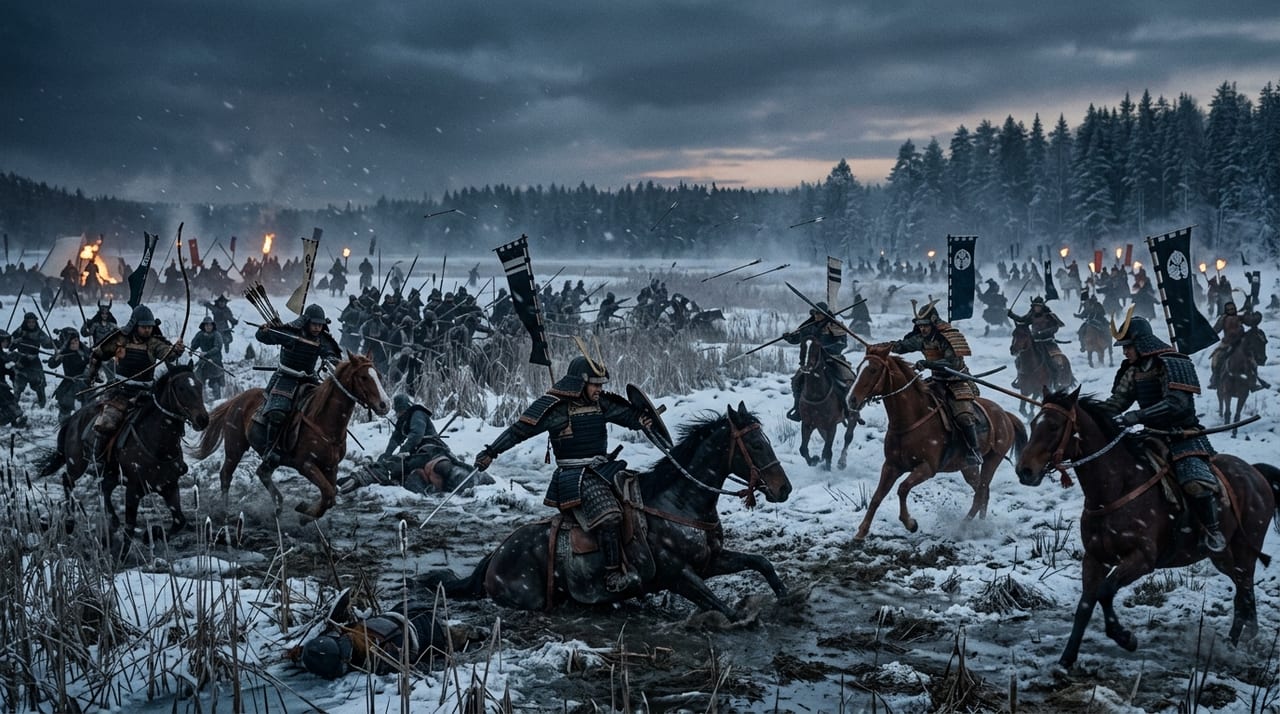
The Battle of Baekgang (Japanese: Hakusukinoe) was a large-scale naval and land battle fought on the 27th–28th days of the 8th month of Tenji 2 (663) at Baekgang on the southwestern coast of the Korean Peninsula, near the mouth of the Geum River in present-day South Korea. The allied forces of Japan and Baekje clashed with the Tang and Silla allied forces. The Japanese chronicle Nihon Shoki records the details, and the Old Book of Tang calls the battlefield the Baekgang estuary ("Baijiang zhi kou"). The defeat shocked the Yamato court and brought about a historic turning point: a major overhaul of the national defense system.
In the 7th century the Korean Peninsula was torn by fierce rivalry among the Three Kingdoms (Goguryeo, Baekje, and Silla). Baekje had close ties with Japan (the Yamato court) since ancient times, and many cultural and technical achievements reached Japan through Baekje. Sword-making techniques were no exception: there are records of Baekje smiths who came to Japan and passed on forging skills. The kantō tachi (ring-pommel sword), which came from the continent, was a sword worn by the ruling class of Japan in the Kofun period. In 660, a combined Tang and Silla army captured Baekje's capital, Sabi, and Baekje effectively fell. Baekje's surviving retainers, including Gwisil Boksin, asked Japan for prince Hōshō (Buyeo Pung) and requested military aid. In Japan, Empress Saimei decided to support Baekje's relief. In 661 she travelled to Kyushu herself, but died there. Her successor, Prince Naka no Ōe (later Emperor Tenji), continued to command the dispatch of troops.
In the 8th month of Tenji 2 (663), the great fleet of the Japanese and Baekje allied forces gathered at Baekgang. According to the Nihon Shoki, the main force numbered 27,000 troops. According to the Korean history Samguk Sagi, there were 1,000 ships. The Tang and Silla allied forces met them with 170 warships. Although the Japanese side had more ships, the Tang navy far surpassed Japan in tactics, equipment, and training. Tang warships were large and sturdy, and they used maneuvers that let them sail freely across the battlefield and set Japanese ships on fire.
In the naval battle fought over two days, the 27th and 28th of the 8th month, the Japanese and Baekje allied fleet suffered a devastating blow from the Tang navy. The Chinese chronicle New Book of Tang records that "four hundred ships were burned, and the sea turned red," and the image of burning ships has been passed down through the ages. The Japanese side was inferior to the Tang navy in ship mobility, crew training, and command structure, and large numbers of soldiers and ships were lost. Baekje's king, Prince Hōshō, fled to Goguryeo, and Baekje's revival was completely cut off.
This defeat was the greatest military crisis Japan faced in the 7th century. Tang and Silla landing attacks on the coasts of Kyushu and western Japan were seen as an imminent threat, and the Yamato court quickly introduced urgent measures to strengthen national defense. After the war, many Baekje officials and craftsmen fled to Japan and settled in the Kinai region and the east.
Swords of the Yamato court in this period were mainly straight blades (chokutō), such as kantō tachi and keitō tachi, which inherited techniques from China and Korea.
The warabite-tō (fern-pommel sword), made in eastern Japan from the late 7th to the 9th century, has a distinctive form with its pommel curled round like a young fern shoot. Most excavated examples come from Hokkaido and the Tōhoku region. Early warabite-tō were straight, but later the blades developed a curve, and through the kenukigata warabite-tō, which had an openwork cutout in the handle, they led to the kenukigata tachi of the Heian period. This is considered one of the origins of the Japanese sword.
In the Shōsōin of the 8th century Nara period, gold- and silver-decorated great swords have been preserved. One of them, the Kingin-den-kazari no Karatachi (a Tang-style great sword decorated with gold and silver), has been the subject of debate over whether its mounts were made in Tang China or in Japan. It shows the East Asian scope of sword culture in the 7th to 8th centuries.
After the defeat at Baekgang, the Yamato court made the defense of western Japan its top priority. In 664 Emperor Tenji built the Mizuki (water fortress) in Tsukushi to protect Dazaifu, a massive barrier of earthen ramparts and moats, in preparation for Tang and Silla landings. He also developed mountain fortresses across Kyushu, including Ōno Castle and Kii Castle, to strengthen the defense of northern Kyushu. The structure of these mountain fortresses was influenced by the Korean-style mountain fortresses of the Korean Peninsula, which is considered evidence that the military technology of immigrants was absorbed into Japan.
The sakimori (frontier guards) system drafted farmers and soldiers from the eastern provinces to serve in the defense of Kyushu. It was organized and strengthened as part of the defense reforms after the defeat at Baekgang. The sakimori carried swords, bows and arrows, spears, and other weapons as they guarded the coasts, and their hardships were passed down to later generations in the sakimori songs of the Man'yōshū. One sakimori song reads, "Leaving behind the children who cling to the hem of my Korean robe and weep, I have come away." It vividly conveys the grief of soldiers conscripted for frontier duty and how harsh the sakimori's service was.
The Battle of Baekgang lies within a continuous historical flow that began with the Isshi Incident (645) and the Taika Reforms. The Wa army sent to Baekgang was in reality a combined force of the forces of the kuni no miyatsuko (provincial chieftains), and it was overwhelmed by the Tang and Silla allied forces because its command structure was not established and it was unused to organized warfare. Afterward, the ritsuryō state developed the gundan (provincial militia regiments) as its military system and built a structure in which soldiers were kept ready in each province. Emperor Tenmu (reigned 673–686) further pushed forward domestic military reform and strengthened state control over weapons.