New Arrivals — Browse our catalog for the latest authentic Japanese sword arrivals. Browse →
6th–7th months of the 1st year of Emperor Tenmu (672)
Nationwide, centered on Yamato, Mino, and Ōmi Provinces
Forces
Prince Ōama's Forces
Prince Ōtomo's Forces
About 11 min read
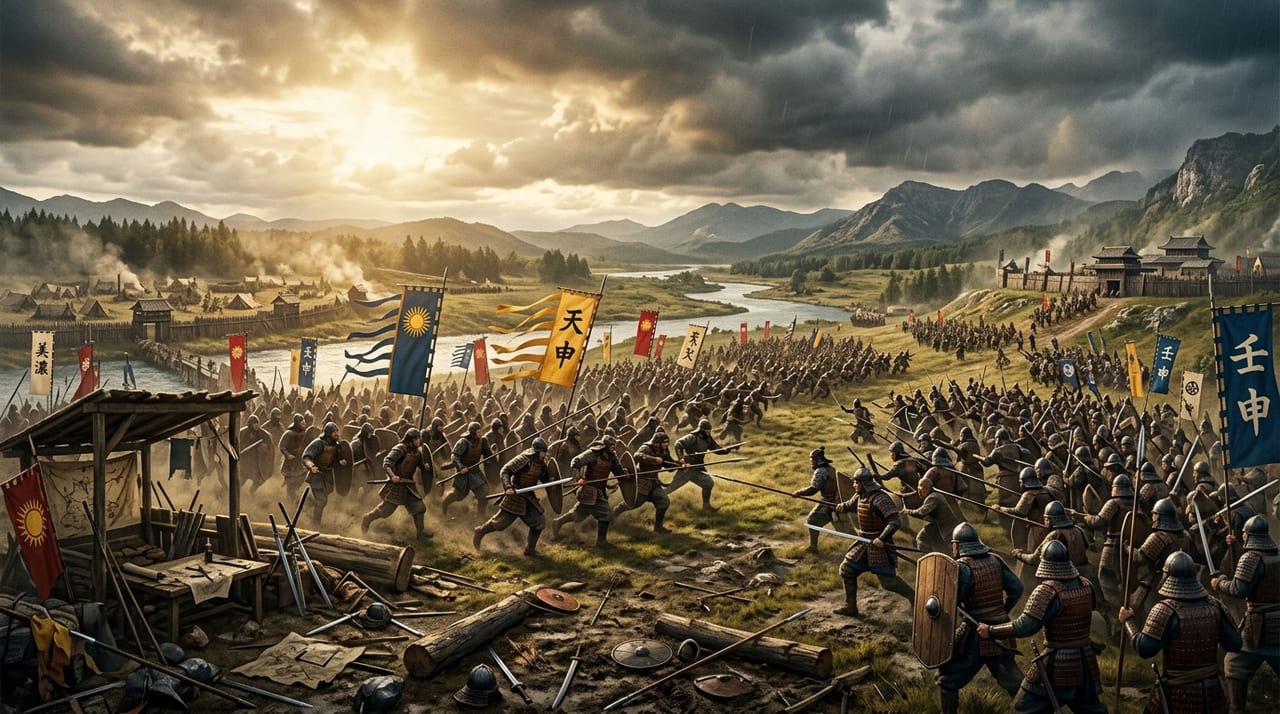
The Jinshin War, which broke out from the 6th month to the 7th month of the 1st year of Emperor Tenmu (672), was the largest civil war in ancient Japanese history. Over the succession to the throne of Prince Naka no Ōe (Emperor Tenji), his younger brother Prince Ōama and his son Prince Ōtomo clashed. Although it was a short decisive struggle lasting barely a month, the impact this civil war had on Japanese history is immeasurable. In terms of the establishment of the ritsuryō state and the strengthening of the imperial system, the Jinshin War is an event that cannot be avoided in any account of Japanese history.
The remote cause of the Jinshin War is found in the reign of Emperor Tenji (Prince Naka no Ōe). Emperor Tenji made the Ōmi-Ōtsu Palace (present-day Ōtsu City, Shiga Prefecture) his capital and pursued the construction of the ritsuryō state. However, a dispute over the succession arose. Prince Ōama, Emperor Tenji's younger brother, was a strong candidate for succession, but Emperor Tenji appointed his eldest son, Prince Ōtomo, as Daijō-daijin (Chancellor of the Realm) and sought to secure the throne for him.
Earlier, when Emperor Tenji fell ill, Prince Ōama asked to take Buddhist vows and withdrew to Yoshino (present-day Yoshino District, Nara Prefecture), where he bided his time waiting for an opportunity. When Emperor Tenji died at the end of 671 (the 12th month of Tenji 10), Prince Ōtomo led the Ōmi court (he was posthumously named Emperor Kōbun in 1870). In the 6th month of 672, Prince Ōama escaped from Yoshino and declared that he had raised troops. This decision opened the largest civil war of antiquity.
The core of Prince Ōama's strategy lay in winning over the clans of Mino (present-day Gifu Prefecture). Mino was a key stronghold on the route to the eastern provinces, and its clans indicated their willingness to follow Prince Ōama. Ō no Homuji of Mino and others, acting on Prince Ōama's orders, blocked the road at Fuwa (present-day Fuwa District, Gifu Prefecture). This cut off communication between the Ōmi side and the eastern provinces and interrupted the supply and reinforcement of the Ōmi-Ōtomo side. This is the strategic concept of "severing the supply lines" in the modern sense, and it shows a remarkably sophisticated strategic insight for an ancient battle.
Meanwhile, the forces of Prince Ōtomo mobilized the official court army based in the Kinai region, but it lacked organized command, and its morale was low. Prince Ōama's forces advanced on two fronts, toward Yamato and toward Ōmi, and on the 22nd day of the 7th month they inflicted a crushing defeat on the Ōmi court army at the Battle of Seta Bridge. On the following day, the 23rd day of the 7th month, Prince Ōtomo took his own life. The war was a decisive struggle lasting barely a month.
The late 7th century, when the Jinshin War broke out, was an important turning point in the history of Japanese swords. The swords of this era were predominantly "chokutō (straight swords)," heavily influenced by China and the Korean Peninsula. The curved form of the "Japanese sword" was perfected in the mid-Heian period (around the 10th to 11th centuries), but its prehistory rested on the technical development of iron chokutō in the 7th century, which became an indispensable foundation.
In the Jinshin War, the weapons carried by the clans centered on chokutō, hoko spears, and bows and arrows. Iron products of this period were made using techniques prototypical of tatara iron smelting, and they form the origins of the later Japanese swordsmithing.
Emperor Tenmu, the victor of the Jinshin War, devoted effort to the management of weapons and armor alongside the construction of the ritsuryō state.
Prince Ōama, having won the Jinshin War, ascended the throne as Emperor Tenmu at the Asuka Kiyomihara Palace (present-day Asuka Village, Nara Prefecture). Emperor Tenmu's reign (673 to 686) can be called the golden age of the construction of the ritsuryō state in Japan. The compilation of the Asuka Kiyomihara Code began, and work started on the Nihon Shoki and the Kojiki in this era. The prevailing view holds that the title "tennō" was also established in this period.
In order to raise the authority of the imperial throne, Emperor Tenmu placed importance on the symbolic value of weapons and armor, including swords. For the emperor to hold the treasure sword (the sword of the sacred regalia) was an expression of the legitimacy of his rule. This idea that "the sword shows the legitimacy of power" would be passed down continuously in later ages, in the era of the Minamoto and Taira and even in the age of the sengoku daimyō.
The historical significance of the Jinshin War is wide-ranging, but from the standpoint of the history of the Japanese sword, the following point is especially important.
This point is that, as Emperor Tenmu advanced the construction of the ritsuryō state, the production, management, and possession of weapons became institutionalized. The attempt under the ritsuryō system to have the state control the production of swords became the starting point of the "state control" of later sword culture.
Several centuries after the Jinshin War, the Japanese sword reached its completed form in the Heian period. Its prehistory includes the chokutō that soldiers wielded in the civil war of 672, and the skill of the smiths who made them. The Jinshin War was not merely a civil war over the succession to the throne; it was also the starting point from which the management of weapons came to be built into the institutions of the state.