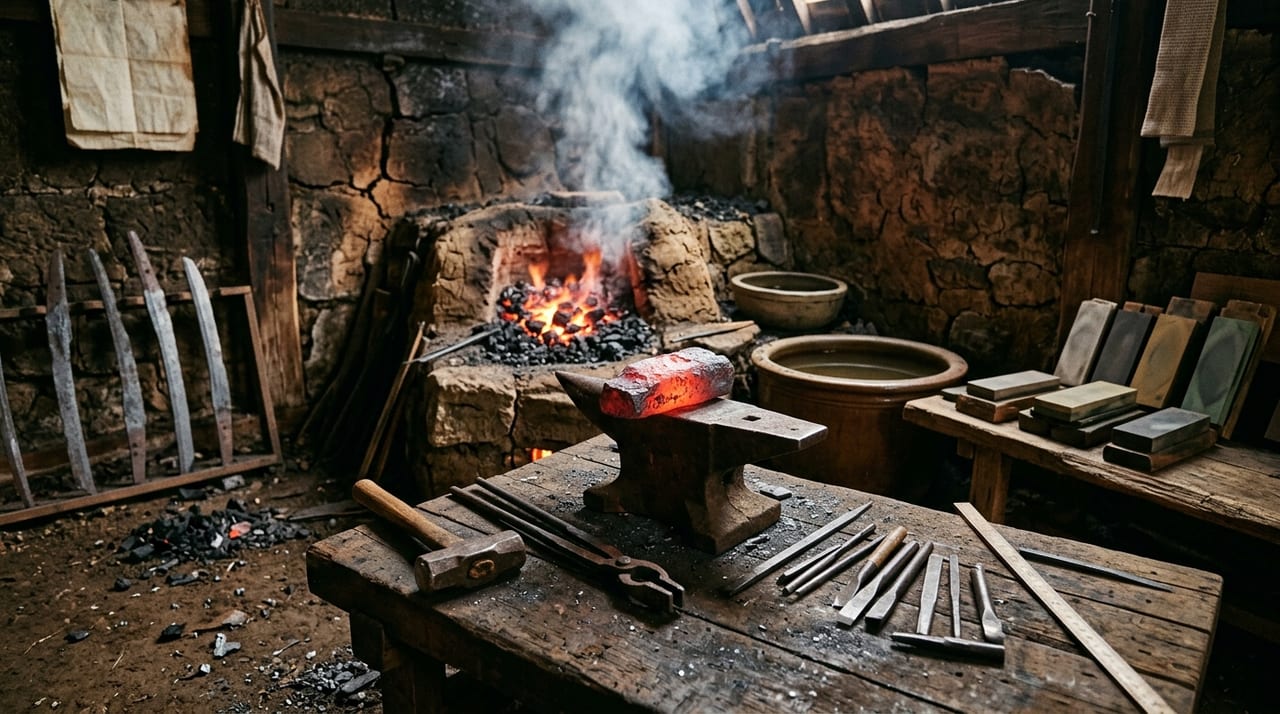
 * Image is for illustrative purposes only.
Hōki Yasutsuna
伯耆安綱
Description
Hōki Yasutsuna was a swordsmith who was active in Hōki Province (present-day central-western Tottori Prefecture) from the mid to late Heian period, and he is also called Ōhara Yasutsuna. He is identified with the figure recorded in the Taiheiki as "a smith named Ōhara Gorōdayū Yasutsuna in Aimi District, Hōki Province," and he is traditionally said to have been a resident of Ōhara in Hōki Province. Old sword records also preserve a tradition placing his activity in the Daidō and Kōnin eras (early ninth century), but the surviving examples show a form that had reached its mature stage as a curved blade with sori, and today the prevailing view is to regard him as a contemporary smith of the late Heian period, alongside Sanjō Munechika and Bizen Tomonari. These three are counted among the oldest master smiths representing the period when the Japanese sword took shape. He is one of the few makers whose signed tachi have survived to the present day, and he is positioned as the ancestor of the curved Japanese sword and as the progenitor of Ko-Hōki works.
His style is characterized by an elegant tachi form with high koshi-zori and a firm, sturdy stance, combined with an archaic construction that adopts a small kissaki. The jigane has well-raised itame-hada, with strong ji-nie and prominent jifu. The hamon is ko-midare mixed with ko-gunome and ko-notare, the nioi is deep and the nie is well developed, kinsuji and sunagashi appear, and it shows a distinctive yaki-otoshi at the machi. The field of work that embodies archaic yet powerful variation in both jigane and hamon was passed on to the Hōki smiths of later generations.
His masterpiece is the famed sword Dōjigiri Yasutsuna (National Treasure; in the collection of the Tokyo National Museum), counted as one of the Tenka Goken. It is known as a fine work that clearly shows Yasutsuna's style, with an imposing tachi form of high koshi-zori, a richly varied ko-midare hamon, and a jigane in which itame flows and chikei intertwines. Its name derives from the legend that Minamoto no Yorimitsu (Raikō) slew the demon Shuten-dōji of Mount Ōe in Tanba Province with this sword. However, this story is a later invention, and the earliest certain record goes back to the Monogatari Mokuroku of Ōei 27 (1420). As for its provenance, it is known that during the Muromachi period it was held by the Ashikaga shogunal house, and in Tenbun 7 (1538) there is a record that the Asakura clan presented it to the shogun Ashikaga Yoshiharu. Afterward, it is said to have passed from Toyotomi Hideyoshi to Tokugawa Ieyasu and Hidetada, and then was presented to Matsudaira Tadanao, lord of the Echizen Domain, and came down in the Matsudaira family of Tsuyama. However, the early course of its transmission is poorly documented in reliable primary sources and belongs to tradition. The dramatic tameshigiri anecdote of cutting through six condemned criminals' bodies stacked together is also one of these legends.
Yasutsuna is regarded as a master smith who stands at the starting point of the history of the Japanese sword, as one of the oldest smiths whose signed works survive. His works have been held in extremely high esteem since ancient times. Dōjigiri Yasutsuna was designated a National Treasure in Shōwa 26 (1951), and in Shōwa 43 (1968) it came into the collection of the Tokyo National Museum. As the progenitor of Ko-Hōki works and one of the progenitors of the Japanese sword, he holds an unshakable position in the history of swords.
Famous Works
- Dōjigiri Yasutsuna (National Treasure, Tokyo National Museum)