New Arrivals — Browse our catalog for the latest authentic Japanese sword arrivals. Browse →
April 25, 1185 (24th day, 3rd month, Genryaku 2 / Juei 4)
Dan-no-ura, Nagato Province (present-day Kanmon Straits, Shimonoseki, Yamaguchi Prefecture)
Forces
Minamoto (Genji) Forces
Taira (Heike) Forces
About 10 min read
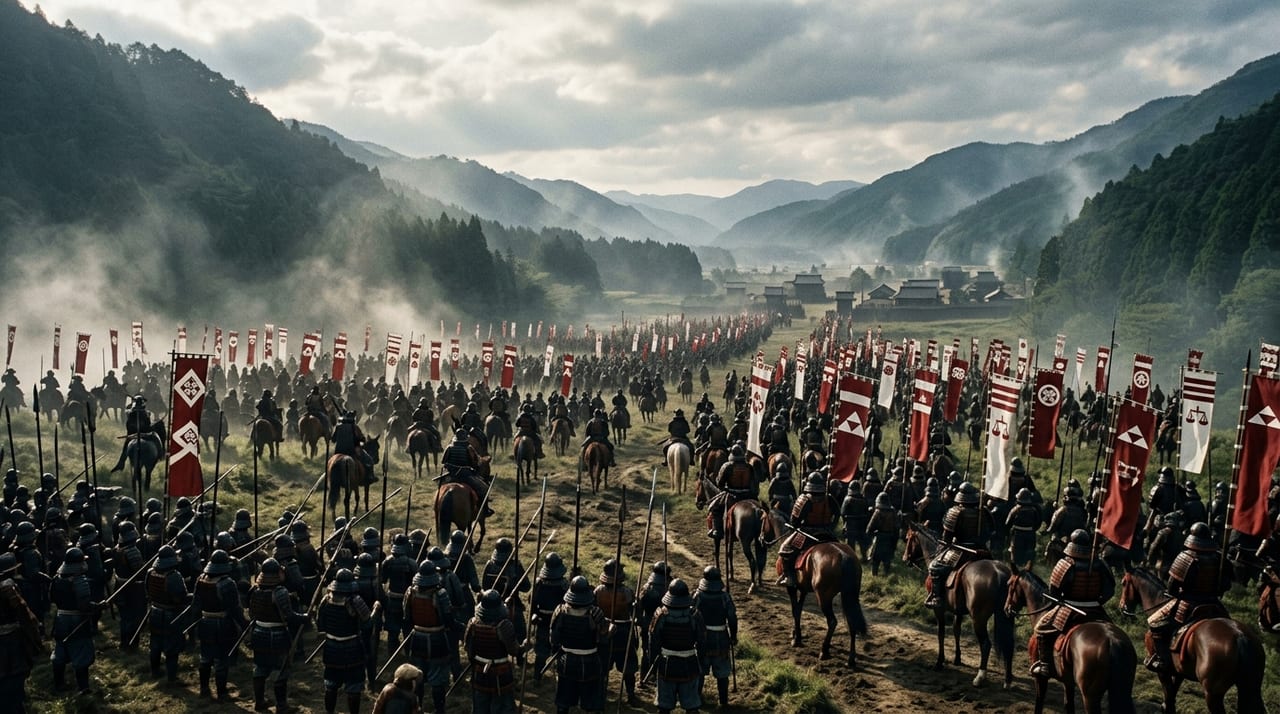
On the 24th day of the 3rd month of Genryaku 2 (1185), the most dramatic naval battle in Japanese history was fought at Dan-no-ura in the Kanmon Strait. The Minamoto (Kamakura shogunate), led by Minamoto no Yoritomo, ordered his brothers Yoshitsune and Noriyori to pursue the Taira. Following the land battles at Ichinotani and Yashima, they finally drove the Taira into the sea at Dan-no-ura, which the Taira had made their last stronghold.
At the end of the Jishō-Juei War (the Genpei War), the Taira had fled to western Japan with Emperor Antoku and the Three Sacred Treasures (Imperial Regalia). After the death of Taira no Kiyomori in 1181, the Taira's actual command was carried out by Taira no Tomomori, Taira no Munemori, and Taira no Noritsune, who prepared for a final battle. Minamoto no Yoshitsune, on the other hand, was known as a matchless tactical genius. He won battle after battle, including the surprise attack at Hiyodorigoe in Ichinotani (1184) and the swift attack at Yashima (1185), and Dan-no-ura became the last battlefield.
The widely known account holds that the tide decided the outcome of the battle that day. At first, the Taira fleet, riding the tide flowing from west to east, had the advantage, but when the tide reversed in the afternoon, the Minamoto gained the upper hand. However, there is also a counterargument that the tidal current in the battle area was weak and did not affect the outcome.
A well-known story holds that Yoshitsune ordered his men to shoot the enemy's oarsmen and helmsmen, breaking the conventions of the time and immobilizing the Taira fleet. However, The Tale of the Heike contains no scene in which Yoshitsune gives such an order. Instead, it depicts how, after the outcome had largely been decided, Minamoto soldiers boarded the Taira ships and shot and cut down the oarsmen and helmsmen. Before the battle, it is also said that Yoshitsune and Kajiwara Kagetoki fiercely clashed over leading the vanguard.
Also, The Tale of the Heike relates that Awa no Minbu Shigeyoshi (Taguchi Shigeyoshi), a Taira commander, defected to the Minamoto in the middle of the battle and informed Yoshitsune of the Taira's stratagem involving Chinese-style ships, which is said to have sealed the Taira's defeat.
The fiercest end at Dan-no-ura was that of Taira no Tomomori. Among the Taira commanders, Tomomori directed the course of the battle calmly to the very end. When defeat became certain, he ordered, "Throw everything unsightly into the sea," then put on two layers of armor and threw himself into the sea. His death poem, "I have seen all there is worth seeing," has been passed down as the ultimate expression of the samurai's resolve.
Nii no Ama (Taira no Tokiko), the grandmother of Emperor Antoku, held the young emperor in her arms and threw herself into the sea, speaking to him, "There is also a capital beneath the waves." This scene is depicted as one of the most poignant in The Tale of the Heike and is counted among the finest tragic scenes in Japanese literature.
One of the most serious historical losses of the Battle of Dan-no-ura was the sinking of the Kusanagi no Tsurugi (Kusanagi Sword), one of the Three Sacred Treasures. In mythology, the Kusanagi Sword is the legendary sword that Susanoo took out of the Yamata no Orochi and that Yamato Takeru used. It is the supreme sacred treasure symbolizing the authority of the imperial family.
Nii no Ama drowned while carrying the treasured sword and the sacred jewel (magatama). The Yata no Kagami (Yata Mirror) was recovered, and the sacred jewel (magatama) was also discovered. However, the Kusanagi Sword that had been with Emperor Antoku at Dan-no-ura, said to be the katashiro (ritual substitute) kept at court, was lost. That said, the original body is said to have been enshrined at Atsuta Shrine and to have escaped disaster, while at the time many regarded the sword that sank at Dan-no-ura as the Ame no Murakumo no Tsurugi itself. Afterward, a new katashiro of the Kusanagi Sword enshrined at court was presented from Ise Grand Shrine.
The loss of the Kusanagi Sword was not merely the loss of a sacred treasure. It was an event that shook the fundamental ancient Japanese concept that "the sword is a symbol of power." It is thought that the reinforcement, from the medieval period onward, of the warrior society's awareness of "sword = authority" is not unrelated to this experience of loss at Dan-no-ura.
In addition, many famous swords associated with the Taira are said to have sunk at Dan-no-ura. The Taira clan's treasured sword Kogarasumaru was thought to be missing after Dan-no-ura, but its transmission within the Ise family was identified in the Edo period. It is now held by the National Institutes for Cultural Heritage as part of the Imperial Household collection (gyobutsu). Yet many of the Taira clan's beloved swords were lost to the depths of the sea.
The Battle of Dan-no-ura is one of the greatest turning points in Japanese political history. With this battle, the Taira, an aristocratic warrior regime, was completely destroyed, and the establishment of a warrior government under Minamoto no Yoritomo (the Kamakura shogunate) became certain.
The Tale of the Heike, known from its opening line, "The sound of the bells of Gion Shōja echoes the impermanence of all things," takes as its theme the transience of power and the sorrow of ruin. It has had an immeasurable influence on later Japanese literature, arts, and culture. Many performing arts, including Noh, Kabuki, and Ningyō Jōruri, took The Tale of the Heike as their subject, and Dan-no-ura became the symbolic stage of the "aesthetics of ruin."
Minamoto no Yoshitsune
Minamoto commander whose tactics annihilated the Taira
Taira no Tomomori
Taira commander who fought to the end and drowned himself
Minamoto no Yoritomo
Minamoto leader who founded the Kamakura shogunate
Taira no Kiyomori
Former Taira patriarch (deceased), whose policies precipitated the war
Musashibō Benkei
Yoshitsune's retainer, said to have accompanied him to Dan-no-ura
1185年(元暦2年)、長門国壇ノ浦(現・山口県下関市)における源平の最終決戦は、三種の神器の喪失・武家政権の確立・刀剣生産の需要爆発という三重の意味で日本刀文化の転換点となった。本稿では壇ノ浦が日本刀の歴史に与えた影響を多角的に考察する。
2026-05-21
源義経が愛用したとされる太刀・膝丸(薄緑)は、源氏の宝刀として平安末期から鎌倉にかけて語り継がれた名刀である。壇ノ浦・一ノ谷・屋島の合戦を経た義経の伝説と刀剣の関係、その後の来歴と現代における所在を解説する。
2026-05-21
平安初期に製作されたと伝わる名刀「小烏丸(こがらすまる)」の歴史・形態・伝承を解説。「両刃(もろは)と片刃(かたは)の中間形態」という独特の刀身構造、桓武平氏の伝来刀としての来歴、現在の所蔵場所(宮内庁三の丸尚蔵館)と文化財的価値、そして小烏丸が日本刀形成史に占める重要な位置づけを詳述する。
2026-05-03
両側に刃を持つ「諸刃(もろは)」の刀剣形式を体系的に解説する。古代の剣(けん)から江戸期の両刃脇差・蕨手刀まで、諸刃造りの系譜と各時代の製作背景、神道・仏教との関連、現代のNBTHK鑑定における諸刃刀剣の評価基準を整理する。
2026-04-20