New Arrivals — Browse our catalog for the latest authentic Japanese sword arrivals. Browse →
7th–9th months of Bunji 5 (1189)
Mutsu and Dewa provinces (present-day Iwate, Miyagi, Akita, Yamagata prefectures)
Forces
Minamoto no Yoritomo Forces (Kamakura Shogunate)
Ōshū Fujiwara Clan
About 9 min read
Ōshū (the present-day Tōhoku region) was one of Japan's richest regions in iron and gold throughout the Heian period. The Ōshū Fujiwara clan, through four generations (Kiyohira, Motohira, Hidehira, and Yasuhira), brought a splendid Buddhist culture into bloom at Hiraizumi in present-day Iwate Prefecture. Hiraizumi's culture, represented by the Konjikidō of Chūsonji, reached a unique height that rivaled the court culture of Kyōto.
Ōshū's abundant iron resources also led directly to its sword culture. The Tōhoku region had its own smithing tradition since ancient times. The swords carried by Ōshū Fujiwara warriors are said to have combined the robust, northern character of blades made from local iron with the refined ornamentation shaped through exchange with Kyōto culture.
During the period when Fujiwara Hidehira (the third generation of the Ōshū Fujiwara) gave protection to Yoshitsune, the swords of the warriors gathered at Hiraizumi are thought to have included some that reached the highest standard of the time. There are various theories about Yoshitsune's favorite sword, and his connection to legendary famous blades has been told through later stories.
In the intercalary fourth month of Bunji 5 (1189), Fujiwara Yasuhira bowed to Yoritomo's pressure and made a surprise attack on Minamoto no Yoshitsune, who had taken refuge at Koromo-no-tate (present-day Hiraizumi Town, Iwate Prefecture). Yoshitsune took his own life along with his wife and children, ending a life of thirty-one years. Yasuhira sought reconciliation by presenting Yoshitsune's head to Yoritomo, but Yoritomo's attitude did not change.
For Yoritomo, the pretext of hunting down Yoshitsune was also a justification for seizing the opportunity to subdue Ōshū. The economic and military power of the Ōshū Fujiwara, centered on Hiraizumi, was an independent force that the Kamakura shogunate could not overlook. Yoritomo asked the court for a pursuit edict (senji) against Yasuhira on the grounds of his long harboring of Yoshitsune, but he decided to dispatch troops without waiting for it. The pursuit edict dated the 19th day of the 7th month did not reach the camp until the 9th month.
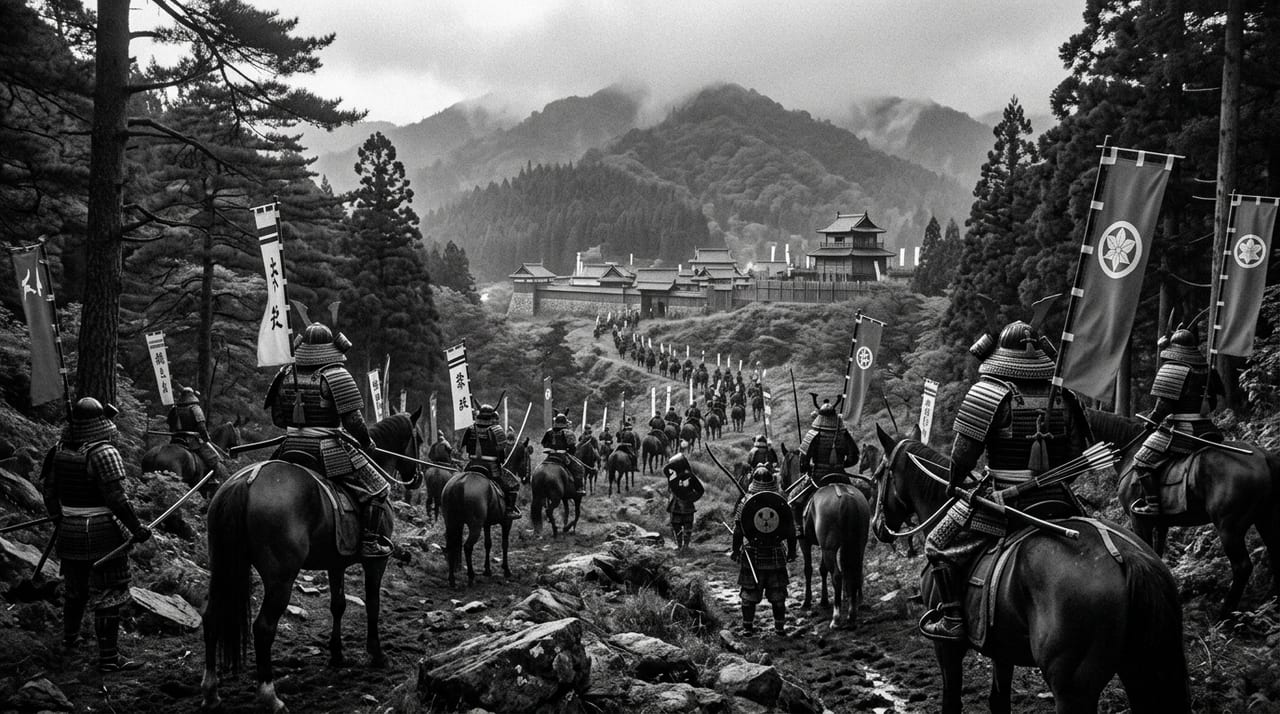
On the 19th day of the 7th month of Bunji 5 (1189), Yoritomo left Kamakura and marched north at the head of a large army. The Azuma Kagami, the historical chronicle of the Kamakura shogunate, records the total strength of the army as 284,000 mounted warriors, but this figure is thought to include exaggeration. In any case, it is certain that the scale greatly exceeded the military strength of the Ōshū Fujiwara.
What stands out in this battle is how well equipped the Kamakura army was. Yoritomo's government had organized warrior bands centered on the Kantō region and had built a firm military system.
Yasuhira's forces attempted sporadic resistance in various places, but against such overwhelming numerical superiority, organized defense was difficult. After their defensive line at Atsukashiyama (Fukushima Prefecture) was broken through, retreat continued in various places.
In hand-to-hand combat during the Ōshū campaign, the tachi (a long sword worn with the edge facing down) and the archery of Kamakura warriors proved their power. By the Heian period, master smiths such as Sanjō Munechika and the Ko-Bizen school had already appeared, and some of the higher-ranking commanders in the shogunate's army are thought to have carried swords by these master smiths. The Fujiwara retainers of Hiraizumi also had their own swords, but they did not reach organized resistance.
In the 9th month, Fujiwara Yasuhira was betrayed and killed by his retainer Kawada Jirō while fleeing north. The Ōshū Fujiwara clan fell after four generations and about a hundred years.
Much of Hiraizumi's golden culture was lost in this campaign and the chaos that followed. The Konjikidō of Chūsonji barely survived, but many cultural properties that testified to Hiraizumi's prosperity were lost. In swords as well, many of the famous blades accumulated by the Ōshū Fujiwara are said to have been scattered during the campaign.
Yoritomo afterward installed jitō (land stewards) across Ōshū and established direct control. With the subjugation of Ōshū, the Kamakura shogunate's control of the whole country was completed in both name and reality. The Ōshū Campaign went beyond a mere military action. As a historic event that firmly laid the foundation of Japan's medieval warrior society, it holds an important place in the history of the Japanese sword as well.
After the Ōshū Campaign, the iron industry of Ōshū, which came under Kamakura shogunate rule, continued under the shogunate's management. Iron and iron sand from Tōhoku remained important resources supporting Japanese sword production, and the smithing traditions based in Mutsu and Dewa continued throughout the medieval period. The land of Hiraizumi, where Yoshitsune rests, has an inseparable bond with the Japanese sword as the "soul of the warrior," and it is still a sacred place visited by many sword enthusiasts today.