New Arrivals — Browse our catalog for the latest authentic Japanese sword arrivals. Browse →
4th month, 9th day – 5th month, 26th day, Jishō 4 (1180)
Kyoto, Onjō-ji (Mii-dera), Uji (Byōdō-in and Uji Bridge), and the torii of Kōmyōzan, Yamashiro Province
Forces
Prince Mochihito and Minamoto no Yorimasa
Taira side
About 14 min read
Prince Mochihito's uprising was a revolt launched in Jishō 4 (1180) by Prince Mochihito, a son of Retired Emperor Go-Shirakawa, together with Minamoto no Yorimasa, in an attempt to overthrow the Taira regime. The plot was discovered and failed. On the 26th day of the 5th month, Mochihito was killed after the fighting at Uji, and Yorimasa took his own life at Byōdō-in. Yet the edict (ryōji) Mochihito is said to have issued moved Minamoto families in many regions, and through the rising of Minamoto no Yoritomo and others it led to the civil war known as the Jishō-Juei War.
In 1178, Minamoto no Yorimasa was promoted to Junior Third Rank on the recommendation of Taira no Kiyomori. It was unusual for a Minamoto warrior to join the ranks of the court nobility, and it shows that Yorimasa enjoyed favor through his relationship with Kiyomori.
The situation changed sharply in the 11th month of 1179, when Kiyomori staged a coup and Go-Shirakawa was confined at the Toba Palace. In the 2nd month of 1180, Emperor Antoku took the throne, and Prince Mochihito lost any hope of succeeding to it. In the 3rd month, the monks of Onjō-ji, calling on those of Enryaku-ji and Kōfuku-ji, planned to seize the two retired sovereigns and keep them within the temples, but word reached the Taira in advance and the plan failed. In the dead of night on the 14th day of the 5th month, Go-Shirakawa was moved from the Toba Palace to a residence in the capital.
Seen this way, the uprising grew out of accumulated resentment toward the Taira regime over the retired emperor and the imperial succession.
On the 9th day of the 4th month, Mochihito, styling himself "Prince Saishō," is said to have issued an edict calling for the destruction of the Taira to Minamoto families and major temples and shrines across the provinces. A ryōji is a document conveying the wishes of a crown prince or imperial prince. On the same day, Minamoto no Yukiie left the capital as a messenger and traveled through the provinces. On the 27th day of the 4th month, he is said to have delivered the edict to Minamoto no Yoritomo at the Hōjō residence in Izu.
The existence and content of this edict, however, differ among the sources, and some scholars regard it as a later invention. When, to whom, and in what wording it was issued is not settled.
In early 5th month, the plot was discovered. The Tale of the Heike says that Tanzō, the Kumano superintendent, informed the Taira.
On the 15th day of the 5th month, the Taira reduced Mochihito to commoner status under the name "Minamoto no Mochimitsu" and decided to exile him to Tosa. Taira no Tokitada, head of the imperial police, went to the Sanjō-Takakura residence, and Yorimasa's second son, Kanetsuna, was among the party. At the residence, Hasebe no Nobutsura fought the police and bought time, and meanwhile Mochihito escaped disguised as a woman and fled to Onjō-ji.
On the 16th, the Taira demanded that Mochihito be handed over, and Onjō-ji refused. On the 21st, the Taira decided to form an attack force against Onjō-ji with Yorimasa among its commanders. That very night, however, Yorimasa burned his own residence, led some fifty riders to Onjō-ji, and joined Mochihito. The man slated to command the punitive force had gone over to the anti-Taira side.
On the 23rd day of the 5th month, a night attack on Rokuhara was proposed at Onjō-ji. Debate dragged on and the plan fell through, and in the meantime the Taira split off the monastic community of Enryaku-ji. Onjō-ji was left isolated, without support from Enryaku-ji.
On the night of the 25th, Yorimasa and Mochihito left Onjō-ji with over a thousand riders and headed for Kōfuku-ji in Nara. The plan was presumably to join the Kōfuku-ji community and regroup there.
On the 26th, an advance party under Fujiwara no Kagetaka and Fujiwara no Tadakiyo caught up with Yorimasa's force at Byōdō-in. Taira no Shigehira and Taira no Koremori were dispatched to Uji as reinforcements.
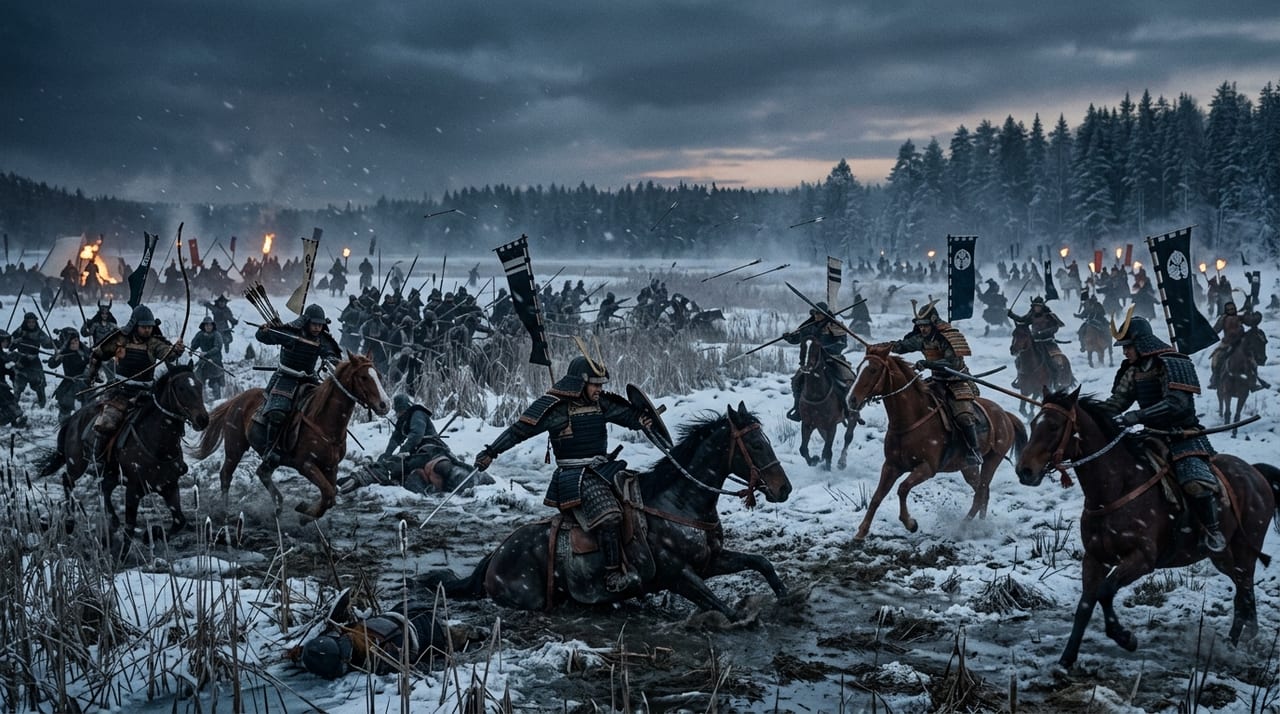
Mochihito, tired from the night march, rested at Byōdō-in. Yorimasa's men removed the planks of Uji Bridge and waited for the Taira across the river, and the two sides exchanged arrows.
On the Taira side, Fujiwara no Tadakiyo advised a detour. But the father and son Ashikaga Tadatsuna and Toshitsuna argued for crossing by "uma-ikada" (a horse raft, in which horses are lined up to ford a river), and they forced their way across the swift current and pushed Yorimasa's men back.
Yorimasa fell back to Byōdō-in and fought on, but his second son Kanetsuna was killed and his eldest son Nakatsuna, badly wounded, took his own life. Yorimasa himself chanted the nenbutsu and then killed himself, with Watanabe no Tonau serving as his second. His adopted son Nakaie, Nakaie's son Nakamitsu and others also died in battle or by their own hand.
Mochihito escaped Byōdō-in under the guard of thirty riders and headed for Nara. But before the torii of Kōmyōzan in Sōraku District, Yamashiro Province, he was struck by an arrow, fell from his horse, and was killed. The spot is identified with the Kabata area of Yamashiro-chō, Kizugawa City, Kyoto Prefecture.
On the 27th, a council was held at the retired emperor's palace. Minamoto no Michichika and Fujiwara no Takasue urged an immediate expedition against Kōfuku-ji, but a more cautious view prevailed. On the 28th, Retired Emperor Takakura is said to have secretly viewed the heads of Mochihito and Yorimasa at Kiyomori's residence, an act criticized among the nobility of the time as exposing him to the pollution of death.
In the 12th month, Onjō-ji was attacked, and on the 28th, temples in Nara were burned by troops under Taira no Shigehira and others (a theory of accidental fire is considered the stronger). After Mochihito's death, rumors that he was still alive circulated and were used by anti-Taira movements. His child was taken by Taira no Yorimori and made to enter the priesthood.
The uprising itself failed. But in the name of the edict, Minamoto no Yoritomo raised troops on the 17th day of the 8th month, followed by Minamoto no Yoshinaka, the Kai Genji, the Ōmi Genji and others in various regions. That was the start of the Jishō-Juei War.
Yoritomo held up Mochihito's edict as justification for his rule of the Kantō. After an imperial rescript in Juei 2 (1183) officially recognized his authority over the Kantō, however, the edict is said to have lost its force.
All dates below are by the old calendar, in Jishō 4 (1180):
- 2nd month: Emperor Antoku takes the throne, and Mochihito loses any hope of the succession. - 4th month, 9th day: Mochihito is said to issue the edict, and Minamoto no Yukiie leaves the capital as messenger. - 4th month, 27th day: Yukiie is said to deliver the edict to Minamoto no Yoritomo at the Hōjō residence in Izu. - Early 5th month: the plot is discovered. - 5th month, 15th day: Mochihito is made "Minamoto no Mochimitsu" and exile to Tosa is decided; while Hasebe no Nobutsura buys time, he escapes to Onjō-ji. - 5th month, 16th day: the Taira demand his surrender and Onjō-ji refuses. - 5th month, 21st day: Yorimasa burns his residence and enters Onjō-ji with some fifty riders. - Night of the 5th month, 25th day: Yorimasa and Mochihito leave Onjō-ji with over a thousand riders for Nara. - 5th month, 26th day: the bridge battle at Uji; Yorimasa kills himself and Mochihito is killed before the torii of Kōmyōzan. - 8th month, 17th day: Yoritomo raises troops. - 12th month, 28th day: temples in Nara are burned.
Matters turned quickly, with only a few days between entering Onjō-ji and the deaths at Uji.