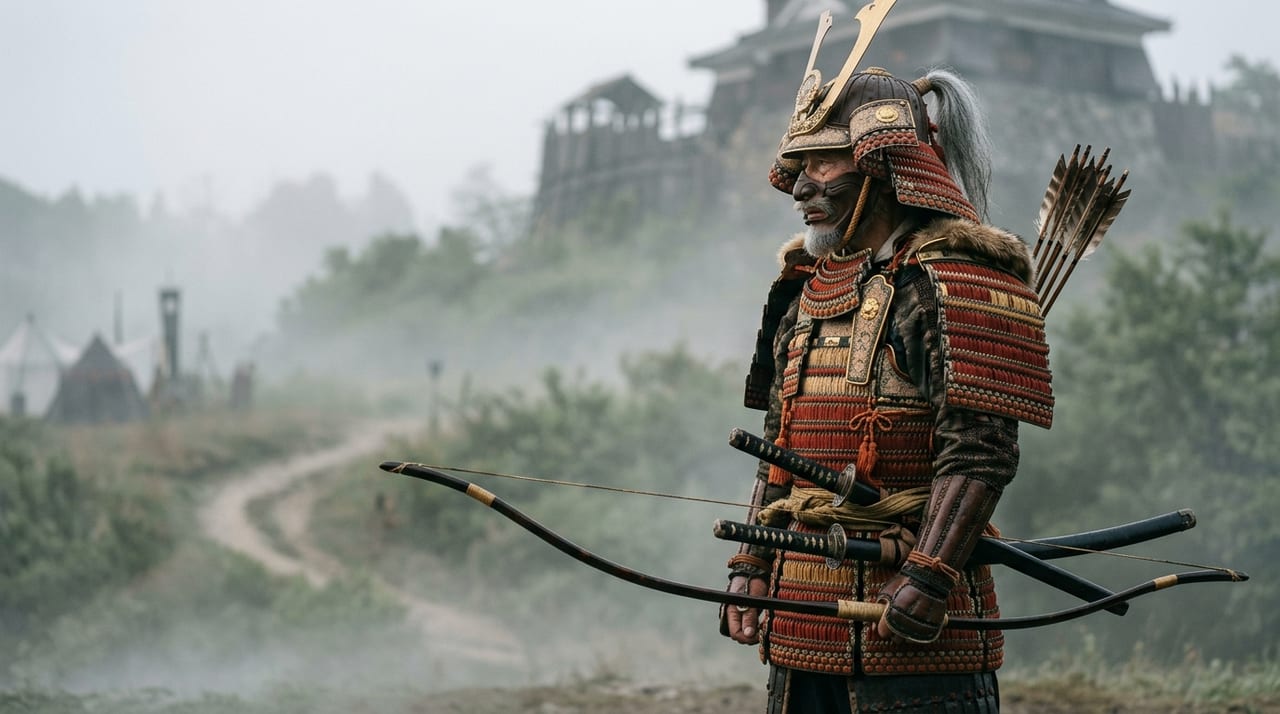
 * Image is for illustrative purposes only.
Minamoto no Yorimasa
源頼政
Slayer of the Nue
Description
Slayer of the Nue
In the 1st year of Chōji (1104), Minamoto no Yorimasa was born into the Minamoto clan, long known as a family of bows and arrows, and grew into a warrior especially skilled in archery. During the reign of Emperor Konoe, a strange voice echoed through the imperial palace every night, and the emperor fell ill. The disturbance was attributed to a monster of unknown identity, the nue, with the head of a monkey, the body of a tanuki, the tail of a snake, and the limbs of a tiger. The court ordered Yorimasa to slay it. He strung his bow and waited quietly in the palace at night. Deep in the night, a fearsome cry rang out from within a black cloud. Yorimasa shot an arrow into the cloud and brought the nue down. Through this feat, Yorimasa's name has been remembered as the slayer of the nue.
Poet and Warrior
Yorimasa was not only a master of archery but also an outstanding waka poet of the late Heian period, who associated with Fujiwara no Shunzei and others. A total of fifty-nine of his poems were included in imperial waka anthologies, beginning with the Shika Wakashū, and his personal collection, the Gensanmi Yorimasa-shū, also survives. He was revered as a model of 'the two ways of letters and arms,' combining martial and literary accomplishment.
Prince Mochihito's Command and the Uprising
In the 5th month of Jishō 4 (1180), Yorimasa, then seventy-seven years old, raised an army against the Taira in support of Prince Mochihito. Several theories exist about his motives. The Tale of the Heike cites the insult that his eldest son, Nakatsuna, received from Taira no Munemori. Yorimasa's uprising soon ended in defeat at the Battle of the Uji River, and he took his own life at Byōdō-in. However, Prince Mochihito's command was transmitted to Minamoto clans across the country, and it became the fuse for anti-Taira movements in various regions, including Minamoto no Yoritomo's uprising in the same year.
Death at Byōdō-in
After the defeat at the Uji River, Yorimasa held out at Byōdō-in to let Prince Mochihito escape, and then killed himself. The death poem he composed at that time, 'Though I was like a buried tree that never once bloomed, how sad is the end my life has come to,' is handed down as a verse that expresses, with great beauty, the regret and the purity of an old warrior who died without reward. A grave of Yorimasa stands at Byōdō-in, and memorial services are held there every year on the anniversary of his death. His valiant last stand at the age of seventy-seven symbolizes the life of Yorimasa, who fulfilled the duty of a warrior even in old age.
The Tachi 'Shishiō'
The Tale of the Heike and the Genpei Jōsuiki relate that Yorimasa received the tachi 'Shishiō' from the emperor as a reward for slaying the nue. An unsigned tachi from the Heian period, said to be this sword, has been designated an Important Cultural Property together with its black-lacquered tachi mounting, and is held by the Tokyo National Museum. (Whether it is the genuine article is disputed.)
Transmission of the Legend
The legend of the nue's slaying had a great influence on later literature and the performing arts. Beginning with the Noh play Nue, scenes of the nue's slaying have been repeatedly taken up as subjects in later paintings and other works.
Notable Swords
- Shishiō (a tachi said, in The Tale of the Heike and the Genpei Jōsuiki, to have been bestowed by the emperor on Yorimasa as a reward for slaying the nue. An unsigned tachi said to be this sword, together with its mounting, has been designated an Important Cultural Property and is held by the Tokyo National Museum)