 * Image is for illustrative purposes only.
Ko-Bizen Tomonari
古備前友成
Also known as: Ko-Bizen Tomonari; a masterpiece of the Heian period
Description
Overview of the Sword
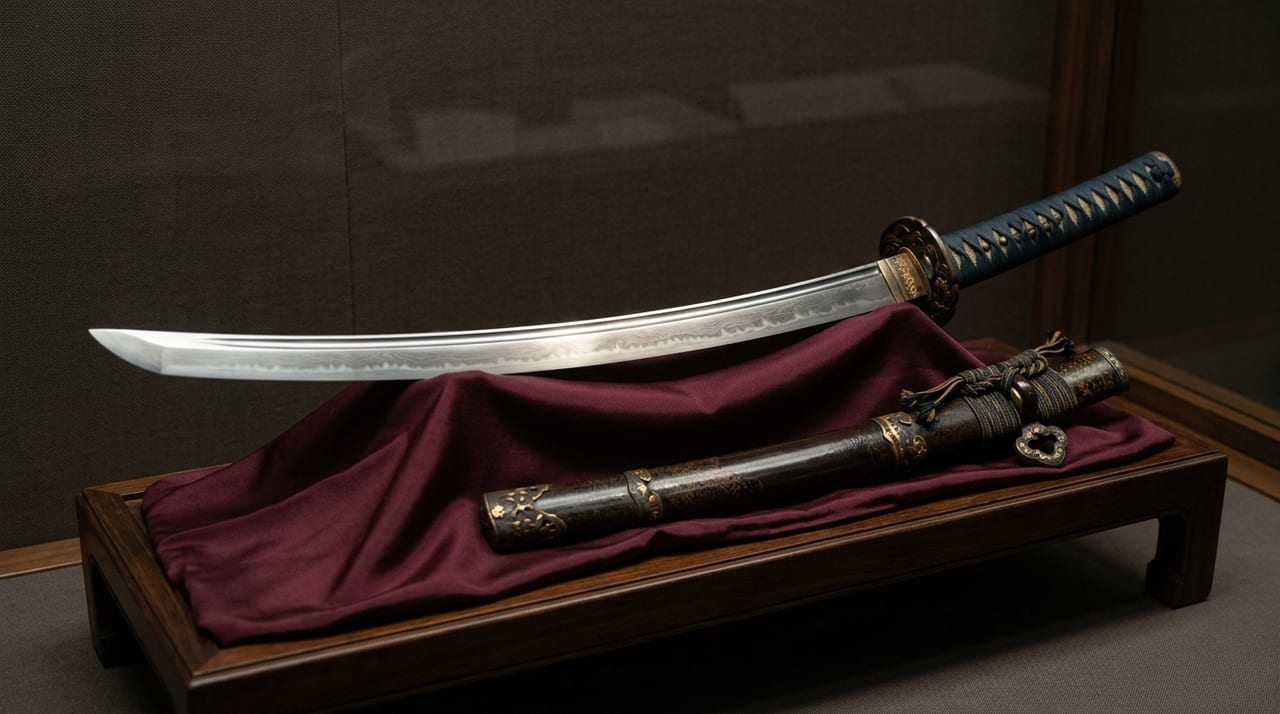
Ko-Bizen Tomonari is a tachi forged by Ko-Bizen Tomonari (dates of birth and death unknown), a master smith of Bizen Province (present-day Okayama Prefecture) in the Heian period. It is designated a National Treasure and is held by the Tokyo National Museum. Tomonari is one of the principal smiths of the Ko-Bizen school (Ko-Bizen-ha), and was responsible for the founding phase of the Bizen tradition (Bizen-den), one of the most important traditions in Japanese swordmaking. The Ko-Bizen school is the collective name for the smiths active in Bizen Province from the late Heian period to the early Kamakura period. Kanehira, Tomonari, and Masatsune are known as its representative smiths.
The Ko-Bizen School and the Origins of the Bizen Tradition
The Bizen tradition is the longest-lasting of the five traditions of Japanese swordmaking (Yamashiro, Yamato, Bizen, Sōshū, and Mino), and the one that produced the largest number of master smiths. The source of the great river of Japanese sword culture, which continues from the Ichimonji and Osafune schools of the Kamakura period through the Nanboku-chō, Muromachi, Azuchi-Momoyama, and Edo periods, lies in the Ko-Bizen school. Tomonari is one of the master smiths at the very upstream of this river, and can be called an ancestor of all later Bizen swords. Ko-Bizen tachi display the graceful koshizori curvature of the Heian period, and their jigane and hamon achieve a level of quality that equals that of any later period. Tomonari's work is especially known for the beauty of its jigane. The ko-itame jigane, with a slight tendency toward raised grain (hadadachi) and a moist sheen, is so overwhelmingly beautiful that, more than a thousand years later, it still captivates everyone who sees it.
Tomonari's Techniques and Style
The features of Ko-Bizen Tomonari's tachi show the Heian-period koto style of the late Heian period, with deep koshizori, a high shinogi, and a sharp, slender monouchi, and at the same time they embody with high accomplishment the beauty of the jigane that is unique to the Bizen tradition. The jigane is ko-itame with slight hadadachi, with ji-niwa, chikei, and utsuri standing out. The hamon is a shallow sugu-ha that tends toward notare, mixed with ko-midare and ko-chōji, giving an ancient and dignified appearance. The bōshi is shallowly undulating and ends in a small round tip. The nakago is ubu, and the signature reads “Bizen no kuni Tomonari zō.” As a whole, the sword develops a unique world of beauty that is found nowhere else, in which the elegance of the courtly culture of the Heian period and the high quality of Bizen steel are fused into one.
The Tokyo National Museum and the Status of a National Treasure
Tomonari's tachi held by the Tokyo National Museum has extremely high cultural value as one of the few securely signed works from the Heian period. Few Heian-period swords survive, and fewer still are both securely signed and of high quality. Tomonari's tachi has been preserved in remarkably good condition for more than a thousand years, and its designation as a National Treasure reflects a high evaluation of both its state of preservation and its artistic value. At the Tokyo National Museum, it is often shown as one of the most important works in exhibitions of Heian-period swords. Alongside Mikazuki Munechika and Dōjigiri Yasutsuna, it is treasured as one of the great Heian swords that adorn the earliest history of Japanese swordmaking.
Bizen Land and Sword Culture
Bizen Province (eastern present-day Okayama Prefecture) has been known since ancient times as a land well suited to sword production. The abundant iron sand of the Yoshii and Asahi river basins, high-quality pine charcoal, and plentiful water together provided the conditions for producing the finest iron. The Bizen sword tradition, continuing from Tomonari's time, was possible only because of these natural conditions, and the beauty of the jigane of Tomonari's tachi carries within it the blessings of the Bizen land. Bizen swords were highly regarded in the Edo period as well, but Tomonari's tachi, as the work of one of the founders of that tradition, is the first crystallization of this evaluation that has lasted a thousand years.
The Form of the Heian Tachi: The Poetics of Koshizori
The deep koshizori displayed by Tomonari's tachi is one of the most characteristic styles of Heian-period tachi. Koshizori is a shape in which the part of the blade near its center of balance, the koshi, curves most deeply. In the Kamakura period, this shifted to sakizori and nakazori. The deep koshizori of Tomonari's era is a functional shape that exerts its greatest effect when a sword is swung downward from horseback, and at the same time it is visually beautiful, with an elegant curve. This curve of koshizori resonates with the “gentle beauty” described in later Heian literature, like the graceful hem of Hikaru Genji's robe in The Tale of Genji, and shows how the aesthetic sensibility of the age permeated even the tools of the sword. When one looks at the form of this tachi, preserved as a National Treasure at the Tokyo National Museum, one has the experience of the air of a thousand years ago coming back to life.
Passing It On to the Present: Preservation and Display at the Tokyo National Museum
As the largest comprehensive museum in Japan, the Tokyo National Museum bears the responsibility of managing and displaying Japan's most important cultural properties, including National Treasures and Important Cultural Properties. Tomonari's tachi is placed under special care as one of the oldest and most important works in the museum's Japanese sword collection, and is preserved under appropriate temperature and humidity control. As a treasure of the sword culture of the Heian period, it attracts many visitors.
Legends & Stories
Tomonari: The Beginning of a Thousand Years of Sword Culture
The fact that Ko-Bizen Tomonari's tachi still exists today as a National Treasure has a symbolic meaning that goes beyond the good fortune of preservation alone. This single sword proves, as a physical object, that Japanese sword culture had already reached, in its earliest phase, a level of beauty and technical skill that the present day considers worthy of the name “famous sword.” If Mikazuki Munechika (made by Sanjō Munechika) represents the highest peak of the Yamashiro tradition in the Heian period, then Tomonari's tachi is the corresponding presence representing the highest peak of the earliest phase of the Bizen tradition, and placing the two tachi side by side makes clear the richness and diversity of Heian sword culture. The stream of the Bizen tradition that began with Tomonari continued afterward through the Ichimonji school (early Kamakura), Osafune Mitsutada and Osafune Nagamitsu (mid-Kamakura), Kagemitsu and Kanemitsu (late Kamakura to Nanboku-chō), and Morimitsu and Yasumitsu (Muromachi), and remained the richest current of Japanese sword culture for a long time, up to the Edo period. The source of this great river lives on in Tomonari's tachi.
The Meaning of “Ko” in Ko-Bizen
“Ko-Bizen” is not the name of a specific school or group of smiths. It is a collective term for the Bizen smiths and their works from the period before the Ichimonji and Osafune schools arose. Tomonari is regarded, together with Masatsune, as a leading smith of Ko-Bizen, and old transmitted records place his era around Eien (987–989).
The Beauty of Swords in the Heian Period
Japanese swords of the Heian period embody a world of beauty completely different from the swords of the Sengoku and Edo periods. The form of the Heian tachi, with its deep koshizori and slender, long monouchi, has a functional beauty meant for wielding on horseback, while at the same time reflecting the elegant aesthetic sensibility of courtly culture. The aesthetic ideals of the age in which The Tale of Genji, The Pillow Book, and the Kokinshū were written, namely mono no aware and yūgen, resonate with the quiet and profound beauty that Tomonari's tachi radiates. A sword refined within the aristocratic aesthetics of the Heian period, which valued spiritual refinement over great military power, can in this sense be appreciated as one of the most “Heian-like Japanese swords.”
Ko-Bizen's Top Rank in Modern Japanese Sword Appraisal
In modern appraisal of Japanese swords, Ko-Bizen tachi are placed in one of the highest categories. Even the broader category of tachi attributed to Ko-Bizen, rather than only signed works by a specific smith, is often overwhelmingly superior in artistic and historical value. Within this, the existence of a signed National Treasure by Ko-Bizen Tomonari has an irreplaceable value as a high point of the earliest history of Japanese swords. However technically refined later master smiths became, the value of an object that embodies the beauty of the beginning never disappears.
Tomonari's Legacy: The Thousand-Year Source of the Bizen Tradition
That one of the tachi forged by Tomonari has been passed down to the present day for more than a thousand years is a miraculous event even within the history of Japan's cultural property protection. Heian-period swords were in many cases lost through historical events such as wars, fires, floods, and the Haitōrei edict. Tomonari's tachi survives because its successive owners recognized its value and kept it carefully. That chain extends across the whole of Japanese history, from the Genpei War through the Nanboku-chō and Sengoku periods and the Edo period, into the Meiji, Taishō, Shōwa, Heisei, and Reiwa eras. The thousand years this sword has survived are proof of the deep respect the Japanese have held for swords and their recognition of their cultural value. In the present day, the Tokyo National Museum's continued protection of it as a National Treasure is the latest link in that long chain. The quiet reverence one feels when standing before Tomonari's tachi is not merely admiration for the craftsmanship of a thousand years ago, but also gratitude toward the countless people who have protected and passed it on.
The Genpei Era and Swords: The Rise of the Warriors and the Sword
The late Heian period, when Tomonari was active, coincides with the era when the warrior class appeared on the stage of history. In the period just before Minamoto no Yoritomo established the Kamakura shogunate (1185), the relationship between warriors and swords was evolving from “a tool for swearing oaths when forming master-retainer bonds” into “a symbol of the warrior's pride and spirit.” Among the swords worn at the waist by heroes of the Genpei War, such as Minamoto no Yoshitsune, Taira no Tomomori, and Kiso Yoshinaka, there may well have been famous Ko-Bizen works like Tomonari's. The birth of medieval Japanese warrior culture and the establishment of Japanese sword culture are inseparable, and Tomonari's tachi, standing at the starting point of both, embodies the spiritual origin of the warrior as a distinctly Japanese social class. Made in the first era when swords came to be recognized as the “soul” of the warrior, Tomonari's tachi can be called a relic that carries the most fundamental spiritual meaning of Japanese sword culture. That this single sword still exists today as a National Treasure is the most precious gift that the Bizen smiths of a thousand years ago have continued to give to Japanese culture.