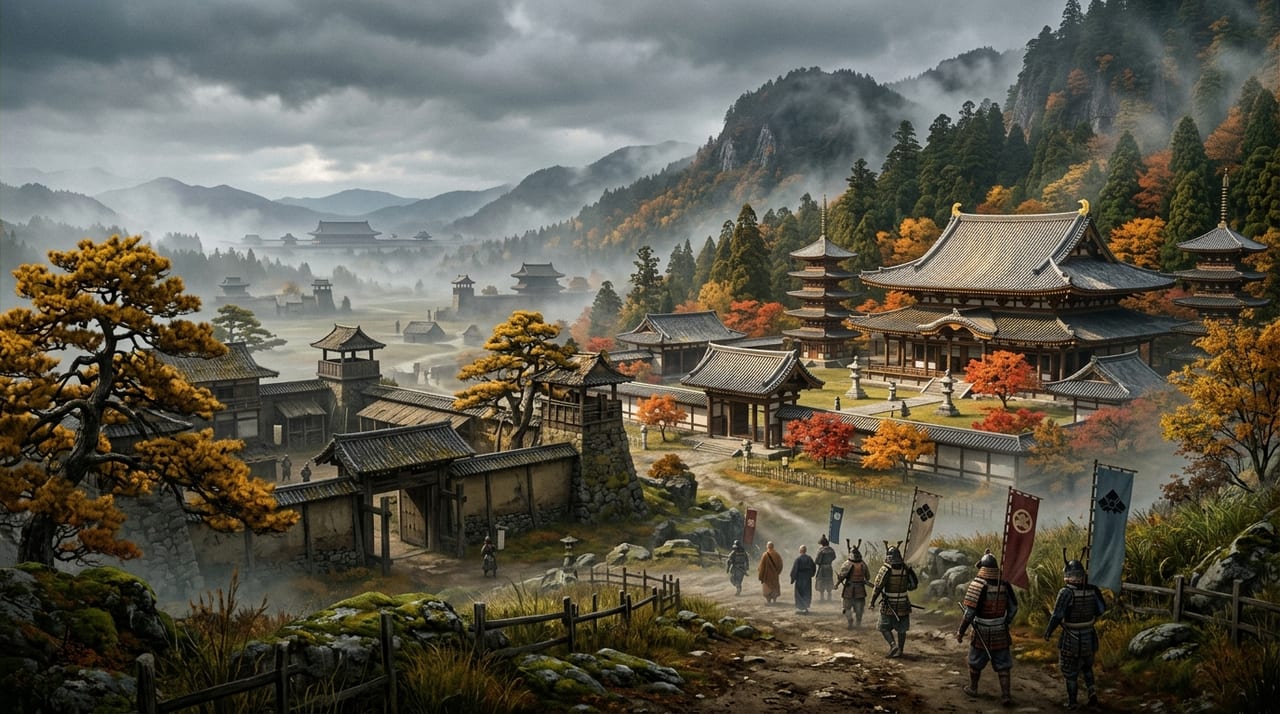
 * Image is for illustrative purposes only.
Hōgen-Heiji Wars Period
保元・平治の乱期
The Hōgen and Heiji disturbances ignited the Genji-Heishi rivalry and opened the era of warrior political dominance. Intensified warfare drove demand for quality tachi, with smiths of Yamashiro, Yamato, and Bizen competing to produce superior blades.
Description
The Course of the Rebellions and the Establishment of Warrior Power
The Hōgen Rebellion of Hōgen 1 (1156) was an armed conflict that arose from a dispute over imperial succession and internal strife within the Fujiwara regent family. It was an unprecedented situation in which both the Minamoto and the Taira divided and fought on both sides, one with Retired Emperor Sutoku and the other with Emperor Go-Shirakawa. After victory in this rebellion, Taira no Kiyomori and Minamoto no Yoshitomo, who had supported Emperor Go-Shirakawa, became the center of the power struggles that followed. In the Heiji Rebellion of Heiji 1 (1159) that came next, Minamoto no Yoshitomo was defeated in his challenge to Taira no Kiyomori and killed, and his surviving son Yoritomo was exiled to Izu. This series of political upheavals laid the groundwork for the later Genpei War (Jishō–Juei War, 1180–1185), and formed a turning point toward a warrior society in which the warrior class took over the reins of political power from regent politics and cloistered rule (insei).
Development of the Tachi and Demand from Actual Warfare
The combat between mounted warriors in the Hōgen and Heiji Rebellions displayed the pinnacle of the most advanced military technology of the time. Mounted warriors wearing armor (ō-yoroi) fought with the bow and arrow as their main weapon, and used the tachi in close combat. Tachi of this era were required to have an elegant form, with a length of roughly 2 shaku 4 sun to 2 shaku 7 sun, a moderate blade width, and deep koshizori. Smiths of Yamashiro Province produced refined tachi for the court, court nobles, and high-ranking warriors, while in Bizen Province the Ko-Bizen smiths were active, and smiths of Yamato Province responded to the demand from temple and shrine powers (sōhei).
Rise of Bizen Blades and Commercial Development
The period of the Hōgen and Heiji Rebellions corresponds to the time when Bizen blades began to grow into a major industry. Along the Yoshii River basin in Bizen Province (present-day Okayama Prefecture) there was abundant iron sand and pine wood as fuel, and geographically, distribution by way of the Sanyōdō and sea routes was easy. The Ko-Bizen smiths, centered on Tomonari, Masatsune, Kanehira, and Sukehira, forged tachi with neat hamon based on a sugu-ha (straight-edged) temper. Blades attributed to 'Ko-Bizen Tomonari' have a dense ko-itame-hada with a gentle ko-midare hamon, and they show the origin of later Bizen blades.
Establishment of the Yamashiro Tradition and Court-Warrior Blade Culture
The smiths of Yamashiro, centered on Sanjō and Awataguchi in Kyoto, maintained strong ties with the court and court nobles, and along with ceremonial and decorative tachi they also produced practical items. Even as warriors rose to prominence through the Hōgen and Heiji Rebellions, the court culture of nobles that valued the artistic worth of swords continued. The refined jigane, dignified hamon, and beautiful curvature characteristic of the Yamashiro tradition reflect the aesthetic sensibility of the upper classes of this era, and a cultural foundation that sought beauty was maintained even in a world of warfare.
Yamato Tradition and Demand for Swords from Warrior Monks
In Yamato Province (Nara), large temples such as Kōfuku-ji and Tōdai-ji maintained many sōhei, and their demand for arms supported local smiths. Among the Five Schools of Yamato (Yamato Goha), the smiths of the Senjuin school, the oldest of them, produced practical, plain, and sturdy tachi, and established a simple yet powerful style with a jigane showing a slightly masame-like appearance and sugu-ha and chū-sugu-ha temper. In the Hōgen Rebellion, it is known that Fujiwara no Yorinaga, on the side of Retired Emperor Sutoku, waited for reinforcements from the akusō (warrior monks) of Kōfuku-ji.
Impact of Genpei Rivalry on Sword Culture
The Genpei rivalry after the Hōgen and Heiji Rebellions was not merely a military conflict, but brought about the regional dispersion and diversification of sword culture. In western Japan (the Kinai and the western provinces) controlled by the Taira, smiths of Bizen and Yamashiro flourished, while in the eastern provinces (Tōgoku) that became the Minamoto base, the development of local smithing was promoted. That both the Taira and Minamoto forces fought carrying first-rate famous blades in the later Jishō–Juei War (Genpei War) shows that the warriors of the time had a strong interest in sword quality. The warrior values toward swords formed in this era prepared the golden age of swords under the Kamakura warrior government.
Characteristics of This Era
- Elegant tachi with deep koshizori were mainstream. Length was roughly 2 shaku 4 sun to 2 shaku 7 sun, with a well-balanced build premised on use in mounted combat
- In Bizen, the Ko-Bizen smiths were active, building the foundation for the later golden age of Bizen blades
- In Yamato, the Senjuin school, the oldest of the five schools, arose. A plain, sturdy style practical in nature, responding to the demand from sōhei, became established
- The Yamashiro tradition produced elegant tachi fused with court culture. Refined construction serving both ceremonial and practical use is its feature
- Accumulated combat experience promoted improvements in blade form. The use of tachi by mounted warriors in close combat raised demand for swords in both quality and quantity