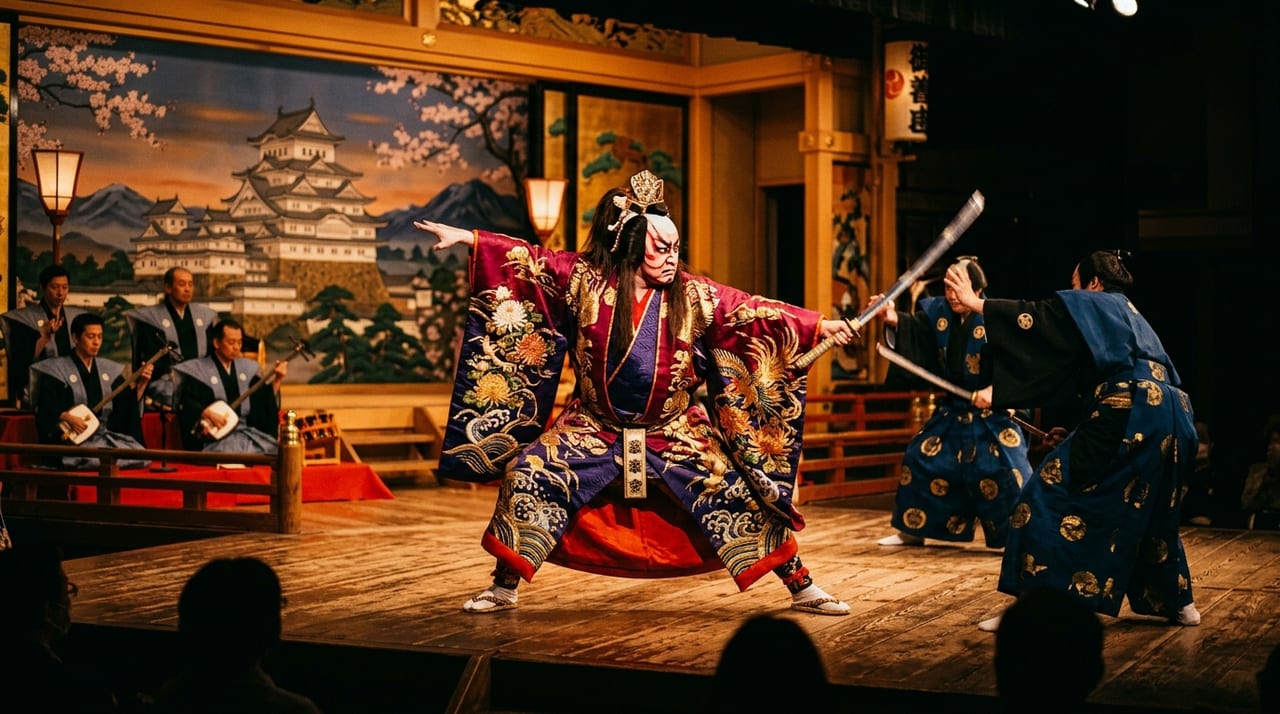
 * Image is for illustrative purposes only.
Swords in Noh and Kabuki Theater
日本刀と能・歌舞伎
Explores how the Japanese sword has played symbolic, performative, and aesthetic roles in Nō and kabuki, Japan's representative stage arts: special stage sword fittings and the fusion of swordsmanship and performance.
Description
In Japanese stage arts, the sword is more than a mere prop. In both Nō and kabuki, the sword becomes one with the performer's body and functions as the symbolic center of the story. Swords on stage are generally not real blades but prop swords made for the stage.
The handling of swords in Nō is deeply connected to the sword culture of the warrior society of the Kamakura and Muromachi periods. Nō developed under the patronage of the Muromachi shogunate and the shogun's family, and many plays with warriors and swords as their themes came into being, such as "Atsumori" and "Yashima." In Nō, the actions involving swords, namely wearing them, drawing them, and clashing blades, have also been passed down as stylized forms.
In particular, in plays such as "Tsuchigumo" and "Momijigari," swords are used in confrontations with demons and transformed beings. In "Tsuchigumo," Minamoto no Yorimitsu slashes the spirit of a Tsuchigumo with the famous sword Hizamaru and renames Hizamaru Kumokiri. In "Momijigari," Taira no Koremochi slays a demon woman with a divine sword he received from a deity of the Hachiman shrine.
The role of the sword in kabuki is even more multifaceted. Kabuki, established in the Edo period as a popular entertainment, centers on the tachimawari, a sword-drama-like highlight of the performance. The aragoto (rough-style acting) of the Ichikawa Danjūrō family (Naritaya) is known for exaggerated swordplay and grand tachimawari. Kabuki tachimawari are based on stylized swordsmanship movements, but they developed as a theatrical technique distinct from actual swordsmanship, with their own stylized beauty that prioritizes visual impact on stage.
The aesthetic standard of the sword fittings (koshirae) for kabuki is also worthy of special mention. Especially in kabuki, which values mibae (visual effect), the decoration of the scabbard, handle, and guard is designed in unison with the costumes and makeup. The props department (dōgukata), in charge of stage props, has produced sword fittings devised to look striking on stage.
Characteristics of This Era
- Sword movement in Noh kata — the wearing, drawing, and striking codified as refined artistic forms
- Kabuki tachimawari — formalized swordfight as theatrical spectacle
- Demon-slaying Nō sword: the sword that cuts down oni and transformed beings in "Tsuchigumo" and "Momijigari"
- Kabuki koshirae for maximum visual splendor — fittings conceived as elements of costume design