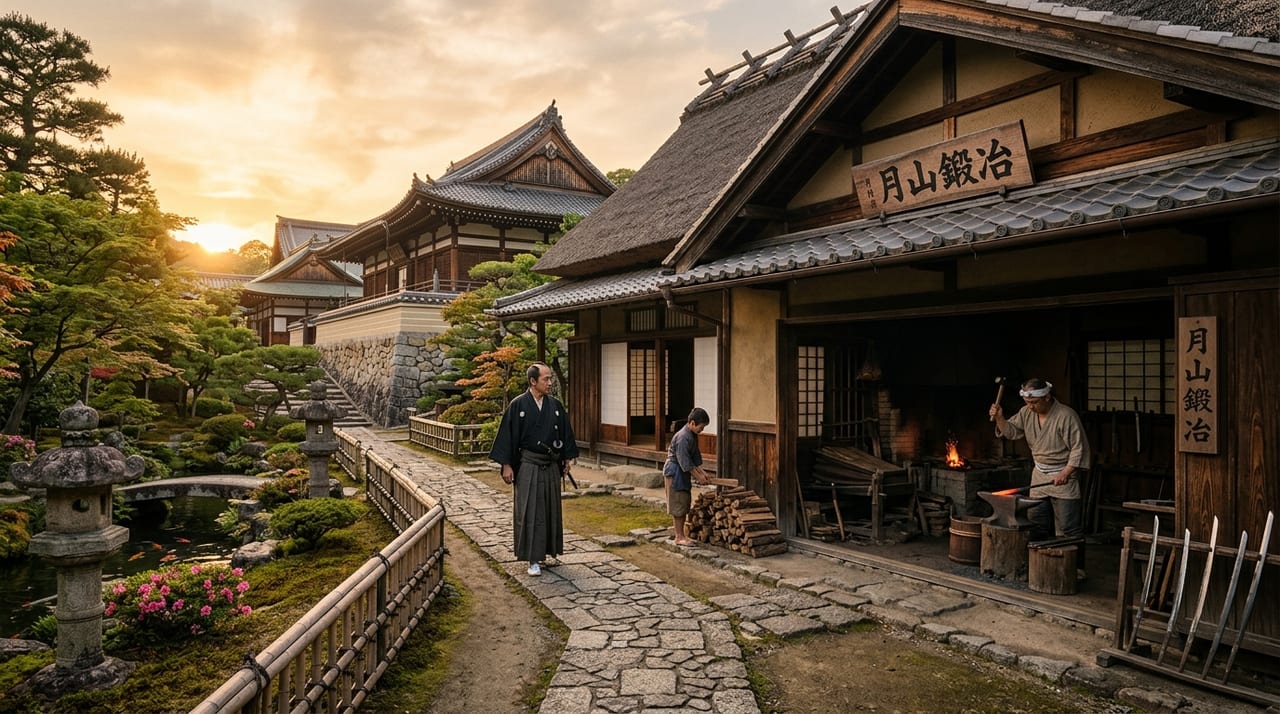
 * Image is for illustrative purposes only.
Swords of the Kamakura Period (Overview)
鎌倉時代の刀剣(概観)
The Kamakura period (1185–1333) was the golden age of the Japanese sword and the most important era in its history. With Minamoto no Yoritomo's establishment of a buke government, the sword reached its peak as the soul of the warrior and a symbol of authority. It was the period in which the schools and techniques that shaped all later Japanese sword making were born, including the Awataguchi school, the Rai school, the Ko-Bizen school and the establishment of the Sōshū tradition. In response to the Mongol invasions (1274 and 1281), blades were strengthened and widened, producing works in which the aesthetics of kotō and military practicality were fused to the highest degree.
Description
The Birth of Warrior Rule and the Transformation of Swords
In 1185, Minamoto no Yoritomo established the shogunate in Kamakura, and political power in Japan shifted from the kuge (court nobility) to the buke (warrior houses). This change of government brought a fundamental transformation to sword culture. Swords, which had until then been symbols of imperial and aristocratic authority, took on new meanings as the souls of warriors, as markers of professional identity, and as proof of the bond between lord and vassal. The Kamakura shogunate invited outstanding swordsmiths to the Kantō region, and a new center of sword production formed in Kamakura, the new political center.
Formation of the Five Traditions
Throughout the Kamakura period, the traditions of five major sword-making regions, later called the Goden, became established. The Yamashiro tradition centered on the Awataguchi and Rai schools and carried on the classical refinement of Kyoto. The Yamato tradition developed under the influence of temples, with the Tegai and Senjuin schools. The Bizen tradition was systematized into Ko-Bizen, the Fukuoka Ichimonji school, and the Osafune school. The Sōshū tradition took shape with the Sagami schools, which became the foundation for the later Masamune. The Mino tradition laid the groundwork for Mino smithing, which grew in importance in the later Sengoku period.
The Mongol Invasions and Technical Innovation in Swordmaking
The battles with Mongol forces in the Bun'ei invasion of 1274 and the Kōan invasion of 1281 posed serious technical challenges for Japanese swords. To counter the Mongols' group tactics, blades needed a tougher structure and a broader body. To meet this military demand, late Kamakura smiths fundamentally reexamined the structure of the jigane, the hardening techniques, and blade shape. In particular, the techniques of the Sōshū tradition (vigorous hamon with abundant nie and broad blade bodies) developed out of this military demand.
Masamune and the Revolution of the Sōshū Tradition
The greatest technical legacy of the Kamakura period is the establishment of the Sōshū tradition by Masamune. Masamune set up his workshop in Kamakura in Sagami (present-day Kanagawa Prefecture) and developed revolutionary techniques that went beyond the framework of the five traditions up to that time. Masamune's blades have abundant nie and display complex hamon activity such as kinsuji and sunagashi, and their jigane has a clear, bluish steel surface with fine ji-nie. The "Juzumaru," one of the Tenka Goken (Five Swords of the Realm), is dated to the Kamakura period and shows the high level of blade-making in this era.
The Aesthetics of Kamakura-Period Koto
In later sword appraisal, "Kamakura-period koto" are regarded as the ideal form of the Japanese sword. They are valued for their sugata, an elegant curve with moderate sori; for their hamon, which is precise and full of variation; and for their jigane, a refined forging surface that shows the high quality of tamahagane. Since the Edo period, shintō and shinshintō smiths have continued to make swords aiming at "Kamakura fukko," and the influence of Kamakura-period koto extends even to modern swords.
Characteristics of This Era
- The Kamakura period (1185–1333) was the golden age of the Japanese sword, in which the five traditions of Yamashiro, Yamato, Bizen, Sōshū and Mino were established, forming the technical and aesthetic foundation for all later sword making.
- Minamoto no Yoritomo's establishment of a buke government fundamentally changed the social meaning of the sword, shifting it from a symbol of imperial authority to the soul of the warrior and a token of the bond between lord and retainer. This brought a dramatic rise in demand for swords and in smithing skill.
- In response to the military demands of the Mongol invasions (1274 and 1281), blades were widened and strengthened. The rugged nie and broad blade body of the Sōshū tradition in particular were technical innovations born of this military need.
- Masamune's establishment of the Sōshū tradition was the greatest revolution in the history of Japanese sword technology. His complex hamon activity, rich in nie and accompanied by kinsuji and sunagashi, had a decisive influence on later sword aesthetics.
- Among the Tenka Goken (Five Swords of the Realm), Onimaru Kunitsuna and Juzumaru Tsunetsugu are attributed to the Kamakura period, testifying to the high technical level of the age.
- Kamakura-period kotō have been regarded since the Edo period as the ideal form of the Japanese sword. Shintō and shinshintō smiths continued to make blades aiming at “Kamakura fukko” (revival of Kamakura), so Kamakura aesthetics still exert a direct influence on contemporary swords.