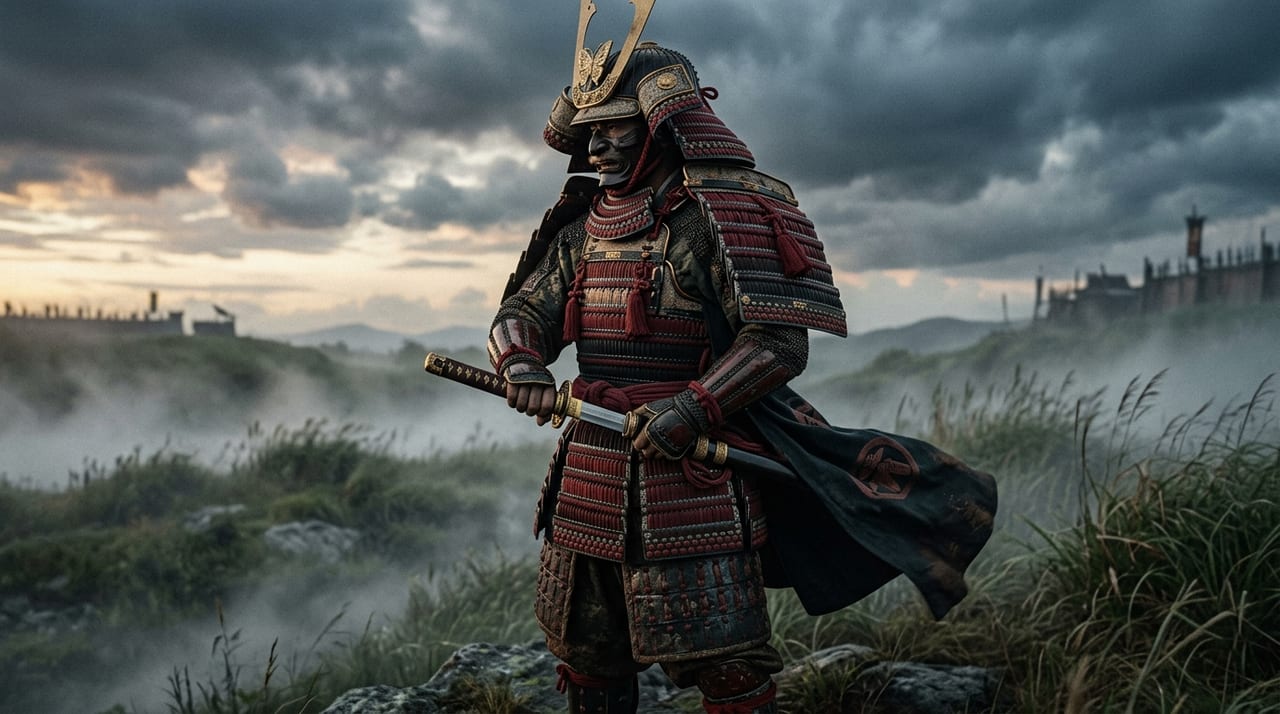
 * Image is for illustrative purposes only.
Taira no Masakado
平将門
The First Samurai Rebel
Description
The Tiger of the East Draws His Blade
Born around Engi 3 (903), Taira no Masakado was a fifth-generation descendant of Emperor Kanmu and based himself in the Toyoda and Sashima districts of Shimōsa Province. He was the first great rebel produced by the warrior society of the Heian period. While still young, Masakado went up to Heian-kyō and served Fujiwara no Tadahira. He then returned to the Eastern Provinces (the Kantō region). Beginning with an armed clash that grew out of a land dispute within his own kin, he went on to take control of the eight provinces of Bandō (the entire Kantō region), an unprecedented course of action. In Tengyō 2 (939), Masakado proclaimed himself Shinnō and declared an independent sovereignty in the eastern provinces.
The Rise of the Warrior Centered on the Sword
The age in which Masakado lived was a transitional period in which the bushi (mononofu) were establishing themselves as a social class in Japan. Against the civil governance of the central aristocracy, warriors in the east who rode horses, drew bows, and swung swords were emerging as the bearers of rule by force. Masakado stood at the front of this movement, and his rebellion was a preview of an age in which warriors would become the main actors in politics.
The Declaration of Shinnō and Downfall
In the 12th month of Tengyō 2 (939), Masakado proclaimed himself Shinnō and declared an independent government in the Kantō region. News of this reached Kyoto as a shock. The imperial court appointed Fujiwara no Tadafumi as Seitō Taishōgun and sent a punitive army. In the east, Taira no Sadamori and Fujiwara no Hidesato, ōryōshi of Shimotsuke Province, gathered troops and stood against Masakado. In the 2nd month of Tengyō 3 (940), Masakado met his fierce end in the battle at Kitayama in Shimōsa Province (present-day Bandō, Ibaraki Prefecture). Though he fought freely and widely as a mounted warrior, he was at last felled by an arrow. His death was a dramatic epilogue heralding the dawn of the age of the warrior. Age at death: 38 (other accounts exist).
Vengeful Spirit and Legend
Masakado's head was sent to Kyoto and exposed at the gokumon (public display of the head). It is said that months later it had not decayed, and that it appeared as if its eyes were wide open and it was grinding its teeth. It is further said that it eventually flew away in search of its own body. This legend of "Masakado's head" shows that Masakado became a fearsome onryō even after his death. Even today, Masakado's Head Mound (Kubizuka) remains in Ōtemachi, Tokyo, and it is still an object of strong reverence, as strange misfortunes are said to follow each time it is relocated or construction is carried out nearby.
As the Archetype of the Warrior
Masakado holds a decisive position in the history of the warrior as the person who created the archetype of the "warrior rebellion." After Masakado, warriors of the east came to hold a sense of independence from the central government, and a long historical current began that led to the Genpei conflict (Genpei no sōran) and the establishment of the Kamakura shogunate. The warrior's way of "upholding political claims by force of arms," as Masakado demonstrated, became one element forming the foundation of the later bushidō. As the earliest example of a sword becoming a means of expressing political will, the age of Masakado also holds a special place in the history of the Japanese sword.