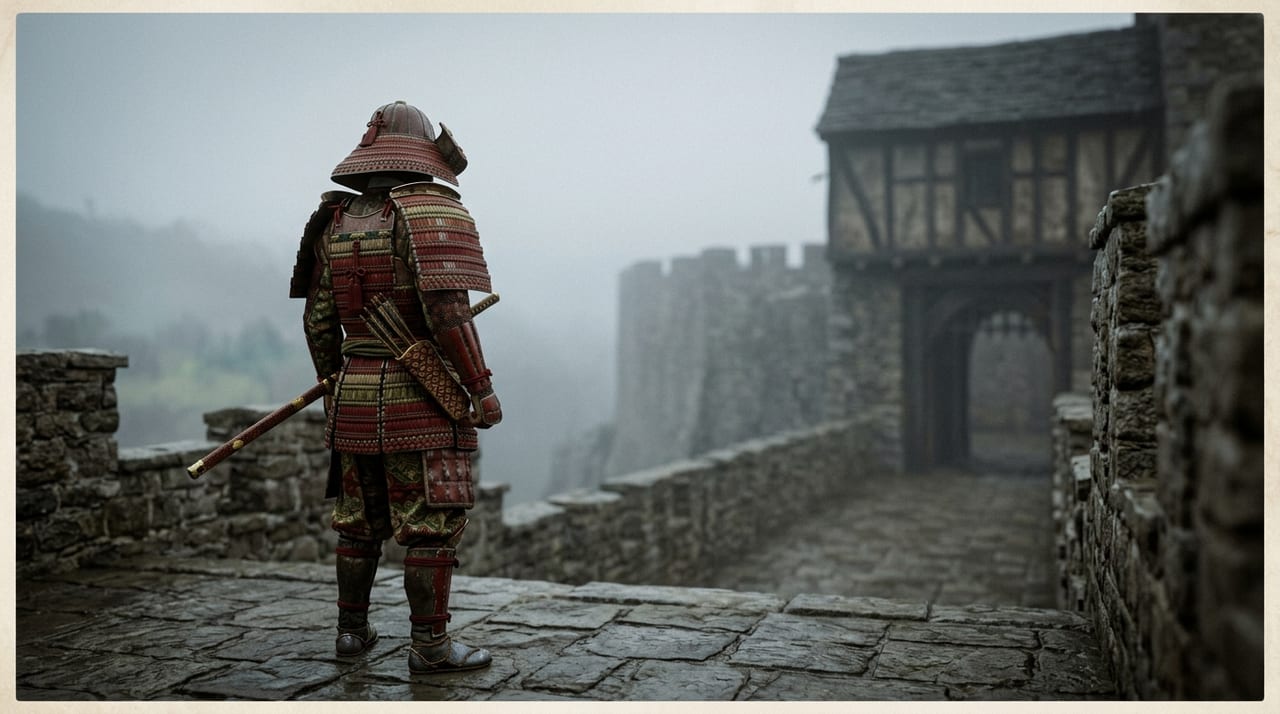
 * Image is for illustrative purposes only.
Minamoto no Yorimitsu
源頼光
Slayer of Demons — The Heian Warrior Who Founded the Legend of the Four Heavenly Kings
Description
Demon-Slayer of the Heian Period
Born in 948 (Tenryaku 2) as the eldest son of Minamoto no Mitsunaka, Minamoto no Yorimitsu later became the founder of the Settsu Genji. Based at Tada in Settsu Province (present-day Kawanishi, Hyōgo Prefecture), he emerged as a figure representing the warrior class of the mid-Heian period. He served as a zuryō (provincial governor) in Bizen, Mino, Tajima, Iyo, Settsu and other provinces. Backed by his close ties to the Fujiwara regent houses, including Fujiwara no Michinaga, he achieved outstanding results in both maintaining public order in the capital and governing the provinces. Yet what made Yorimitsu's name immortal for later generations was above all his legend as a demon-slayer.
The Demon Hunt at Mount Ōe
Yorimitsu's most famous legend is the subjugation of Shuten-dōji, leader of the demons that dwelt on Mount Ōe (present-day northern Kyoto Prefecture). Amid a string of mysterious disappearances of young men and women in the capital, Yorimitsu, together with Fujiwara no Yasumasa, led the Four Heavenly Kings (Shitennō): Sakata no Kintoki (Kintarō), Watanabe no Tsuna, Usui Sadamitsu and Urabe no Suetake, toward Mount Ōe. Disguised as mountain ascetics, they infiltrated the demons' stronghold and made Shuten-dōji drunk with the 'divine poisoned sake (Jinben Kidoku-shu)' received from a god. Then, in the opening this created, they struck off his head. This tale is recorded in many texts, including the Ōeyama Ekotoba and the Otogizōshi, and has been repeatedly depicted as a subject of illustrated scrolls.
Yorimitsu's Four Heavenly Kings and the Glory of the Warrior House
Four retainers of Yorimitsu, Sakata no Kintoki, Watanabe no Tsuna, Usui Sadamitsu and Urabe no Suetake, were called Yorimitsu's Four Heavenly Kings (Shitennō). They were praised as exemplars of the warrior house, and each boasted legendary martial prowess. Watanabe no Tsuna in particular is renowned for the legend of severing a demon's arm at Rajōmon. The sword said to have been used on that occasion, Higekiri (also called Onikiri), earned fame as Yorimitsu's beloved blade and as a celebrated masterpiece. These legends are more than mere tales. They symbolize the process by which the warrior class came to be recognized as indispensable to aristocratic society.
Higekiri and Onikiri: The Legendary Beloved Blade
Higekiri, said to have been owned by Yorimitsu, is a famous sword handed down to later generations as an heirloom treasure of the Genji. Also called 'Onikiri,' it is said to have been used by Watanabe no Tsuna to sever a demon's arm at Rajōmon. Later it was passed down to the Genji main line and is said to have come into the hands of father and son Minamoto no Yoshitomo and Yoritomo. It is now offered to and preserved at Kitano Tenmangū under the name 'Onikiri-maru.' Also transmitted as a famous sword associated with Yorimitsu is Hizamaru (Kumokiri), which is said to have cut down a Tsuchigumo. The sword said to have slain Shuten-dōji is the National Treasure Dōjigiri, held by the Tokyo National Museum. These famous swords reflect Yorimitsu's role as a symbolic bearer of sword culture in the martial arts of the Heian period.
Tsuchigumo Subjugation and Its Significance
Alongside the Shuten-dōji legend at Mount Ōe, another demon-slaying attributed to Yorimitsu is the subjugation of the Tsuchigumo (spider). According to the 'Tsurugi no Maki' (Book of Swords) of the Heike Monogatari, when Yorimitsu lay in bed suffering from ague (malarial fever), a suspicious monk appeared and tried to entangle him by casting a rope. When Yorimitsu slashed at him with Hizamaru kept by his pillow, the monk fled. The next day, following the trail of blood, they reached a burial mound at Kitano, where a giant mountain spider was found. This also became the subject of Yamato sarugaku and the Noh play Tsuchigumo, showing that Yorimitsu's martial prowess was long told in the world of performing arts as well. What these many legends show is that Yorimitsu, beyond being merely a historical military commander, became in the Japanese imagination an archetype of the 'demon-slayer' who battles supernatural powers.
Legacy as Founder of the Settsu Genji
Yorimitsu was not only a military hero but also a politician who consolidated the foundation of the Settsu Genji and served as a bridge to the later golden age of the Genji. His political skill, which stabilized his rule in Settsu Province by revering Tada-in (now Tada Shrine) as his clan deity (ujigami), marks the starting point of the process by which warriors grew from the 'claws and fangs' of the aristocratic government into independent political actors. In that sense, Minamoto no Yorimitsu is still spoken of with high regard today, as a figure standing at the source not only of the history of Heian martial families but also of Japan's warrior ethos (bushidō).
Notable Swords
- Higekiri (Onikiri-maru): an heirloom treasure sword of the Genji and a legendary blade said to have been used by Watanabe no Tsuna to sever a demon's arm at Rajōmon. Now offered to and preserved at Kitano Tenmangū
- Hizamaru (Kumokiri): a famous sword said to have been used to slay a Tsuchigumo. A treasure blade of the Genji that forms a pair with Higekiri