Hoki Province Swordsmiths: The Lineage of Yasutsuna and the Blademaking Tradition of Western Japan
 * Image is for illustrative purposes only.
Table of Contents
Hōki Province: Geography and Historical Background
Hōki Province (伯耆国) was a ritsuryō province corresponding to present-day western Tottori Prefecture. Positioned north of the Chūgoku Mountains, it was known from ancient times as a land rich in iron sand resources. As a vital junction along the Sanin Road connecting the Kinai region to Izumo (出雲) and Iwami (石見) provinces, it possessed advantageous geographic conditions for the dissemination of iron-working culture.
From ancient times, this region was praised as "the land of iron." Tatara (たたら) smelting developed early here, producing abundant high-quality iron sand and charcoal. This foundation cultivated excellent sword smiths.
Yasutsuna (安綱)—Hōki's Greatest Master Smith
When discussing Hōki, one must begin with Yasutsuna (安綱). A sword smith active in the mid to late Heian period (roughly 10th to 11th centuries), he is inscribed in the history of swords as a master craftsman representing Hōki Province and the koto (古刀) period.
His representative masterpiece, widely known, is the Dōji-giri Yasutsuna (童子切安綱). A legendary blade said to have been wielded by Minamoto no Raikō (源頼光) in slaying the demon child of Mount Ōe (大江山), it is presently housed as a National Treasure tachi (太刀) in the Tokyo National Museum. With a blade length of approximately 80.2 centimeters and a curve of 2.7 centimeters (sori 反り), it preserves the grand and robust tachi form of the late Heian period to this day, counted among the Five Swords Under Heaven (天下五剣) as the oldest of the famous blades.
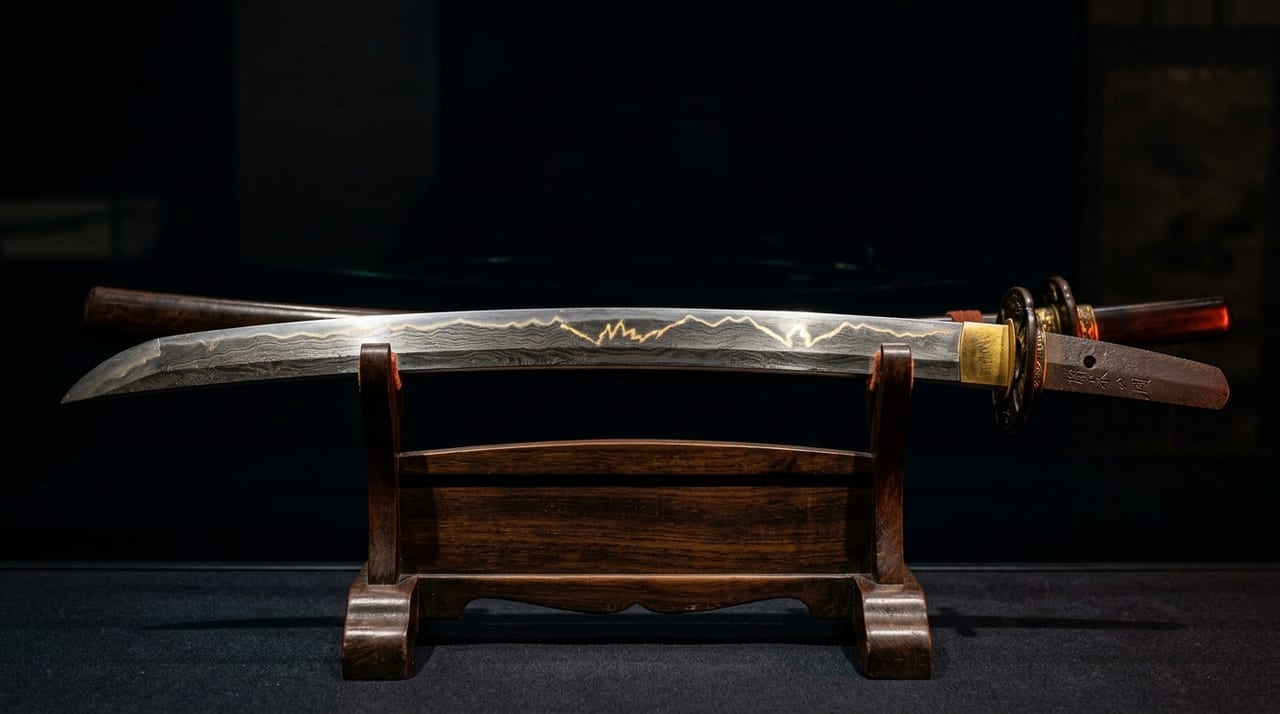
His blades feature a distinctive jigane (地鉄) and surface texture that differ from the Bizen (備前) or Sōshū (相州) traditions of the Kamakura period, reflecting the characteristics of Hōki iron. Prominent gold lines (kinsuji 金筋) and lightning patterns (inazuma 稲妻) occasionally appear in the jigane, serving as identifying characteristics of the Hōki tradition in appraisal.
Hōki Sword Smiths of the Heian to Kamakura Periods
After Yasutsuna, several smith lineages were established in Hōki Province. Names such as Sanekage (真景) and Aritsuna (有綱), transmitted as successors to Yasutsuna, appear in historical records, but surviving examples are few and many details of the lineages remain unclear.
With the Kamakura period's rise of the Bizen Osafune and Yamashiro Awataguchi schools, Hōki smiths are believed to have sought to absorb techniques from the Kinai region. As sword smiths of the Chūgoku region, they—alongside the Mihara school (備後) and Izumo smiths—each maintained their distinctive regional characteristics while adapting to the methods of the center.
Transformation from the Kamakura Period Through the Northern and Southern Courts Period
From the late Kamakura period through the Northern and Southern Courts period, the sharp increase in demand for swords due to warfare greatly affected sword smiths of the Chūgoku region. Among Hōki smiths, some adopted eclectic styles combining Bizen and Sōshū traditions, and it is said that the distinctive characteristics of the Hōki tradition itself showed signs of dilution.
During the turmoil of the Northern and Southern Courts, the Chūgoku region became a battleground with forces of both sides in conflict, leading to the migration and scattering of sword smiths. This confusion has contributed to the difficulty in clarifying the lineages of Hōki smiths.
Technical Characteristics of the Hōki Tradition
Swords classified as Hōki tradition exhibit several common characteristics.
- Jigane (地鉄): Itame (板目) grain appears with a flowing tendency, and kinsuji and inazuma frequently manifest.
- Hamon (刃文): Based on large patterns with small irregularities and undulating forms (notare 湾れ), with relatively broad hardening depth.
- Form (sugata 姿): Works from the Heian to Kamakura periods often retain a long, grand tachi form even after major re-grinding (ōsuriage 大磨上げ).
- Ji-nie (地沸): Fine nie (沸) particles may be scattered throughout the jigane.
The aesthetics of the Hōki tradition are characterized by bold, rustic strength, distinct from the clove-bud hamon (chōji 丁子刃文) of Bizen or the broad, straight hardening patterns of Sōshū.
Major Re-grinding and Interpreting Attribution on Unsigned Blades
Many tachi of the Heian and Kamakura periods were re-ground in later centuries to a shorter length suitable for uchigatana (打刀). Among works attributed to Hōki, blades bearing major re-grinding marks without signatures are not uncommon. When a smith's signature has been lost through re-grinding, an attribution (kiwame 極め) is established based on stylistic features—form, jigane, and hamon—to estimate the province and period of its manufacture.
Attribution is, after all, a judgment based on style and cannot be equated with works bearing signatures. Yet the very process of inferring region and period from the flow of the jigane and the characteristics within the hamon constitutes a profound pleasure in appreciating koto blades. Regions like Hōki, where the jigane exhibits strong individuality, provide textbook examples where such inference is relatively straightforward.
Checklist for Evaluating Hōki Works
When considering the purchase of a blade attributed to Hōki, the following points should be verified in sequence.
First, verify the presence and content of the registration certificate and appraisal report. Possession and sale of blades within Japan requires a registration certificate issued by the prefectural board of education. An appraisal report from the Japanese Sword Society for the Preservation of Fine Art Swords (NBTHK) or similar organization clarifies the grounds for attribution and its standing.
Second, examine the notable features of the jigane. Determine whether kinsuji and inazuma are evident in the flowing itame grain, and assess how the ji-nie appears in the ground steel. If viewing photographs, inspect from multiple angles and lighting conditions.
Third, assess condition. Many works from earlier periods have been repeatedly sharpened, resulting in loss of width and thickness. Evaluate the preservation of the edge area and spine area, and examine the clarity of engraved patterns and the ridge line of the shinogi (鎬) to gauge how well the blade maintains its original integrity.
Surviving Examples and Appraisal of Hōki Smiths
Blades attributed to Yasutsuna are limited in number, with National Treasure and Important Cultural Property examples housed in museums and shrines throughout the country. Such pieces rarely enter the market, and opportunities for collectors to acquire one directly are exceedingly rare.
By contrast, works by Hōki and other Chūgoku region smiths from the Northern and Southern Courts period onward occasionally appear in sword auctions and dealer catalogs in Tokyo and Osaka. These pieces offer the true pleasure of appraisal informed by both regional and period characteristics, holding steady appeal as objects of inquiry for intermediate and advanced collectors.
We encourage you to use it as a reference while comparing the distinctive characteristics of swords from different regions and periods, thereby considering the direction of your own collection.