Sen-gake — The Technique and Role of the Rough-finishing Process of Shaving and Shaping the Blade After Yaki-ire
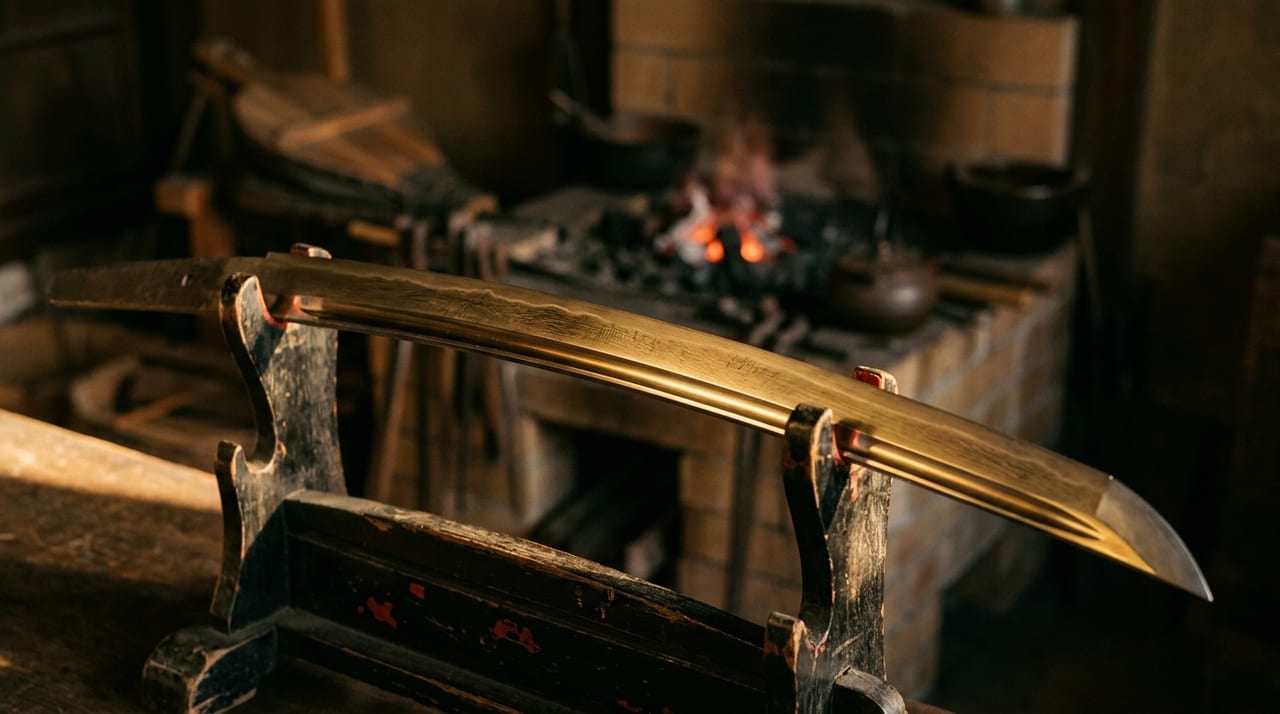 * Image is for illustrative purposes only.
Table of Contents
What is Sen-gake — The "Pre-finishing Process" of the Sword Kaji
In sword-making, a blade immediately after yaki-ire is complete is not yet in a state where finish polishing can be performed. The blade surface retains fine irregularities, distortions, and scale (oxide film) produced by forging and yaki-ire, and the sori of the blade may not be fully settled.
It is at this stage that "sen-gake" is performed. A "sen" is a specialized cutting tool (blade) whose cutting edge forms a thin, flat plate; it is made of iron or steel. Sen-gake is the rough-finishing process of pressing and drawing the sen against the blade to scrape away excess surface material and bring the blade's shape and sori into order.
Types and Use of the Sen
The sen comes in multiple shapes depending on its purpose. These include the "hira-sen," used to shave the hira (flat surface) of the blade; the slender "kiwa-sen," used to work the edges (kiwa) of the blade such as the ha-machi and mune-machi; and the "shinogi-sen," used to shape the shinogi-suji.
The work is performed with the blade secured to a daigi (wooden stand), and the tōshō grasps the sen with both hands and pushes it in a fixed direction. Since the blade immediately after yaki-ire is of high hardness and in a state where files do not easily bite, adjusting the pressure angle and speed of the sen becomes important. Applying excessive force will introduce fine scratches into the blade, which will affect the subsequent togi process.
Positioning in the Process — From After Yaki-ire to Before Togi
When the sequence of sword-making processes is laid out, sen-gake is positioned as follows.
- Material selection and tsumi-wakashi (selection of tamahagane and hi-zukuri)
- Orikaeshi tanren (jigane formation)
- Sunobe and hi-zukuri (rough shaping of the blade)
- Tsuchioki (application of clay coating before yaki-ire)
- Yaki-ire
- Sen-gake ← here
- Yasuri-gake
- Nakago finishing (shaping of the nakago)
- Handover to the togishi
The essential role of sen-gake is to bring the blade's shape to a "state fit for togi" before the togishi takes it over, and it forms part of the tōshō's final finishing stage.
Adjusting Sori — Shape Correction Performed in Sen-gake
After yaki-ire, the sori of the blade is for the most part finally set, but subtle differences in furnace and tank temperature, the niku-oki (fullness of the blade body), and cooling speed can cause it to come out stronger or weaker than intended.
In sen-gake, by varying the amount shaved from the shinogi-suji, hira, and mune of the blade, residual stress balance can be fine-tuned and the sori adjusted by a small amount. However, large shape corrections are not performed in sen-gake; it remains strictly within the range of "fine adjustment in preparation for togi." A large deviation in sori is recognized as a manufacturing problem and may lead to a decision to remake the blade.
Difference from Yasuri-gake
A process easily confused with sen-gake is "yasuri-gake." The yasuri (file) is a file-shaped tool that shaves the surface finely and is used for finishing to a higher precision than the sen. It is most often used for finishing the nakago and for detailed shaping of the shinogi-suji, and its role differs from that of the sen, which is used for rough shaving of the blade's flat surfaces.
In terms of process order, yasuri-gake is often performed after sen-gake, and both are positioned within a staged "coarse → fine" progression.
Where the Quality of Sen-gake Shows in the Finished Sword
The shaving marks of sen-gake itself disappear from the surface through subsequent togi. However, its results remain unmistakably in the "sugata" (form) of the finished sword. When appreciating a sword, it is worth turning one's eye to the following three points.
- The line of the shinogi-suji: Does the shinogi-suji run cleanly, without deviation, as a single line from the hand (hilt side) to the yokote?
- Niku-oki (fullness): Is the swelling of the hira-ji (flat ground) surface natural, and does the reflection when light is cast upon it flow smoothly? Does it undulate unnaturally in places?
- Crispness of the ridgelines: Do the ridgelines on the mune side and the yokote-suji stand sharply, without distortion?
The precision of such forms does not arise from the togishi's skill alone, but is supported by the tōshō's underlying work — the care taken in the shaping process, including sen-gake. By turning one's eye not only to the hamon and jigane but also to the "line flow," one can sense the quality of the work in processes invisible from the surface.
Sen-gake in Contemporary Workshops
As of 2026, sen-gake continues to be passed down unchanged in sword-making. Some workshops may use power tools as an auxiliary in the rough-shaving stage, but the final adjustments that determine the blade's sori and niku-oki are most often performed by traditional hand work relying on tactile sense. Even as the toolkit changes with the times, the essential nature of the process — "determining the blade's shape completely before passing it to the togishi" — does not change.
Also, since the sen's edge wears down with repeated use, the tōshō also re-sharpens and maintains the sen's edge personally. Keeping one's tools in order is part of the work — a principle shared by many forms of hand craft.
The Years Required for Mastery
Despite its unassuming appearance, sen-gake is a process that requires many years to master. Because the combination of the sen's pressure, angle, and speed bears directly on blade quality, a deeply cultivated sense of feel is demanded.
A tōshō's apprentice spends the first few years under their master on basic forging, then gradually begins assisting in the finishing processes. It is not uncommon to require 5 to 10 years from entry before being entrusted with sen-gake on one's own.
"A single difference in how the sen is applied changes the togishi's workload" — some tōshō express it this way. The meaning is that how carefully the preparatory work is finished before handover to the togishi determines the ultimate quality of the sword. Sword-making is a composite art completed through the collaboration of many craftsmen, and sen-gake can be called the quiet but vital process that carries the baton in that chain.