A Detailed Account of the Hizukuri Process: Steel Deformation and Microstructure Control, from Sonobe to Rough Finishing
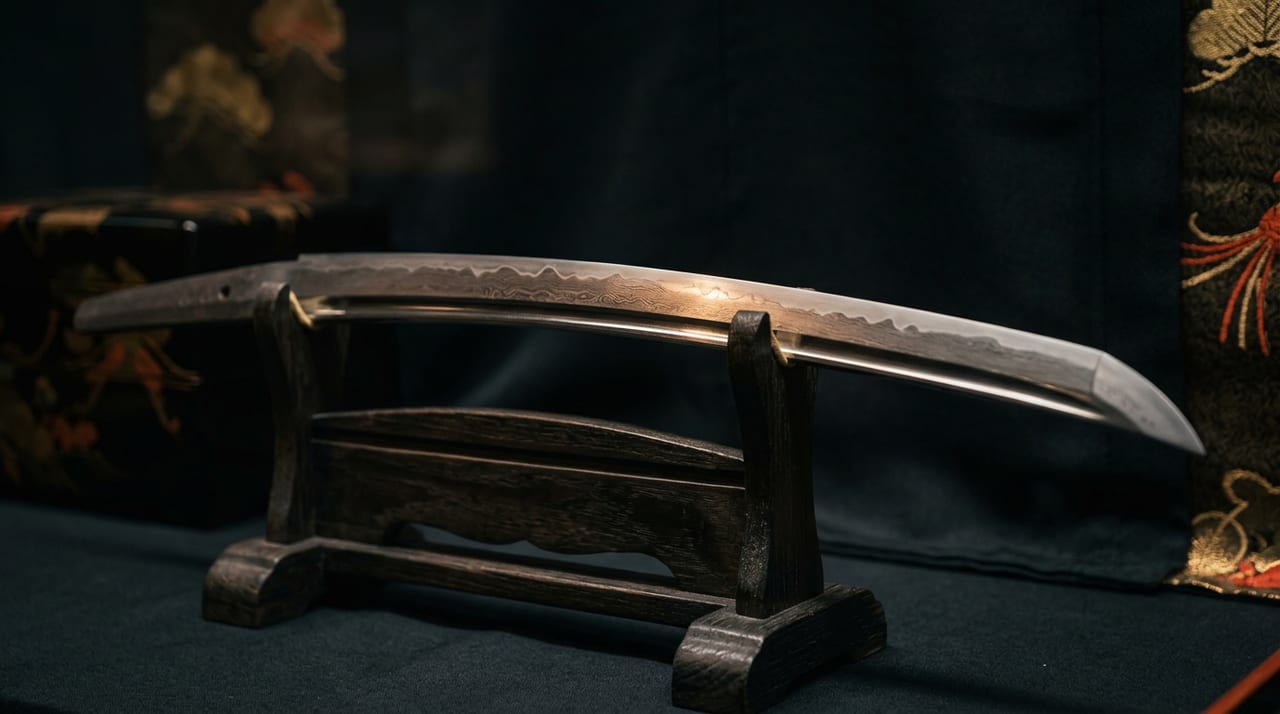 * Image is for illustrative purposes only.
Table of Contents
What Is Hizukuri? — The Core of the Forging Process
Hizukuri is the process that follows sonobe (rough drawing-out) in Japanese sword forging, and is the most critical stage for shaping the blade's final external form—the thinness of the edge, the shape of the mune, the form of the kissaki, and the finishing of the nakago.
If sonobe is the process that determines the "skeleton of the sword (nagasa, direction of sori, and the taper from base to tip)," then hizukuri corresponds to "the stage of sculpting the fine details (edge, mune, kissaki, hi, machi, and nakago)." It is the process that demands the most skill of a tōkō, and failures at this stage cannot be corrected in subsequent processes.
Prerequisites for Hizukuri — The State of the Blade After Sonobe
When hizukuri begins, the blade is in the following condition.
- The approximate nagasa and base-to-tip taper have been established
- The kasane is still uneven and rough
- The kissaki, hasaki, mune, and nakago are not clearly differentiated—it is a "featureless, bar-like mass"
- An oxide layer (kuro-kawa) covers the entire blade
From this state, hizukuri creates the specific forms that define each sword's individuality.
Main Tasks of Hizukuri
1. Drawing Out the Hasaki Thinly — Creating the Edge Thinness
One of the first tasks in hizukuri is precision striking with the kozuchi (small hammer) to draw out the hasaki to a thin edge.
Technical points
- To thin the hasaki, the angle of the hammer face is adjusted so it strikes in the direction of the edge
- An appropriate temperature is around "red heat (900–1,000°C)," lower than white heat (1,200–1,300°C). If the temperature is too high, the steel is too soft to hold its shape
- The amount of deformation per strike is kept small, thinning the edge gradually over multiple passes
- Since an extremely thin hasaki is prone to cracking during yaki-ire (quenching), a craftsman's intuition is required to judge the limits of thinness
Hammer types
- Ozuchi (large hammer): weight 1–2 kg. Used for rough, large-scale deformation
- Kozuchi (small hammer): weight 200–400 g. Used for forming precise sections
- Kakuzuchi (square-faced hammer): hammer with a square cross-section. Used for shaping the mune and the area near the machi
2. Shaping the Mune — Creating the Back of the Sword
The mune is the back side of the blade (the opposite side from the edge), and is an important part whose shape is determined by hizukuri.
Types of mune and shaping methods
- Iori-mune: mune with a triangular (▲) cross-section. A ridge line is created from the flat surface to form the triangular peak. The most common form
- Maru-mune: mune with a rounded cross-section. Shaped by rounding with the hammer
- Kaku-mune: mune with a square cross-section. Requires more complex shaping
Because mune shaping is directly linked to the balance of the blade's center of gravity, the work proceeds with constant attention to the balance between edge thinness and mune thickness.
3. Shaping the Kissaki — Creating the Tip of the Sword
The kissaki is the tip of the sword, an important part that determines thrusting capability and aesthetic appeal.
Techniques for shaping the kissaki
- At the sonobe stage, the tip is in a rounded, lump-like condition
- In hizukuri, the kozuchi is used to create the "yokote-suji (the boundary line between the kissaki and the blade body)" while shaping the kissaki
- Whether to make an inokubi-kissaki (small kissaki) or an o-kissaki (large kissaki) is decided at the design stage, and hizukuri brings it to that shape
- Because the kissaki is the thinnest and most delicate part, temperature control and the force of the hammer are particularly difficult
4. Shaping the Machi — Creating the Hamachi and Munemachi
The machi is the boundary section between the blade and the nakago, with two points: the hamachi (the boundary on the edge side) and the munemachi (the boundary on the mune side).
The position and shape of the machi affects the sword's "balance point" and is directly linked to the feel of drawing and swinging the sword. The shape of the machi (its angle and depth) must be precisely determined in hizukuri.
5. Shaping the Nakago — Creating the Part Inserted into the Tsuka
The nakago is the part inserted into the tsuka (hilt), and its thickness, length, and shape (bo-nakago, ken-gata nakago, karasukubi-nakago, etc.) differ according to the sword's intended use and the tōkō's design intent.
In hizukuri, the nakago is drawn out long and thin, the position where the mekugi-ana (peg hole) will be opened is determined, and it is finished to a rough shape (the mekugi-ana itself is opened in a later process).
Temperature Control — The Most Critical Technical Element in Hizukuri
Hizukuri is a process of repeatedly cycling through "heating in the furnace → shaping → cooling (or reheating)," and temperature management at each stage greatly affects the finished result.
The danger of overheating If the steel is struck in an overheated state beyond white heat, the steel's crystals coarsen (overheated microstructure), and toughness drops dramatically. This condition is a fatal defect that cannot be fully corrected in the subsequent yaki-ire. Experienced tōkō judge the temperature by observing the white-heat intensity of the flame and the color of the steel surface.
Striking at the proper temperature (tanren temperature) By striking at the optimal tanren (forging) temperature (which varies by steel type but is generally around 900–1,150°C), the steel's deformability is maximized. At this temperature range, the steel is sufficiently soft and precise shaping is possible.
The danger of striking at too low a temperature (cracking) If the steel is struck when it has cooled too much, it enters a "cold working" state and the steel can crack or chip. "Return it to the furnace when it goes black" is an absolute principle of forging.
The Effects of Hizukuri on Steel Microstructure — Why Not Just the "Shape" but the "Quality" Also Changes
Hizukuri is not merely "shaping." In this process, the steel's microstructure also changes, influencing the beauty of the hamon that emerges in the subsequent yaki-ire.
Grain refinement through tanren By repeatedly heating, deforming, and cooling, the crystal grains of the steel are refined. The finer the grains, the more dense the jigane appears after polishing, and the piece is praised as having a "well-packed ground."
Redistribution of carbon When the steel is deformed in hizukuri, carbon (Fe–C compounds) is redistributed within the steel. This homogenization of carbon distribution affects the sharpness of the boundary between the yakiba (hardened edge) and the jihada (jigane portion) that emerges in yaki-ire.
Treatment of scale (oxide layer) During hizukuri, an oxide layer (kuro-kawa, scale) forms on the steel surface and scatters each time the steel is struck with the hammer. If scale is pressed into the interior of the steel, it causes jikizu (surface flaws in the jigane), so the work proceeds while removing the scale by applying straw ash or water.
Arashiage (Rough Finishing) — The Shaping Process Following Hizukuri
After hizukuri is complete, the next step is "arashiage (rough finishing)." Using files and a sen (scraping tool), this process removes distortion from the blade and precisely refines the overall shape. Unlike hizukuri, which is hot working by hammer, arashiage is centered on cold finishing work.
The blade at the stage when arashiage is complete is in its final check state before proceeding to the next process, "tsuchioki (applying the clay coating) and yaki-ire (quenching)." The tōkō here re-examines the blade by sight and touch, returning to arashiage to correct any sections that require adjustment.
Conclusion — Hizukuri and Arashiage Determine the Life of the Sword
Hizukuri is one of the most important processes that determines both the "form" and the "quality" of a Japanese sword. The thinness of the hasaki, the shape of the mune, the beauty of the kissaki, the position of the machi—all of these are determined in hizukuri and cannot be changed in subsequent processes.
Through the complex control of three elements—temperature management, hammer angle, and force—a tōkō brings the steel to the designed blade shape. It is said that mastering this process requires ten or more years, not only because of the technical difficulty, but because the "sense of conversing with the steel" must be absorbed into the body.
The traces of hizukuri are forever carved into the "sugata (form)" of the finished sword. When viewing a sword, in its graceful curves and precise kissaki, one is invited to feel the time a tōkō spent in front of the furnace.