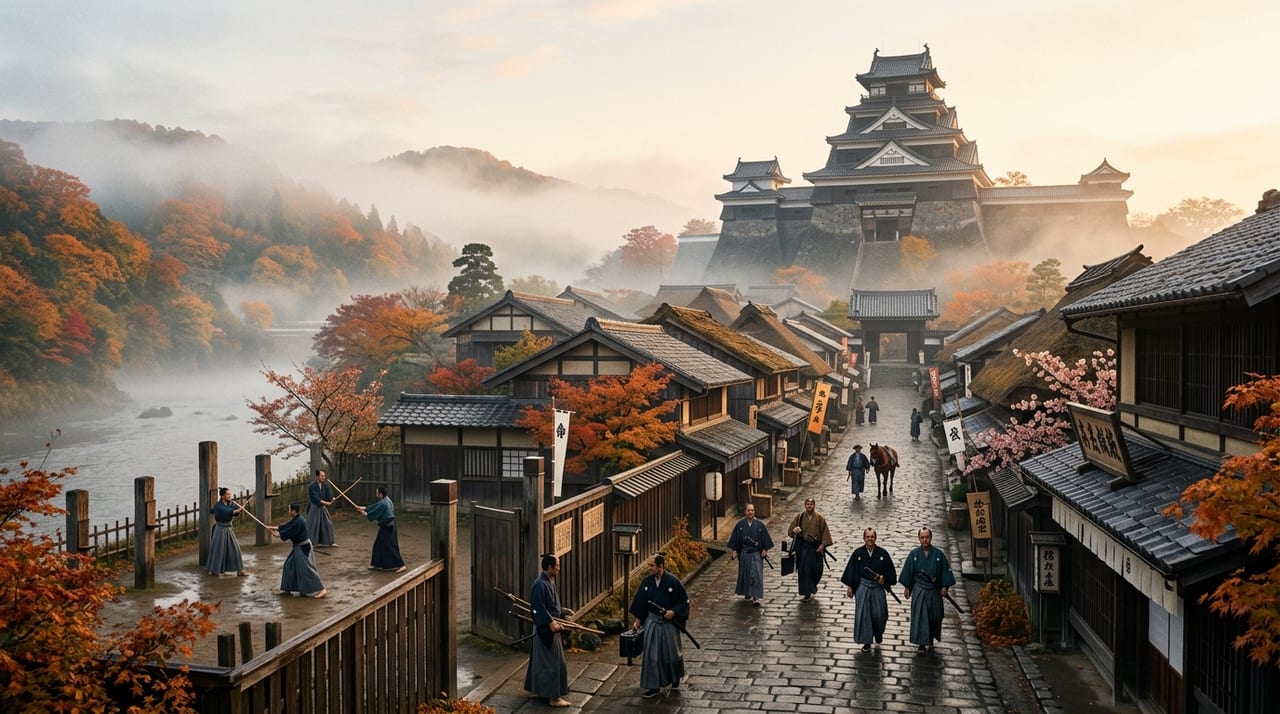
 * Image is for illustrative purposes only.
Birth of the Tachi — Formation of the Curved Sword in the Mid-Heian Period
太刀の誕生——平安中期・反りある湾刀の形成
A tachi with a curved, shinogi-zukuri blade is said to have been born in the mid-Heian period, around the time of the Jōhei-Tengyō Rebellions (935–941). The rise of the bushi, whose main mode of combat was mounted warfare, prompted the technical shift from straight blades to curved swords, and a form suited to drawing and cutting on horseback was established. This technical transformation determined the fundamental characteristics of Japanese swords, and early master smiths such as those of Ko-Bizen pursued both the beauty and the function of the curved sword.
Description
Historical Background
From the Nara period into the early Heian period, the Japanese swords in use were mainly straight blades without curvature (chokutō, or jōkotō), influenced by the continent. The blades were straight and designed chiefly for thrusting, a form consistent with the infantry-centered combat of the time.
Around the 10th century, in the mid-Heian period, a warrior class known as bushi (mononofu) began to rise in the provinces. At the same time, the mode of combat shifted from foot fighting to mounted combat. Fighting on horseback centered on cutting downward at an opponent from the side of the horse, and the straight blade left dissatisfaction in drawing speed, cutting power, and portability alike. It is thought that the shift to curved swords (wantō) began around the time of the Jōhei-Tengyō Rebellions (935–941), in which Taira no Masakado and Fujiwara no Sumitomo rose in revolt.
Technical Characteristics of the Curved Blade (Tachi)
The greatest technical innovation of the tachi, a curved shinogi-zukuri sword, is the curvature of its blade (sori). The curve dramatically increases cutting power in the downward stroke. This follows the same principle as 'hikikiri' in kendō: the edge contacts the target while tracing an arc, allowing a deep cut with less force.
In addition, shinogi-zukuri (a construction in which a ridgeline called the shinogi runs along the blade) preserves blade strength while reducing weight, realizing a sword that could be handled one-handed on horseback. The tachi was carried hung from the waist with the edge facing down, in the tachi-koshirae mounting, optimized for drawing on horseback.
The blade length was generally about 2 shaku 5 sun (approximately 75 cm) as standard. Compared with the later uchigatana, the classic characteristics of the tachi are a deeper curve, a larger difference in width between the moto (base) and saki (tip), and a small point (ko-kissaki).
Early Smiths and the Development of Production Centers
From the mid to late Heian period, when the curved tachi was born, groups of smiths that became the foundation of later Japanese sword culture formed across the country.
The Ko-Bizen school was based in Bizen Province (present-day Okayama Prefecture). Tomonari, said to have been active around the Eien era (987–989), and Masatsune are regarded as its twin pillars, followed by Kanehira, Sukehira, Nobufusa and others. Masatsune is credited with 5 National Treasures and 8 Important Cultural Properties and is regarded as the highest-ranking master representing Ko-Bizen. Ō-Kanehira (Tōkyō National Museum, National Treasure) is known as one of the finest extant masterpieces and, alongside Dōjigiri Yasutsuna, is compared to 'co-yokozuna of East and West'; it shows the peak of Kanehira's skill.
In Yamato, the Senjuin school, which belonged to Tōdai-ji, was active early on (of the five Yamato schools, the other four arose in the Kamakura period). In Yamashiro, the early smiths of the Awataguchi school began producing tachi with elegant jigane and hamon.
Social Context
The birth of the curved sword in the mid-Heian period is inseparable from the emergence of a new social class, the bushi. The bushi rose as those responsible for maintaining order in the provinces and protecting shōen (manors), and developed into 'military aristocrats' employed by the court and the nobility. Through this process the tachi became a social symbol of the bushi and began to take on cultural meaning beyond that of a mere practical weapon.
In court and aristocratic culture as well, the tachi came to have ceremonial importance. Tachi were used as offerings and as gifts bestowed by the court, famous swords were given individual names (gō), and their provenance was recorded. This practice became the seed of the later culture of sword appreciation.
Historical Significance
The form of the curved, sori-bearing tachi established in the mid-Heian period is the starting point of all later development of Japanese swords. Though its appearance changed with each era, from the imposing forms of the Kamakura period to the great tachi of the Nanboku-chō period and the uchigatana of the Edo period, the basic structure of a curved shinogi-zukuri blade has been maintained down to the present day. Without the technical innovation of the Heian-period tachi, the Japanese swords of today would not exist.
Characteristics of This Era
- Adoption of curved shinogi-zukuri form suited for cavalry warfare
- Formation of early schools such as Ko-Bizen and Senjuin
- Elevation of tachi to ceremonial and social symbol