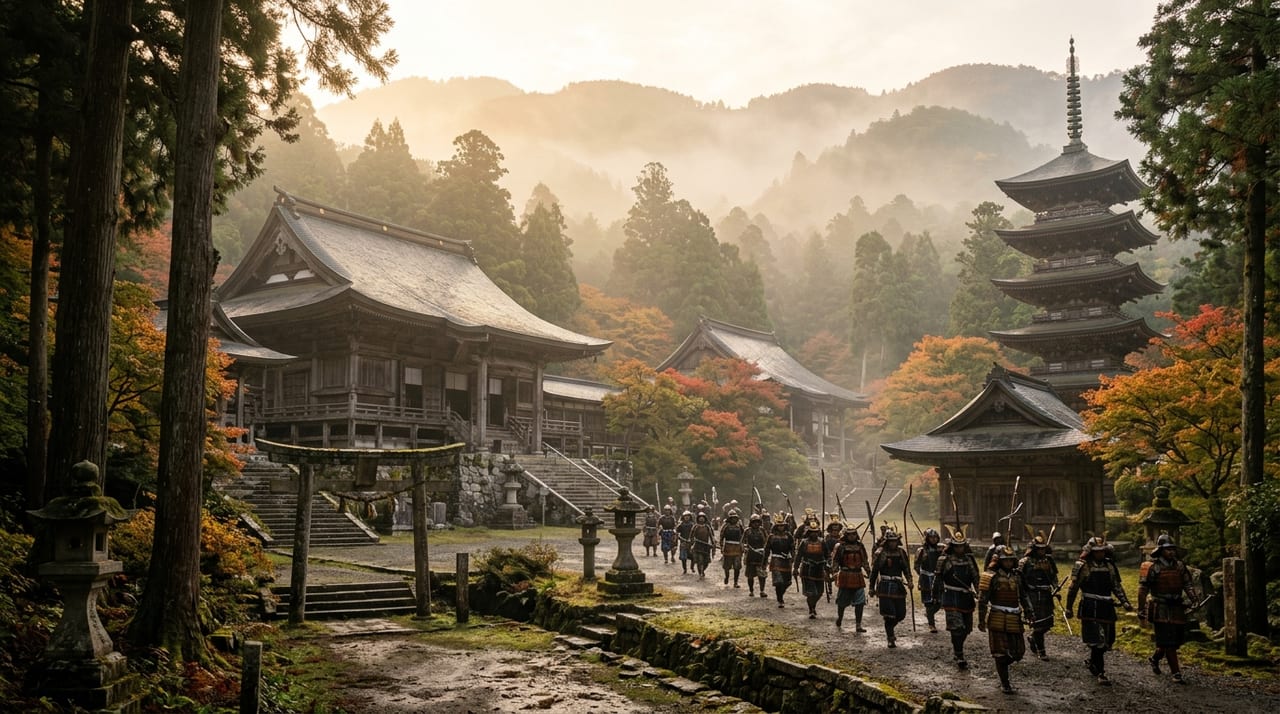
 * Image is for illustrative purposes only.
Early Kamakura Period — The Birth of the Classical Tachi
鎌倉初期の刀剣
From the establishment of the Kamakura shogunate by Minamoto no Yoritomo in 1185 through the Jōkyū War in 1221, the early Kamakura period was a dawn era in which the tachi style of Japanese swords was established. While ancient smith groups such as the Senjuin school of Yamato continued their activity, the Awataguchi school of Yamashiro perfected the clear jigane of nie-deki and the ko-chōji hamon, and this became a historically significant period that decisively set the aesthetic standards of Japanese swords thereafter.
Description
The early Kamakura period (Kenkyū to Jōkyū, roughly the 1190s to around 1221) was a distinctive era in which the political transformation of establishing a warrior regime and the cultural achievement of perfecting the tachi style of Japanese swords proceeded at the same time. When Minamoto no Yoritomo opened the shogunate at Kamakura in 1185 and the warrior class seized real political power, the nature of social demand for swords changed fundamentally. The core of the sword culture of the early Kamakura period lies in this shift: from the decorative tachi used in court aristocratic ceremonies to practical yet aesthetic tachi that warriors used both in combat and for everyday wear.
In Yamashiro Province (present-day Kyoto Prefecture), the Awataguchi school rose to prominence and established a firm position as the representative smith group of the early Kamakura period. The greatest feature of Awataguchi swords is the refinement of their jigane. Itame and ko-itame flow densely, and the clear jigane with evenly distributed nie established an aesthetic standard that was later inherited as the foundation of the 'Yamashiro-den.' The hamon centers on ko-chōji and suguha, and together with elegant and dignified sugata, it embodies aristocratic refinement. Some works left by Awataguchi lineage smiths such as Kunitomo, Hisakuni, Arikuni and Kuniyasu have been designated National Treasures and Important Cultural Properties, conveying the high level of craftsmanship of the early Kamakura period.
In Yamato Province (present-day Nara Prefecture), the Senjuin school, closely tied to the great shrines and temples of Nara, continued its activity, and later the Tegai school and others arose. The traditional features of Yamato-mono, namely jigane with a masame tendency, strongly active nie in the hamon, and a sugata with a broad lower section, were preserved even in the early Kamakura period, and fine pieces were produced as offerings to Tōdai-ji and Kasuga Taisha. Yamato smiths also accepted commissions for swords aimed at the warrior society of Kamakura, functioning as a production center that supplied sturdy tachi with a warrior taste distinct from the Yamashiro-den.
A notable technical development in the early Kamakura period is the diversification of the curvature and kissaki styles of tachi. Swords of this period feature pronounced koshi-zori, and the powerful chū-kissaki style, with a broad blade width and a compact, ikubi-like form, blossomed greatly in the following mid-Kamakura period. This shows a shift from the slender tachi of the late Heian period toward securing the width of the kissaki to meet the practical demands of warriors. However, the tachi of the early Kamakura period as a whole still strongly retained the slender and elegant style of the Heian period, and it is clearly distinguished from the robust tachi of the golden age of the mid-Kamakura period.
The establishment of Yoritomo's warrior regime also brought great changes to the circulation and offering culture of swords. Yoritomo developed Tsurugaoka Hachimangū as the guardian shrine of the warriors and actively made offerings of arms and swords. This practice spread among the warrior strata of the eastern provinces, and it became the first step toward institutionalizing the offering of famous swords to shrines and temples in the context of expressing faith and displaying authority. Yoritomo also used famous swords as political gifts, incorporating them into the strengthening and maintenance of lord-vassal bonds through bestowals on influential gokenin. This strengthening of the political and ceremonial functions of swords became the foundation for forming the distinctive character of sword culture in warrior society.
The Jōkyū War (1221) was an incident in which the movement of Retired Emperor Go-Toba to overthrow the Kamakura shogunate was suppressed, and afterward Go-Toba was exiled to Oki. Go-Toba was fond of swords and is known as a noble ruler who established the goban-kaji system, summoning renowned smiths from across the country to the imperial palace to make swords. After the Jōkyū War, part of the sword-forging culture that had been under Go-Toba's influence shifted to Kamakura and became the prehistory of the establishment of the Sōshū-den in the mid-Kamakura period. Thus, the early Kamakura period holds an indispensable position in Japanese sword history as the period in which aesthetic standards led by Yamashiro were formed.
Characteristics of This Era
- Establishment of the Awataguchi school: the clear jigane of nie-deki and the ko-chōji hamon completed the aesthetic standard of the Yamashiro-den, the greatest achievement of the early Kamakura period
- Continuation of Yamato-mono and warrior robustness: the Senjuin school supplied tachi of differing aesthetics to Tōdai-ji and Kasuga Taisha and to warrior society
- Establishment of the koshi-zori tachi style: the shift from the slender Heian form toward koshi-zori and ikubi formation to meet warrior demand began
- Yoritomo's sword policy and offering culture: offerings to Tsurugaoka Hachimangū and bestowals on gokenin institutionalized the political and ceremonial functions of swords
- Go-Toba's goban-kaji and the bridge to the mid-Kamakura period: smith migration after the Jōkyū War formed the prehistory of the establishment of the Sōshū-den