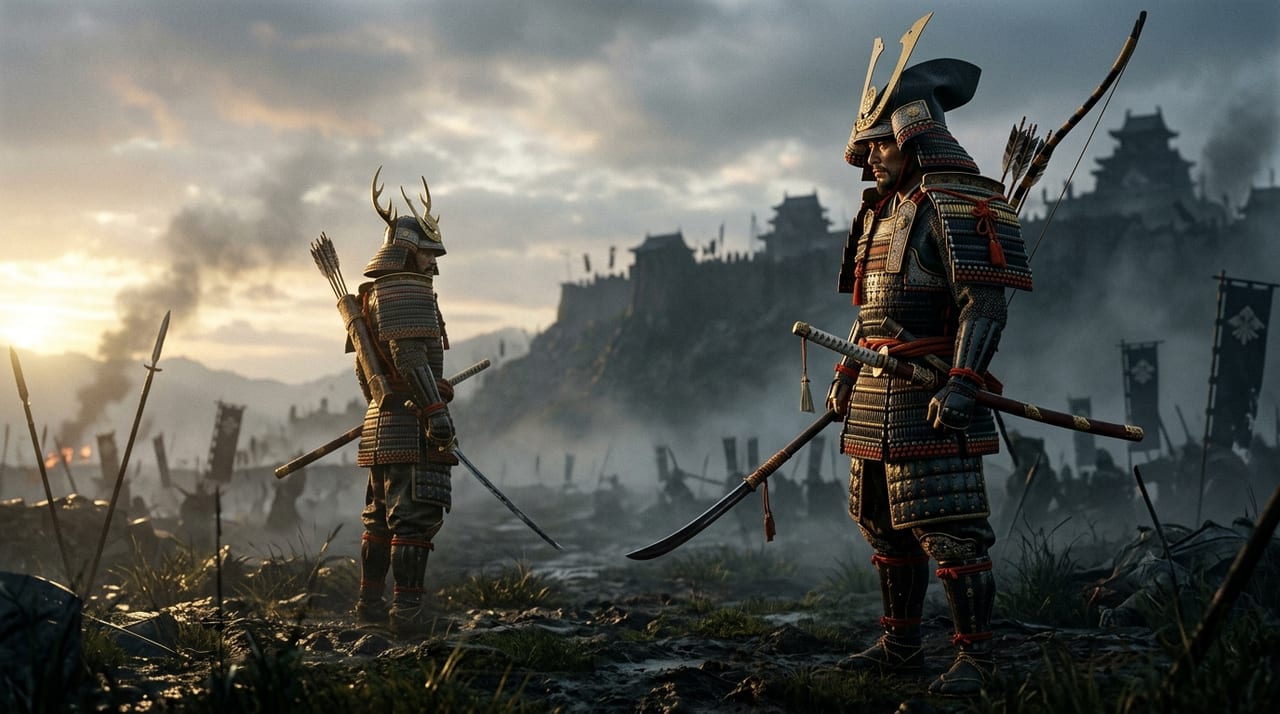
 * Image is for illustrative purposes only.
Minamoto no Yoshiie
源義家
Hachimantaro — The First Son of Hachiman, supreme warrior of the Heian age
Description
The Birth of Hachiman Tarō
Minamoto no Yoshiie was born in Chōreki 3 (1039), the eldest son of Minamoto no Yoriyoshi. From childhood he performed his coming-of-age ceremony (genpuku) at Iwashimizu Hachimangū, and this gave him the common name 'Hachiman Tarō.' The god Hachiman was the guardian deity of the warrior house, and this boy, who swore the vows of a warrior before the god's sacred presence, would in time have his name inscribed in history as the emblem of the Bandō warriors of the late Heian period. In the Former Nine Years' War (1051–1062), fought together with his father Yoriyoshi, Yoshiie gained combat experience from his mid-teens into his twenties. In fierce battles against the Abe clan (fushū, subjugated Emishi) of the northeast, he displayed rare martial prowess. His skill with the bow was said to be unmatched in his era, and his technique of shooting down enemy commanders from long range was feared as divine skill.
The Former Nine Years' War and the Establishment of His Martial Renown
The martial prowess Yoshiie displayed in the Former Nine Years' War became widely known among the Kantō warrior bands. Working in concert with his father Yoriyoshi, he captured the Abe clan's strongholds one after another. In Kōhei 5 (1062), in the battle at the Kuriyagawa Stockade, which was the final decisive battle, Abe no Sadatō was slain, and the Former Nine Years' War came to an end. Through this war Yoshiie showed his aptitude as 'leader of the warrior house,' and he received fervent reverence from the Bandō warriors. His martial prowess was not mere physical strength. It was supported by strategic insight and the leadership to win over his subordinates' hearts, and in his overall qualities as a military commander he was rated the best of his era.
The Later Three Years' War and the Politics of 'Righteousness'
The Later Three Years' War (1083–1087) further raised Yoshiie's reputation as a warrior, and at the same time it complicated his political position. Yoshiie intervened in the internal strife of the Kiyohara clan of Dewa and Mutsu and supported Kiyohira (later Fujiwara no Kiyohira), and he succeeded in capturing the Kanazawa Stockade. Earlier, in the attack on the Numa Stockade, he had withdrawn after suffering deaths from freezing and starvation in the winter cold. The Kanazawa Stockade fell to a siege that starved out its defenders, following a strategy proposed by Kimiko no Hidetake. However, the imperial court judged this war to be a 'private war' and gave no reward. It is said that Yoshiie distributed rewards to his subordinates from his own private property. Later, donations of rice paddies and fields to Yoshiie from various provinces came in one after another, to the point that the court prohibited such donations in Kanji 5 (1091). The lord-vassal bonds between warriors, formed without going through the court, became the prototype of the later warrior society.
Relationship to Swords and the Warrior Spirit
Yoshiie is known as a master of the bow. While Heian-period warriors fought mainly as mounted archers, skill with the tachi sword was also indispensable to warriors in close combat. At Tsuboi Hachimangū (Habikino, Osaka Prefecture), the clan's tutelary shrine of the Kawachi Genji, there is preserved a kurokawa-odoshi dōmaru (a cuirass laced with black leather; Important Cultural Property), said to have been favored by Yoshiie. The early Kamakura-period Heiji Monogatari also contains an anecdote that a sword called Higekiri ('Beard Cutter') was named because Yoshiie cut off the heads of a thousand captured enemies, beards included, and that it was handed down to the senior line of the Kawachi Genji. It is also said, however, that this was a fabrication meant to present Minamoto no Yoritomo as the senior line of the Genji.
As the Father of the Bandō Warriors
Minamoto no Yoshiie's greatest historical significance lies in having laid the spiritual and institutional foundations of the later warrior society. In later ages it was said that the military customs of the eastern provinces were arranged by Yoshiie, and his fame raised the prestige of the Kawachi Genji, his descendants. Yoshiie's grandson Tameyoshi and great-grandson Yoshitomo followed him, and the golden lineage of the Seiwa Genji unfolded, eventually leading to the generation of Yoshitsune and Yoritomo. The 'Hachiman Tarō' of the Heian period continues to shine forever as an undying presence in the spiritual history of the warrior.