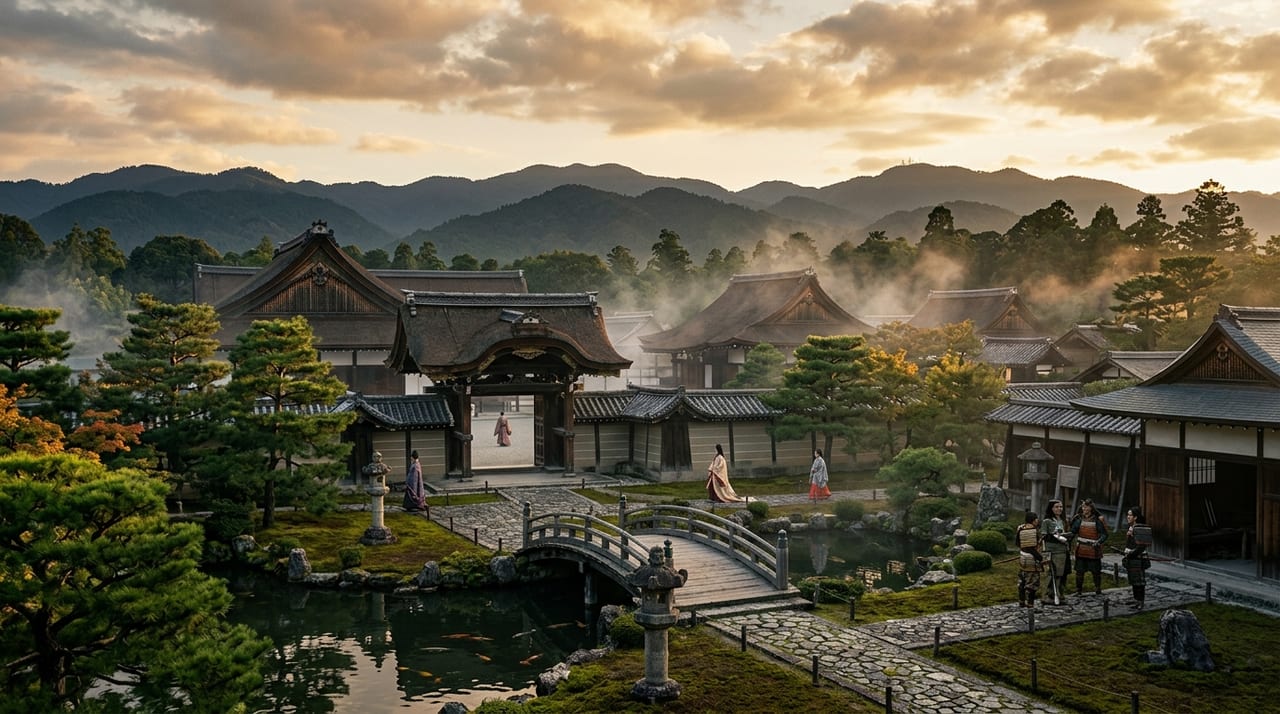
 * Image is for illustrative purposes only.
Jōkyū Disturbance Period
承久の乱前後
The Jōkyū War, which ended in failure for the plan of retired Emperor Go-Toba to overthrow the bakufu, sealed the supremacy of the warrior class. Go-Toba himself was deeply devoted to swords; he established the goban-kaji system to gather master smiths, and he was a man of extraordinary aesthetic discernment.
Description
The Jōkyū War and the Shift in Power Structure
In 1221 (Jōkyū 3), Retired Emperor Go-Toba issued an inzen calling for the pursuit of Hōjō Yoshitoki and summoned warriors across the country to take up arms. However, the mobilization capacity of the Kamakura shogunate far exceeded the retired emperor's expectations, and the imperial forces suffered a major defeat in the battles of Uji and Seta. Retired Emperor Go-Toba was exiled to Oki, Retired Emperor Juntoku to Sado, and Emperor Chūkyō was deposed. As a result of the Jōkyū War, the Rokuhara Tandai was established, strengthening oversight of the court and control of the warriors of western Japan, and the superiority of the warrior houses over the kuge society was institutionally established.
Retired Emperor Go-Toba's Devotion to Swords and the Goban-kaji
What makes Retired Emperor Go-Toba's role in the Jōkyū War special in the history of swords is the fact that he was himself a connoisseur with the foremost discerning eye of his era, and that he is said to have applied the yakiba (hardening) to blades himself. In 1208 (Jōgen 2), the retired emperor summoned master smiths from various provinces and established a system called "goban-kaji," under which the smiths took turns each month forging swords at Minase. The smiths selected for this system were elite craftsmen centered on Bizen, Bitchū, and Yamashiro, and their competitive drive to meet the retired emperor's aesthetic judgment, the highest standard, promoted the advancement of their techniques. A sword said to have been given yakiba by the retired emperor himself and decorated with a sixteen-petaled chrysanthemum crest engraved in kebori is called "Gosho-yaki" or "Kiku-gosaku."
Demand for Swords under the Kamakura Warrior Government
After the Jōkyū War, the control of the Kamakura shogunate fully extended into western Japan, and demand for swords among the warriors expanded on a nationwide scale. Influential gokenin, led by the Hōjō tokusō family, competed to acquire famous swords, and this further intensified the technical competition among smiths. In the somewhat later mid-Kamakura period, the Osafune school of Bizen rose to prominence, and Mitsutada left magnificent works with gorgeous midare-ba, paving the way for the golden age of Bizen blades. Meanwhile, in Kyoto, the lineage of smiths who had taken part in the goban-kaji of Retired Emperor Go-Toba continued, and the refined techniques of the Yamashiro tradition were carried on and developed.
Sword Aesthetics Fusing Court and Warrior Culture
The period before and after the Jōkyū War was a unique era in which court culture and warrior culture mutually influenced each other and shaped a sword aesthetic. Because smiths from various regions, including Bizen, Yamashiro, Yamato, and Bitchū, took part in the goban-kaji of Retired Emperor Go-Toba, technical exchange between different traditions was promoted. The retired emperor's aesthetic judgment went beyond the functionality of swords as weapons and incorporated purely aesthetic values into the criteria for sword evaluation, such as the beauty of the jigane, the artistry of the hamon, and the balanced beauty of the sori. This perspective of "swords as works of art" became the direct source of the later culture of sword appreciation from the Muromachi period onward.
Geographic Distribution and Influence of the Goban-kaji Smiths
The smiths who took part in the goban-kaji of Retired Emperor Go-Toba were a broad group that included the Fukuoka Ichimonji school of Bizen, the Aoe school of Bitchū, and the Awataguchi school of Yamashiro, as well as smiths from Yamato, Bungo, Hōki, and Mimasaka. In particular, Norimune of the Fukuoka Ichimonji school is regarded as the foremost of the goban-kaji. Because many of the swords on which the retired emperor had put yakiba and engraved the chrysanthemum crest bore the characteristics of the Ichimonji school, they were called "Kiku-ichimonji." The techniques and aesthetic sense cultivated through the goban-kaji system were carried back to their home regions by each participating smith, contributing to the overall improvement of sword-forging techniques across the country and forming the foundation for the golden age of the Japanese sword from the mid-Kamakura period onward.
Characteristics of This Era
- Go-Toba's goban-kaji system made possible technical exchange across regional traditions, creating a competitive environment in which elite smiths from across the provinces, centered on Bizen, Bitchū and Yamashiro, vied with one another.
- "Gosho-yaki" and "Kiku-gosaku" are said to be swords whose edges the retired emperor himself quenched and on which he finely engraved the sixteen-petal chrysanthemum crest. Many show the characteristics of the Ichimonji school, and they were also called "Kiku-ichimonji" after Norimune, the chief of the goban-kaji.
- The aristocratic aesthetic sense of the kuge (court nobility), in its refinement of the jigane (steel), the artistry of the hamon (temper line) and the balance of form, merged with the practical demands of the buke (warrior houses) and established the standards for the later culture of sword appreciation.
- With the Kamakura bakufu's establishment of control over the western provinces, demand for swords among the warrior class spread nationwide. In the mid-Kamakura period the Osafune school of Bizen rose to prominence, laying the foundations for its golden age.