New Arrivals — Browse our catalog for the latest authentic Japanese sword arrivals. Browse →
1221 (Jōkyū 3)
Kyoto / Kamakura
Forces
Imperial Forces
Shogunate Forces
About 9 min read
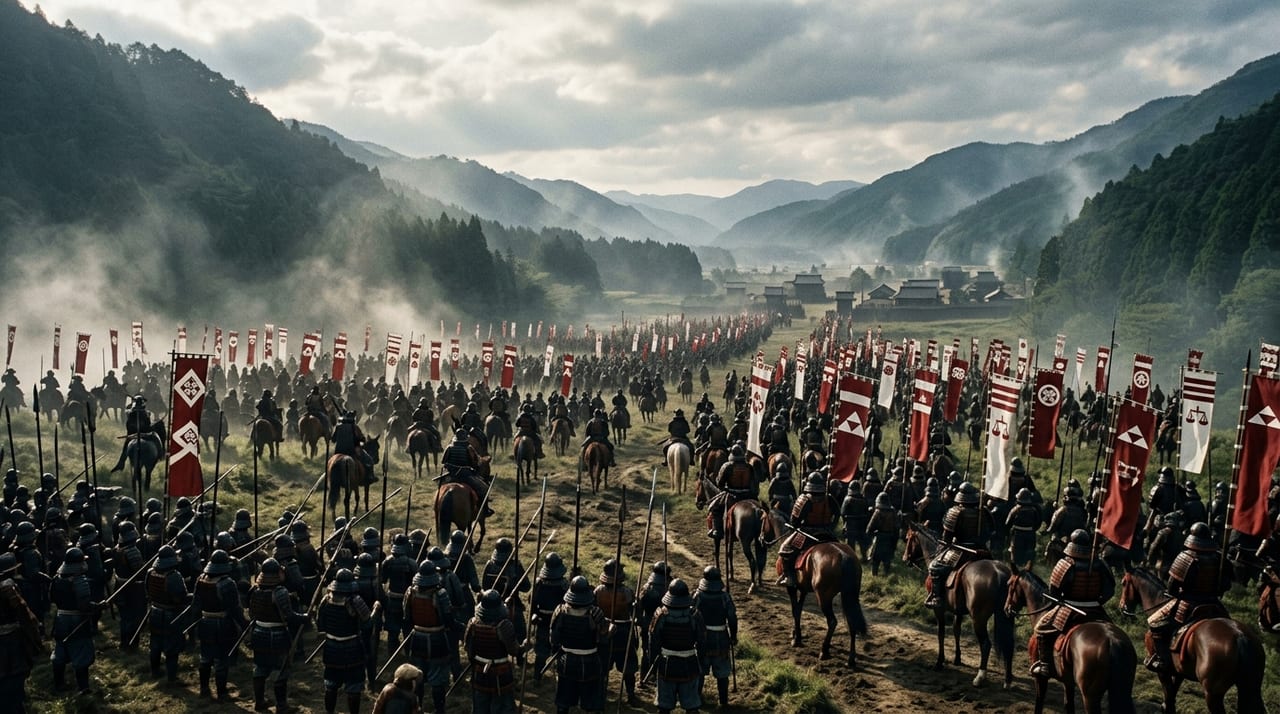
In the 3rd year of Jōkyū (1221), Retired Emperor Go-Toba raised an army to destroy Hōjō Yoshitoki, who held real power in the Kamakura shogunate. However, the shogunate's forces were united by a speech from Hōjō Masako and sent an overwhelming army up to the capital. In little more than a month, the court's forces were annihilated, and Retired Emperor Go-Toba was exiled to Oki. This is the Jōkyū War.
To understand the Jōkyū War, one must grasp Retired Emperor Go-Toba's deep devotion to swords. Retired Emperor Go-Toba (1180–1239) was known as a master of waka poetry, and he was also one of the most remarkable “sword emperors” in Japanese history, going so far as to collect and appraise swords and to personally harden the blade (yaki-ire).
The Retired Emperor is said to have summoned skilled swordsmiths from across the provinces to forge blades and to have hardened the blades himself. This system was called the goban-kaji. Swordsmiths from the provinces set up a monthly rota and served at the Retired Emperor's court, forging the imperial swords. Swords connected with Retired Emperor Go-Toba were called “Go-Toba-in gosaku,” and were handed down to later generations as special works engraved with the chrysanthemum crest.
Some of the Go-Toba-in gosaku known as “Kiku Gosaku” survive today, and several are held as Important Cultural Properties by institutions including the Kyoto National Museum and the Tokugawa Art Museum.
The goban-kaji system established by Retired Emperor Go-Toba holds a groundbreaking significance in the cultural history of Japanese swords.
First, this system gathered outstanding swordsmiths from across the country in one place, providing a venue where they could compete in skill and influence one another. Swordsmiths from Bizen Province and Bitchū Province (both in Okayama) and from Yamashiro Province (Kyoto), among others, took turns serving at the Retired Emperor's court on a monthly rota.
Second, the system institutionalized the “deep connection between the imperial house and swords.” Because emperors and retired emperors themselves “made” swords, swords firmly established their status not merely as weapons but as sacred cultural objects.
Third, the goban-kaji system raised the social standing of swordsmiths. Serving the Retired Emperor's court was the highest honor for a swordsmith, and their works were regarded as “cultural properties” distinct from swords made for the warrior class. In later sword appraisal, Go-Toba-in gosaku and goban-kaji works would receive especially high evaluations.
The direct cause of the Jōkyū War was the political ambition of Retired Emperor Go-Toba, but behind it lay a power struggle between the Retired Emperor's court and the shogunate. For Retired Emperor Go-Toba, swords were not merely a hobby but also a “sword of martial prestige” (bui no katana). Through the goban-kaji system, acquiring the finest swords was also a symbolic display of the Retired Emperor's court's superiority over the warrior class.
However, in actual military strength, the court's forces fell far short of the shogunate. Little more than a month after the uprising, the great army of the Kamakura shogunate pressed on Kyoto, and the forces on the Retired Emperor's side suffered defeat in various regions. Retired Emperor Go-Toba was exiled to Oki (present-day Shimane Prefecture) and died after about eighteen years of exile.
After the war, the shogunate sharply reduced the power of the court and established the Rokuhara Tandai in Kyoto to place the court under its watch. The historic shift toward the establishment of warrior rule was also a turning point at which the “center of gravity of sword culture” moved from the court to the warrior class.
After the Jōkyū War, warrior culture centered on Kamakura flourished. In Kamakura, Sagami Province, a distinctive sword-making tradition known as “Sōshū-den” developed. Standing at its peak is Masamune.
Masamune was a swordsmith of Kamakura, Sagami Province, in the early 14th century, and he left behind many works described as “masterpieces of Japanese swords.” The workings of nie, such as ji-nie, seen in Masamune's blades are considered a major characteristic of the Sōshū-den.
The Jōkyū War was a political event that ended in victory for the warrior government, but the sword culture that flourished before and after it, namely the artistic legacy of the Go-Toba-in gosaku and the technical maturity of Kamakura warrior swords, laid the foundation for the golden age of Japanese swords. The passion of Retired Emperor Go-Toba, who loved swords and personally hardened their blades, is said to have continued even in his place of exile on Oki Island, and his spirit lives on today in the swords he was involved in making.
承久3年(1221年)、後鳥羽上皇は執権北条義時の追討を命じて兵を挙げたが、幕府軍に敗れて隠岐へ流された。乱の後、幕府は京都に六波羅探題を置いた。刀剣の歴史では、上皇が諸国の名工を月番で召したと伝わる「御番鍛冶」と、上皇自ら焼刃を入れたとされる「菊御作」の太刀とともに語られる。
2026-05-01
承久の乱(1221年)は日本刀史の転換点でもある。後鳥羽上皇の刀剣愛護・自ら鍛刀した記録、乱後の名刀接収・奉納、そして備前鍛冶への影響を解説する。
2026-04-20
1232年に制定された御成敗式目は、刀剣そのものの規格や帯刀の作法を直接定めた法典ではない。刃傷・殺害を処罰する条文が、鎌倉武家社会における武力行使をどう間接的に抑えていたのか、罪科規定と吾妻鏡が伝える帯刀慣行の両面から読み解く。
2026-10-02
後鳥羽上皇の御番鍛冶として知られる一文字派の中でも最高峰に位置する菊一文字の特徴、鑑定上の見分け方、現存する代表作の美を徹底解説する。
2026-05-22