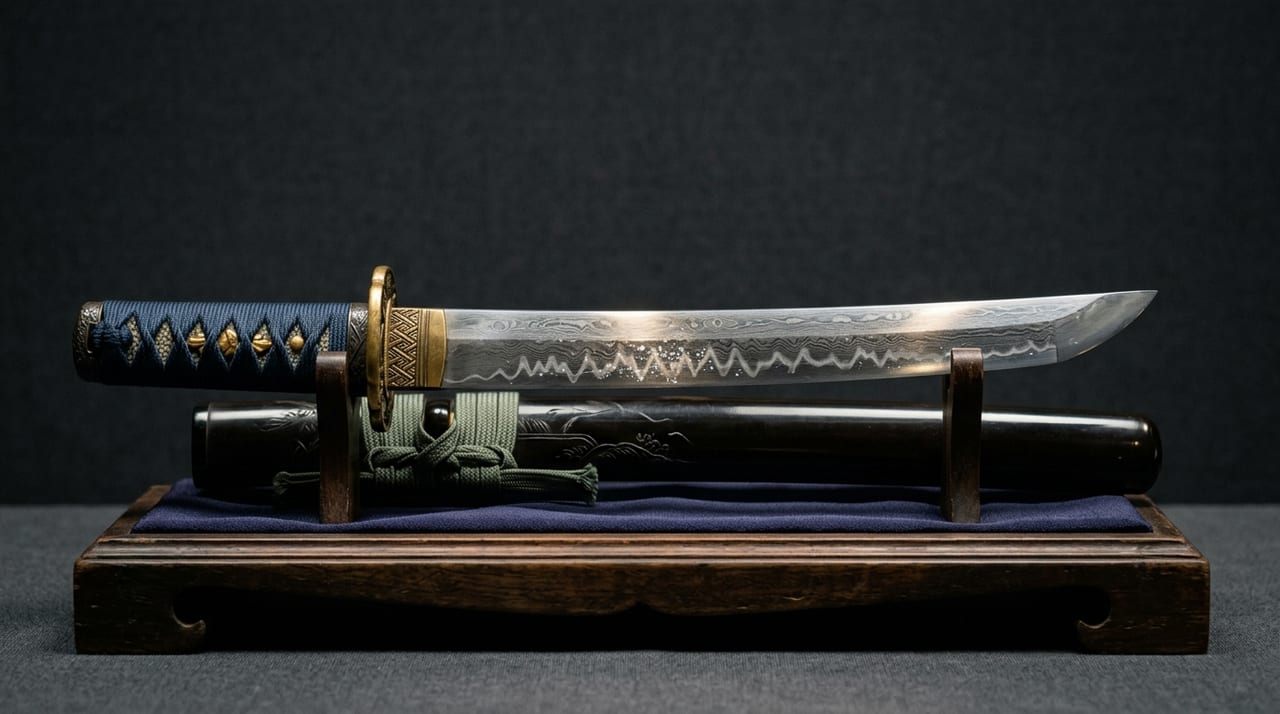
 * Image is for illustrative purposes only.
Kiku-gosaku (Emperor Gotoba's Own Work)
菊御作(後鳥羽上皇御作)
Also known as: Kiku-gosaku — the tachi personally forged by Retired Emperor Gotoba, Kyoto National Museum
Description
Emperor Gotoba (1180–1239), the 82nd emperor of Japan, abdicated in 1198 but continued to rule through cloistered government. Beginning in 1208 or 1209, he established the "Goban-kaji" (御番鍛冶) system, summoning the finest swordsmiths from Bizen, Yamashiro, and Bichū provinces to work in monthly rotations at court. Unusually for an emperor, Gotoba himself took the striker's role in the forging process and is said to have personally performed the quenching. Swords produced this way — known as Kiku-gosaku (菊御作, "chrysanthemum-made") or Gosho-yaki (御所焼き, "palace-quenched") — bore the twelve-petal chrysanthemum crest (kiku-mon) of the Imperial family engraved on their tang (nakago), just below the blade collar.
This tachi is transmitted as a work of Emperor Gotoba himself and is held at the Kyoto National Museum as an Important Cultural Property. The chrysanthemum crest engraved below the habaki (blade collar) is the defining mark of such imperial-forged work. Surviving authenticated examples are exceedingly rare, making this blade an outstanding relic of imperial swordsmanship.
The blade reflects the refined early Kamakura aesthetic: close-grained ko-itame ji-hada with clear utsuri, and a hamon of choji and ko-midare with elegant activity, blending Bizen and Yamashiro influences.
Note on nomenclature: "Kiku-gosaku" and "Kiku-ichimonji" (菊一文字) are frequently conflated. The former refers to blades in which Gotoba himself actively participated in forging; the latter are blades by the senior Goban-kaji smith Norimune, to whom Gotoba granted permission to use the chrysanthemum crest. This confusion dates to medieval records, and the boundary between the two categories remains historically ambiguous.
Following the Jokyu War (1221) in which Gotoba unsuccessfully moved against the Kamakura shogunate and was exiled to Oki Island, his imperial-forged swords continued to be revered by both the warrior and courtier classes. The Goban-kaji institution elevated the social standing of swordsmiths and deepened the bond between court culture and the sword arts — a legacy the Kiku-gosaku preserved at Kyoto National Museum embodies today.
Legends & Stories
Legend holds that on the eve of the Jokyu War (1221), Emperor Gotoba forged swords himself to inspire martial spirit for his uprising against the Kamakura shogunate. In reality, his passion for swordsmanship was as artistic as it was martial, but imperial-forged blades were revered by both the court and warrior class for generations.