 * Image is for illustrative purposes only.
Koshirae and Tōsōgu — The Culture of Sword Fittings
拵・刀装具の発展
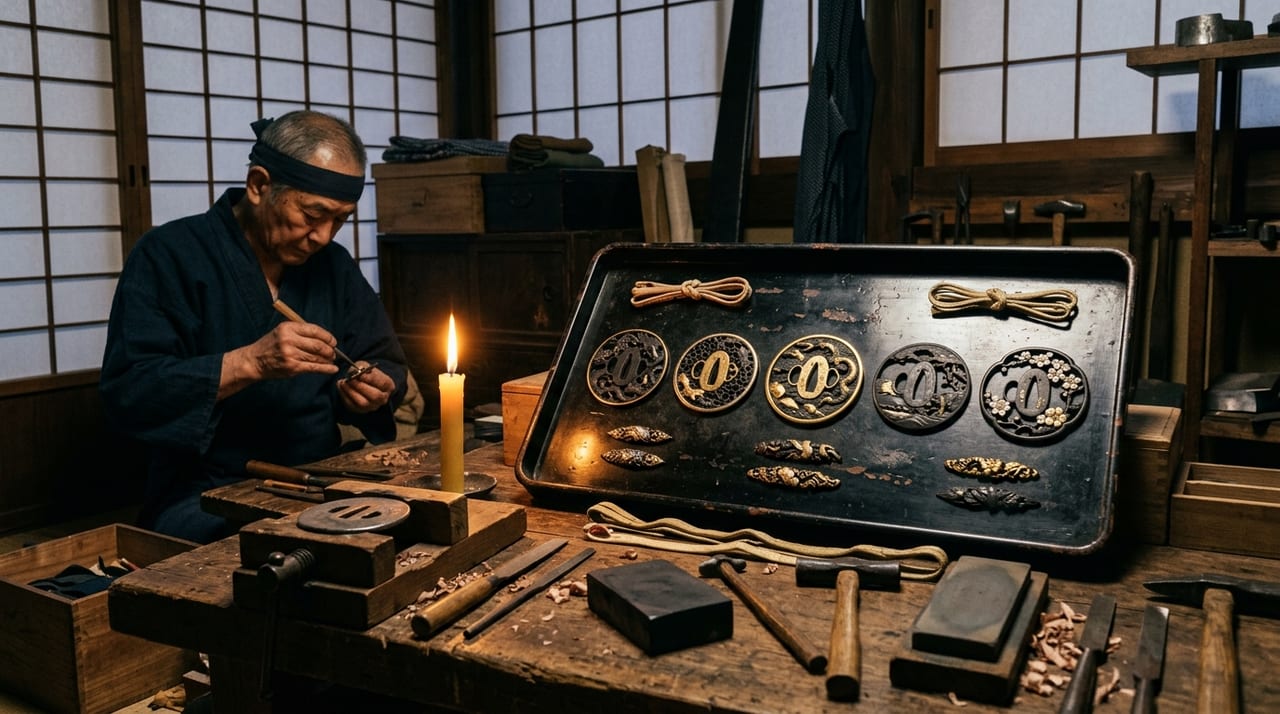
The outer mountings (koshirae) that encase the blade of a Japanese sword, and the various metal fittings (tōsōgu), developed from the Muromachi to the Edo period as a distinct craft genre. Sword guards (tsuba), menuki, and kōgai were raised to the level of art by master craftsmen.
Description
What Is Koshirae?
"Koshirae" refers collectively to the complete set of outer mountings fitted to the blade. It consists of parts such as the tsuka (hilt), tsuba (guard), saya (scabbard), habaki, menuki, kōgai, and kozuka, and each of these had its own specialist craftsmen. Collectively these fittings are also called "tōsōgu" (sword fittings). The blade was the domain of the swordsmith, whereas the individual parts of the koshirae were made by different artisans, including metalworkers, lacquer artisans, and lacquerers, who together formed the sword as an integrated work of craft.
The Development of the Tsuba
The most artistically developed of the koshirae parts is the tsuba, the guard placed between the blade and the hilt. In earlier times, tsuba were mostly simple iron forms. From the Muromachi period onward, however, a variety of materials came into use, including iron, copper, brass, shakudō, and sudō, and advanced techniques such as sukashi-bori (openwork carving), kebori (fine line carving), zōgan (inlay), and nunome-zōgan (cloth-pattern inlay) came to be employed.
In the Edo period, tsuba schools were established in various regions. The Shōami school (Kyoto), the Ishiguro school, and the Gotō school each developed a distinctive style and received commissions from daimyō houses and from wealthy samurai and merchants. The Gotō family, as official metalworkers to the shogunal and daimyō houses, produced the Gotō mitokoromono, the kozuka, kōgai, and menuki, generation after generation.
The Gotō Family and the Mitokoromono
The Gotō family was a family of metalworkers founded in the mid-Muromachi period by its founder, Gotō Yūjō (1440–1512). Over the following seventeen generations it worked as official metalworkers serving the shogun and the daimyō. The hallmark of the Gotō family is a distinctive style based chiefly on shakudō, an alloy of gold and copper with a deep, lacquer-black color. On this surface, plants, animals, and figures from historical episodes are expressed in high-relief gold carving. The Gotō mitokoromono, the set of three pieces consisting of menuki, kōgai, and kozuka, was regarded as the highest standard of sword koshirae in the Edo period.
The Function and Beauty of Menuki, Kōgai, and Kozuka
The menuki originated as a component for securing the nakago inside the tsuka, but in the Edo period it became a purely decorative object and the pinnacle of small-scale sculpture. The kōgai was a tool for grooming the hair and was stored on the outside of the saya. The kozuka was the handle portion of a small kogatana housed in the saya, serving both practical and decorative purposes. These three pieces often shared a unified design as a set, and they were a status symbol that displayed a samurai's taste and wealth.
Koshirae Fashion in the Edo Period and Samurai Culture
In the Edo period, an age of peace, decorative quality came to be valued more than the practical utility of swords, and koshirae production became ever more refined and artistic. Koshirae commissioned by the shogunal and daimyō houses were composed entirely of top-grade craftworks: scabbards decorated with maki-e, tsuka wrapped in pure silk (tsuka-maki), and tsuba by renowned masters. At the same time, simple, practical koshirae for battlefield use, known as jitsuyō-goshirae (practical mountings), continued to be produced alongside them, so that a range of styles suited to different purposes coexisted.
Characteristics of This Era
- Use of shakudo, gold, and copper alloys as primary metalwork materials
- Gotō family mitokoro-mono sets as the highest-prestige fitting format
- Advanced tsuba techniques: sukashi (openwork), zōgan (inlay), taka-bori (relief carving)
- Integration of maki-e lacquer sheaths and silk handle wrapping
- Multiple regional and family schools (Shōami, Ishiguro, Gotō) with distinct styles