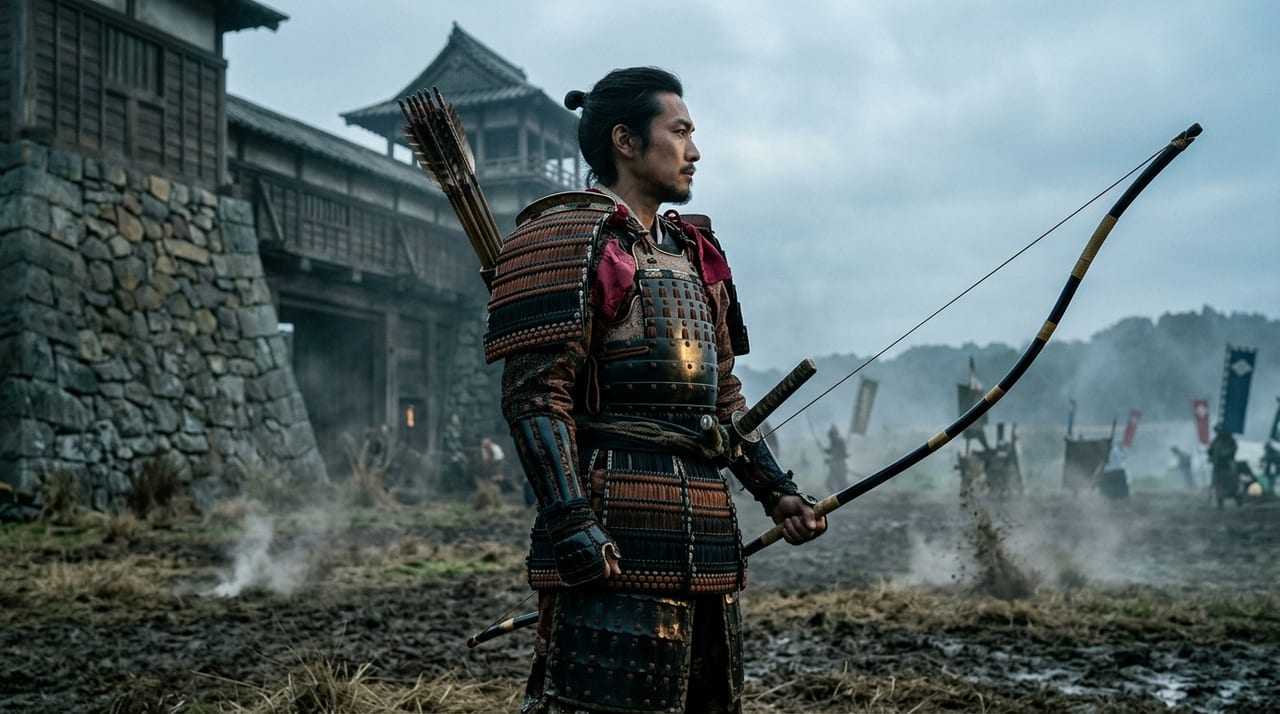
 * Image is for illustrative purposes only.
Minamoto no Tametomo
源為朝
Master Archer of the Hōgen Rebellion
Description
Minamoto no Tametomo (1139-1170) was a fierce warrior representative of the late Heian period, and he left his name in Japanese history as a master of rare archery skill. He was born as the eighth son of Minamoto no Tameyoshi, and from a young age he showed a wild temperament and extraordinary martial prowess. At the age of thirteen, his violence went too far and his father disowned him and exiled him to Kyushu. There he based himself in Bungo, fought repeatedly with the local powerful families of Kyushu, and is said to have taken the name 'Chinzei Hachirō' and subjugated one warrior after another of Kyushu.
Tametomo's height is also said to have been about seven shaku (about 210 cm), and his massive frame and great strength gave him unmatched power in archery. His bow was a strong bow so powerful that ordinary warriors could not draw it, and his arrows were said to have such penetrating power that they could pierce even thick armor. In the Hōgen Rebellion (1156), he sided with Retired Emperor Sutoku, and at the Shirakawa Kitadono palace he fought together with his father Tameyoshi and his brothers against the great army of Emperor Go-Shirakawa's side. At this time, Tametomo repeatedly pushed back the attacks of Taira no Kiyomori and others with his own bow and arrows, and his martial prowess was recognized by both friend and foe.
However, the Hōgen Rebellion ended in victory for Go-Shirakawa's side, and Tametomo was taken prisoner. He was spared because his martial prowess was valued, but to prevent him from drawing a bow, his elbows were dislocated, and he was then sentenced to exile on Izu Ōshima. Yet even at his place of exile, Tametomo recovered his power, and once again claimed supremacy by bringing the warriors of the Izu Islands under his command.
Some ten-odd years after his exile, when the court sent a force to pursue him, Tametomo put up fierce resistance, and in the end he is said to have cut open his own belly and died. His fame as a master of archery has been passed down to later generations, and the legend that his arrows never missed their mark was also taken up as a subject in the Edo-period yomihon 'Chinsetsu Yumiharizuki' (by Takizawa Bakin). In relation to Japanese swords, the 'Hōgen Monogatari' depicts Tametomo in the Hōgen Rebellion as wearing a tachi of three shaku five sun and holding a five-man bow (gonin-bari) as he guarded the gate of the Shirakawa Kitadono palace. His vigorous warrior figure is still passed down today as a symbol of the way of the bow and horse in the late Heian period.
Notable Swords
- Tachi of three shaku five sun (the Hōgen Monogatari depicts him wearing it in the Hōgen Rebellion)