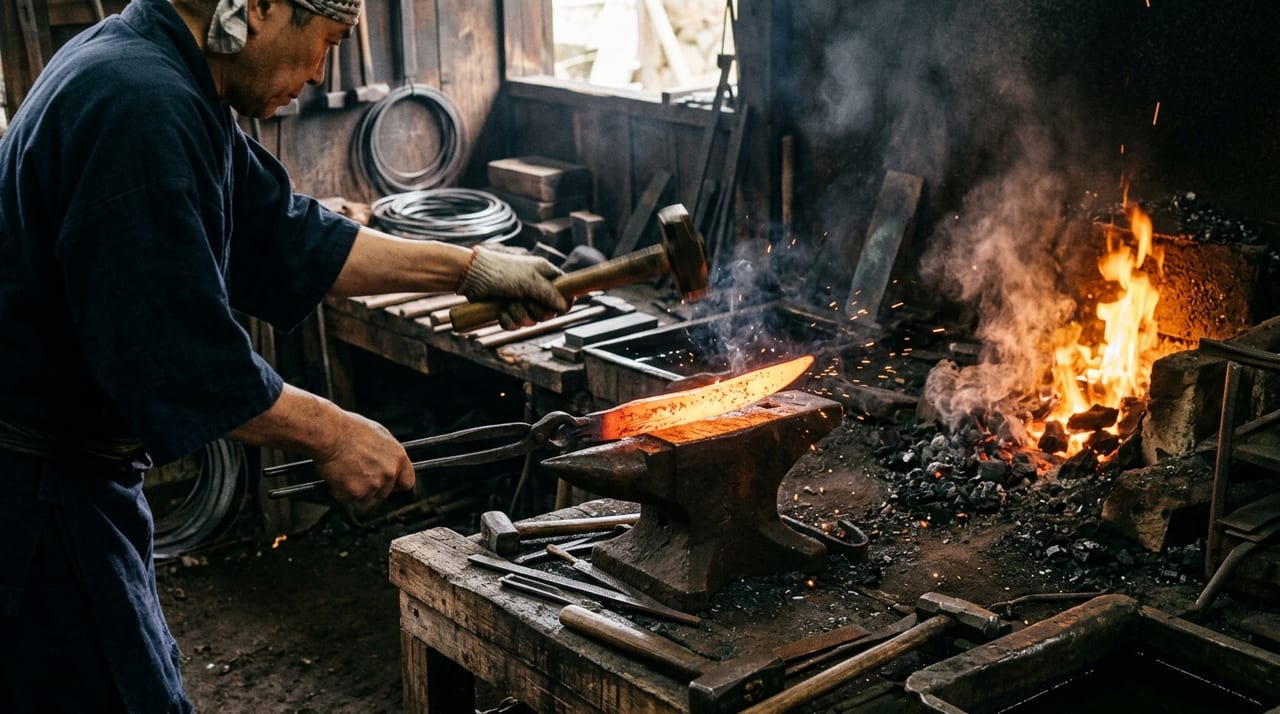
 * Image is for illustrative purposes only.
Naminohira Yukiyasu
波平行安
Description
Naminohira Yukiyasu and the Satsuma Naminohira School
Naminohira Yukiyasu was a leading master smith of the Satsuma Naminohira school, active in Satsuma Province (present-day Kagoshima Prefecture). The first-generation Yukiyasu is said to have been active from the late Heian period into the early Kamakura period, and from then on the name was passed down through successive generations by the main line of the family. His representative work is the signed tachi Sasanuki from the Kamakura period (13th century). Sasanuki is designated an Important Cultural Property and is held by the Kyoto National Museum. The Naminohira school is traditionally said to have begun with swordsmiths who moved from Yamato to Satsuma in the late Heian period. It continued making swords in Satsuma for roughly 900 years, making it the longest-lived school of swordsmith families in Japan. Among the five traditions of Japanese swords (Yamashiro, Yamato, Bizen, Sōshū, and Mino), it is considered to descend from the Yamato tradition. Over the long years, however, it underwent its own regional transformation and developed a style that might be called the "Satsuma tradition."
Yukiyasu is also said to be the de facto founder of the Naminohira school, standing in for the founding ancestor Masakuni, none of whose works can be confirmed to survive. The school was based in Naminohira in Satsuma Province, around Higashi-taniyama in the southern part of present-day Kagoshima City. Satsuma was a remote frontier far from the center, but this geographical isolation paradoxically nurtured a distinctive character. As a result, archaic techniques that had been lost in other regions were preserved and handed down within the Naminohira school.
The Satsuma Development of the Yamato Tradition
Yukiyasu's swords retain the basic characteristics of the Yamato tradition while undergoing their own transformation within the environment of Satsuma. The sugu-ha (straight temper line) and ko-nie (small nie) techniques characteristic of the Yamato tradition are maintained as the foundation in Yukiyasu's work. However, the jigane strongly reflects the properties of Satsuma iron sand, showing a distinctive surface pattern in which a slight admixture of masame (straight grain) appears within the itame-hada (flowing grain). The ji-nie is fine yet dense, the jigane has rich activity, and a sense of shirake tends to appear readily. The jigane of the representative work, Sasanuki, is precisely this forging of itame with masame mixed in.
The hamon is mainly sugu-ha, mixed with ko-gunome and small midare, showing a calm dignity. While it has the serenity characteristic of the Yamato tradition, the way the nie is distributed carries a slightly dry texture unique to Satsuma works, and this is an important criterion when assessing Yukiyasu's pieces. Activity within the blade includes kinsuji and sunagashi, which, though restrained, point to the presence of genuine skill.
Satsuma's Geography and Sword Culture
Although Satsuma Province lay on the remote southern edge of Kyushu, it had long been a region where powerful warrior bands held sway, and demand for swords was consistently high. The Naminohira school served as the local industry that single-handedly met this demand. In Yukiyasu's era it held the spiritual center of swords within Satsuma's warrior culture.
Geographic isolation also meant technical isolation, but at the same time it meant the "high-purity preservation of tradition," unaffected by outside fashions. The archaic sugu-ha seen in Yukiyasu's work can be said to reflect the craftsman's integrity in striving to keep the aesthetic sense inherited since the Kamakura period.
Surviving Works and Their Significance for Research
Few signed works by the early Yukiyasu survive. Among them, the tachi Sasanuki (Important Cultural Property, held by the Kyoto National Museum) is renowned as a representative work that conveys the first-generation Yukiyasu's skill to the present day. Some swords attributed to Yukiyasu are also said to have been dedicated to or held by shrines and temples in Satsuma, and they serve as cultural testimony to the relationship between regional faith and swords. These are basic source materials for the history of Satsuma swords and the study of the Naminohira school.
Toukenza and Naminohira Yukiyasu
The significance of Toukenza featuring Naminohira Yukiyasu lies in shedding light on the diversity of Japanese swords from the axis of "region." The swords of the Naminohira school developed in a context different from the central five traditions. They show that Japanese swords are not the product of a uniform "central culture," but a collection of diverse cultural practices formed in dialogue with the natural and human environments of each region. Yukiyasu's serene sugu-ha and Sasanuki, which stands at its summit, can also be said to be a self-portrait of Satsuma's warrior culture, which, though on the frontier, continued to maintain a high spiritual character.
Who Was Naminohira Yukiyasu?
Naminohira Yukiyasu was a leading master smith of the Satsuma Naminohira school, active in Satsuma Province (present-day Kagoshima Prefecture). He is regarded as the de facto founder of the Naminohira school, standing in for the founding ancestor Masakuni, whose swords do not survive. The name "Yukiyasu" was not confined to a single person. It was passed down through successive generations by the main line of the Naminohira school until the early Meiji period. Accordingly, "Naminohira Yukiyasu" is both the name of an individual and a name that refers to the lineage of swordsmiths representing Satsuma itself. His representative work is the signed tachi Sasanuki from the Kamakura period (13th century) (Important Cultural Property, held by the Kyoto National Museum).
What Kind of School Was the Naminohira School?
The Naminohira school (Naminohira ichimon) is a group of swordsmiths in Satsuma Province, traditionally said to have begun with smiths who moved from Yamato Province to Satsuma in the late Heian period. According to legend, the move took place around the Eien era (987–989). The school is known as the longest-lived school of swordsmiths in Japan, having continued making swords without interruption in the same Satsuma region for roughly 700 to 900 years thereafter. Besides Yukiyasu, the school includes many swordsmiths who shared the "yuki" or "yasu" element in their names, such as Ieyasu, Yasutsugu, Yasuyuki, and Yasuyo. Among the Five Traditions, it is considered to descend from the Yamato tradition. But in the climate of Satsuma, far from the center, it preserved and passed down archaic sugu-ha and fostered a regional character that might be called the "Satsuma tradition." It is precisely this long continuity and regional distinctiveness that make the Naminohira school the foremost representative among provincial swordsmiths.
Where Can Naminohira Yukiyasu's Swords Be Seen Today?
Naminohira Yukiyasu's representative work, Sasanuki, is an Important Cultural Property held by the Kyoto National Museum. In addition, works by later Yukiyasu are transmitted in various places. The Tokyo National Museum holds a tachi from Ansei 6 (1859) signed as the 63rd-generation descendant of Masakuni (正国六十三代孫波平住大和介平行安), as well as a tanto from Meiji 3 (1870). Individual works are not always on permanent display, so if you wish to view the actual pieces, it is advisable to check the exhibition information of each holding institution. The swords of Naminohira Yukiyasu, which developed in a context different from the central Five Traditions, show us that the beauty of Japanese swords is not the product of a uniform "central culture." Rather, it is a collection of diverse practices nurtured in dialogue with the climate of each region.
Famous Works
- Tachi, signed Naminohira Yukiyasu (named Sasanuki; Important Cultural Property; Kyoto National Museum)