Sasanuki and the Naminohira School — Satsuma's Important Cultural Property Tachi and a Nine-Century Sword Lineage at Japan's Southern Edge
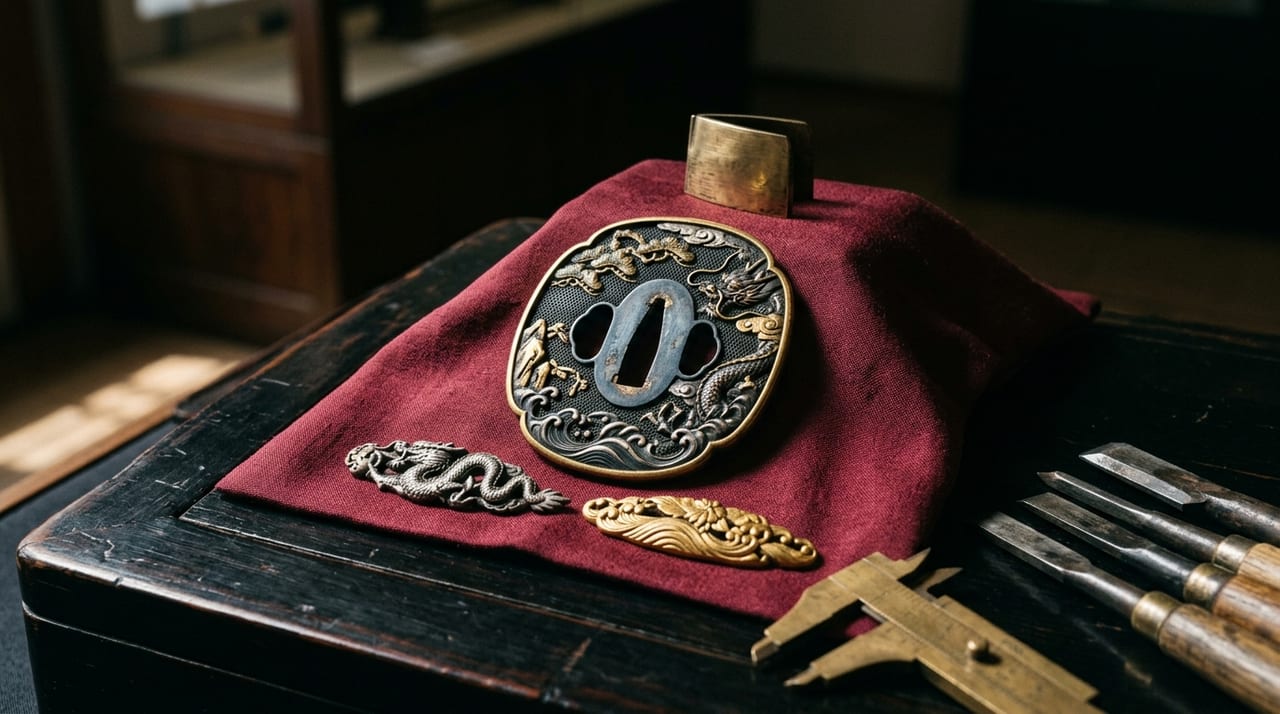 * Image is for illustrative purposes only.
Table of Contents
Sasanuki
Sasanuki is a tachi said to be made by Naminohira Yukiyasu, a swordsmith from Satsuma in the Kamakura period (13th century). The blade bears an inscription "Naminohira Yukiyasu," and it is highly valued as one of the few signed works from the early Yukiyasu period. A celebrated sword transmitted in Satsuma since ancient times, it has been known by the name "Sasanuki." It is currently held by the Kyoto National Museum (Higashiyama Ward, Kyoto City) and was designated as a National Important Cultural Property in 1972 (Showa 47).
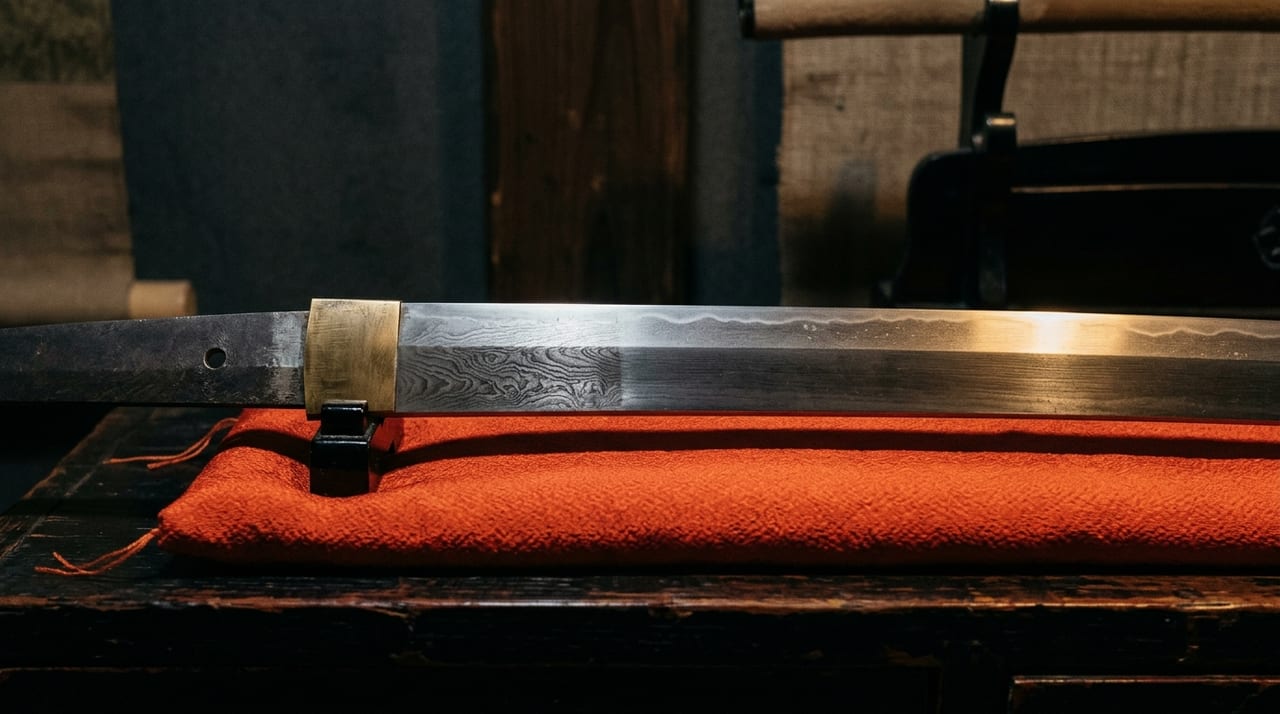
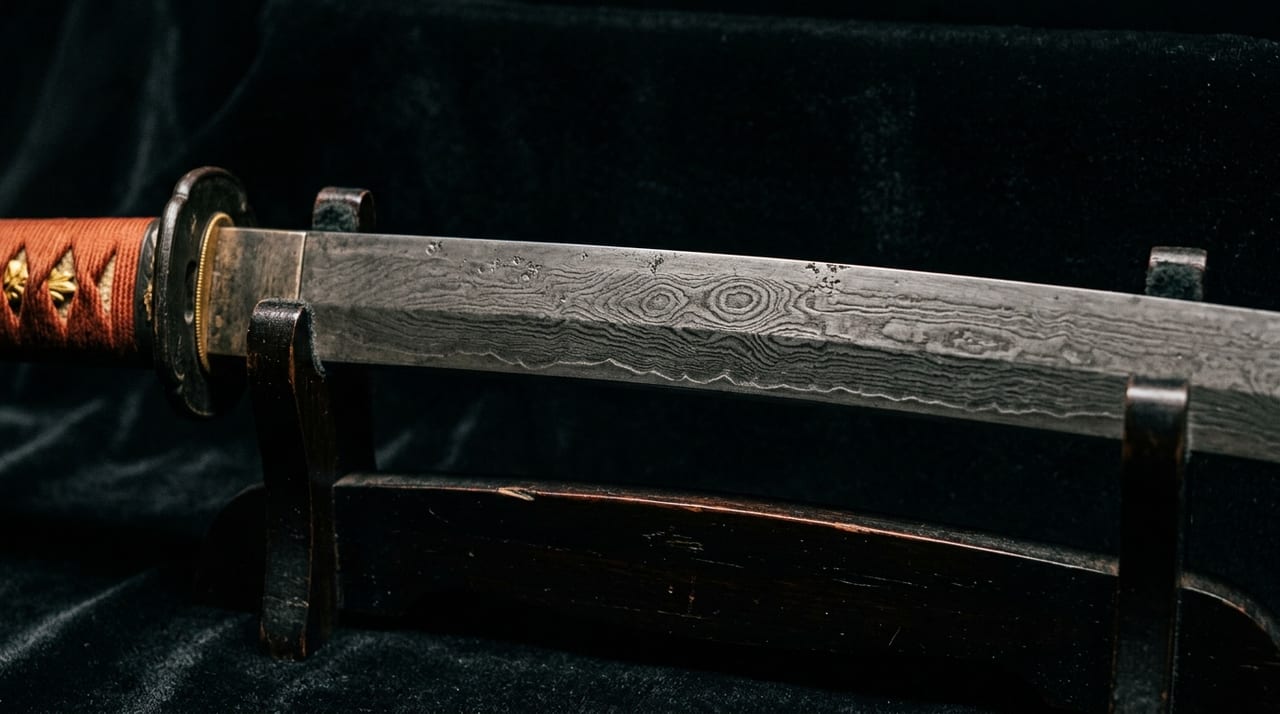
The blade length is approximately 72.5 cm, and the curve is approximately 2.3 cm. The curve is deep throughout, and the kissaki takes a short, compact, powerful form called an ikubi-kissaki. The jihada consists of itame with masame interspersed, and fine jinie is present. The hamon is a calm suguha, which well demonstrates that the Naminohira school to which the creator Naminohira Yukiyasu belonged followed the Yamato tradition. Although it is a kotou nurtured in Satsuma, at the southern end of Japan, it is a blade that richly embodies the classical aesthetics of Yamato. Let us first examine the appearance of this blade itself.
The Form and Style of Sasanuki—Reading the Ikubi-kissaki, Suguha, and Jinie
The construction of Sasanuki is stately with broad blade width, to which is added a deep curve. The short, compact ikubi-kissaki is a form seen in powerful tachi of the Kamakura period, and it is known as a characteristic that often accompanies practical military tachi designed with actual combat in mind. When held, it can be said to be a tachi that evokes reliability rather than elegance.
The jihada has masame flowing through itame skin, with fine, thick jinie present. The color of the iron has a slight blackish tint, showing a calm, austere texture characteristic of Satsuma-tō, which uses iron sand from southern Kyushu. The hamon is based on a tightly-formed suguha, with small irregularities and workings interspersed here and there. It lacks flamboyance, but the ji and ha are both sound and of high quality. This is the essence of the Naminohira school = Yamato tradition-lineage Satsuma swords, and it contrasts with other schools.
| School | Hamon Characteristics |
|---|---|
| Naminohira school (Yamato tradition-lineage, Satsuma) | Tightly-formed suguha, serene and straightforward |
| Bizen tradition | Choji-midare, bright and elegant |
| Soshu tradition | Nie-deki, intense |
Sasanuki well demonstrates that a regional sword school maintained dignity comparable to the great central schools.
The boushi curves in a ko-maru shape, further enhancing the impression of a well-balanced kissaki overall. The nakago has retained its form without significant polishing, and the fact that the inscription "Naminohira Yukiyasu" can be directly confirmed is also academically important. The style of the inscription is powerful yet orderly, displaying typical characteristics of Kamakura period smith signatures.
The degree of soundness as a tachi is also high, and the fact that it retains the inscription "Naminohira Yukiyasu" on its nakago without significant polishing is also valuable. Among the few surviving Satsuma swords with signatures from the Kamakura period, Sasanuki also possesses value as a benchmark work that reliably transmits the output of the first generation (Ko-Naminohira) Yukiyasu. What particularly distinguishes Sasanuki among the many Satsuma swords is that it combines both the provenance of a meibotsu with a name, and the academic reliability of a signed work.
The Origin of the Name "Sasanuki"
The name "Sasanuki" is connected to a legend surrounding its maker, Naminohira Yukiyasu. While Yukiyasu was about to forge a sword with all his might, he strictly forbade his wife from looking into the forge, but she broke the taboo and peeked inside. Distracted, Yukiyasu mistakenly believed the sword to be a failure and threw it into a bamboo thicket. However, thereafter, strange lights began to emanate from the bamboo thicket night after night. When people, puzzled by this, retrieved the sword, they found that countless bamboo leaves that had fallen and accumulated on the ground had been pierced by the kissaki—it is said that the name "Sasanuki" comes from this tale of the sword piercing bamboo leaves.
The paradoxical phrase—a sharpness so keen as to pierce thin, soft bamboo leaves without bending them—symbolizes the cutting power of this tachi and the spiritual power said to dwell within it. While there is also a simpler explanation that the name derives from the blade's sharpness in piercing bamboo, all explanations share the common point of "piercing bamboo leaves." In speaking of the mysterious power dwelling in the sword itself rather than tales of valor in cutting down men, the reverence that the people of Satsuma held for the finest swords shines through.
Current Ownership and Provenance—From the Kabayama Family to the Kyoto National Museum
Sasanuki is known as a tachi that was transmitted through the Kabayama family, a prominent retainer house of the Shimazu clan of Satsuma. According to tradition, this celebrated sword was at one time presented to the main Shimazu house, but due to continued strange occurrences in the residence, it was returned to the Kabayama family. Thereafter, Sasanuki was carefully preserved as a treasure of the Kabayama family and has survived to the present day along with its black lacquered tachi mounting made in the early Muromachi period. It is said that the fittings of the mounting bear the Shimazu family crest of a cross within a circle.
In the modern era, Sasanuki was designated as a National Important Cultural Property in 1972 (Showa 47). It is now owned by the Independent Administrative Institution National Institute for Cultural Heritage and is held and preserved by the Kyoto National Museum. A blade born in Satsuma and protected by Satsuma warriors is now on display and studied at the Kyoto National Museum as a page in the history of Japanese swords. The very fact that a tachi born from a regional sword school far removed from the central five schools is treated as a national cultural property speaks eloquently of the high quality of Naminohira school swordmaking.
The Significance of National Important Cultural Property Designation and Public Display at the Kyoto National Museum
The significance of Sasanuki's designation as a National Important Cultural Property in 1972 (Showa 47) goes beyond merely conferring a title on an "old sword." The designation criteria for National Important Cultural Properties under Japan's Cultural Properties Protection Law is "something of particular historical or artistic importance to our country," and in the case of Sasanuki, the four conditions—"Kamakura period, Satsuma, signed, Naminohira Yukiyasu"—are all present, and its academic value as a benchmark work indispensable for understanding the style of the early Naminohira school was recognized.
The Kyoto National Museum (Kyohaku) is one of Japan's premier institutions for Japanese sword collections, and Sasanuki holds a special place among them. It is normally kept in strict preservation in the storehouse, but opportunities for public display arise through special exhibitions held multiple times per year and through the "Gallery of Masterworks." When on display, the angle of lighting is carefully arranged so that the masame flowing through itame, the fineness of jinie, and the tightness of the suguha's nioi-guchi are displayed to their best advantage. In recent years, this display has drawn attention as a venue where young visitors who learned of Sasanuki's name through the Touken Ranbu game can experience a dialogue between historical reality and fictional creation when confronted with the actual blade.
The Naminohira School and Naminohira Yukiyasu—From Yamato to Satsuma
The Naminohira school, which produced Sasanuki, was a group of swordsmiths based in Satsuma (present-day Kagoshima Prefecture) and occupies a strikingly unique position in Japanese sword history. This is because they maintained their own tradition for a long time in southern Kyushu, far removed from the central locations of the five schools—the major sword-producing regions of Kyoto (Yamashiro), Yamato, Bizen, Soshu, and Mino.
The founder of the Naminohira school is said to be Masakuni, who is said to have migrated from Yamato (present-day Nara Prefecture) to Satsuma. However, no signed works by Masakuni are known to survive, and in fact Yukiyasu, who is said to be his son, is treated as the de facto founder of the school. The period of migration is said to be the late Heian period (around the 10th to 11th centuries), but the exact time is uncertain. The school settled in Naminohira, Satsuma (near present-day Higashi-taniyama in the southern part of Kagoshima City) and took this place name as the name of the school.
The name "Naminohira Yukiyasu" was subsequently passed down and used in succession by the legitimate line. This means the school continued to support Satsuma's sword culture for some 900 years, from the late Heian period to the early Meiji era. There is no other example of a single school lasting so long in the history of Japanese swords, and the Naminohira school is often spoken of as "the longest-lived swordsmith lineage in Japan." The creator of Sasanuki, Yukiyasu, is positioned early in this long lineage, and Sasanuki itself is a representative work that transmits to the present day the high skill of the first generation (Ko-Naminohira).
The Style of the Naminohira School—The Yamato Tradition Rooted in Satsuma
Although the Naminohira school's blades are not counted among the five schools, their style clearly follows the Yamato tradition. This is consistent with the tradition that the founder came from Yamato, and the school shares many characteristics with Yamato blades: a quiet hamon based on suguha, jihada with flowing masame, and a dignified old-fashioned tachi form with deep waist curve. Sasanuki's suguha and jihada with interspersed masame are indeed in this lineage.
On the other hand, the environment of southern Kyushu and the iron sand obtained there gave the Naminohira school its own distinctive character. The jihada has a slight blackish tone with a shira-ke appearance, and the nie-tsugi shows a dry texture characteristic of Satsuma-tō. This style, which shunned ostentation and valued integrity and strength, later came to be often described as "Satsuma rusticity" and was discussed in terms of the spirit of Satsuma samurai. The fact that it was a peripheral region removed from central trends ironically resulted in the preservation of the old style with high purity. It is worth noting that the magnificent Satsuma shinshintōs of the late Edo period, which fascinated many, trace their distant source to the koto tradition that the Naminohira school had cultivated since the Heian period.
Touken Ranbu and Sasanuki—The Kamakura Memory Illuminated by the Game
In the browser game "Touken Ranbu -ONLINE-" (commonly known as "Tōrabu"), which began distribution in 2015, numerous characters are personifications of historical Japanese swords. Among them, a character named "sasanuki" appears, and the historical sword that inspired it, "Sasanuki (made by Naminohira Yukiyasu, National Important Cultural Property, held by the Kyoto National Museum)," became widely known.
Due to the influence of this game, it is reported that younger generations and women who had previously had little familiarity with swords came to learn about the real Sasanuki and the Naminohira school, resulting in increased inquiries and visits to the Kyoto National Museum. While the game character is ultimately a fictional creation and must be distinguished as separate from the historical sword, this phenomenon is noteworthy in the history of Japanese sword culture dissemination as an example of how popular culture can kindle interest in classical art. The fact that the historical Sasanuki came to be understood in the context of "a Kamakura-period Satsuma signed work by Naminohira Yukiyasu and National Important Cultural Property" is meaningful in broadening the social support base for sword culture.
Evaluation as a Satsuma Sword and Its Market and Acquisition
Naminohira school blades are an indispensable part of any discussion of Satsuma swords. When people think of Satsuma swords, many imagine the magnificent shinshintōs used in slashing matches during the late Edo period, but their source lies in the koto tradition that the Naminohira school cultivated from the late Heian period onward. Signed works by the early Naminohira school, such as Sasanuki, are extremely rare, seldom appear on the market, and when they do, they are highly valued as important research materials.
On the other hand, works by later swordsmiths who took the name "Naminohira Yukiyasu" from the Edo period onward survive in greater numbers and circulate as Satsuma swords that collectors can actually handle. Even with the same "Yukiyasu" signature, the period, style, and valuation differ greatly between the first generation (Ko-Naminohira) and later versions, so when acquiring one, it is essential to verify the date of creation (which generation of Yukiyasu) and the kiwame (attribution/appraisal). One should rely on appraisal certificates from the Japanese Art Sword Preservation Society (NBTHK) and similar sources to determine the period, quality, and authenticity of the signature.
Naminohira school blades enjoy steady popularity among collectors who prefer integrity and soundness over flashiness, with their unique appeal lying in the experience of classical Yamato beauty within the Satsuma setting. It is worth noting that the Satsuma clan in the late Edo period employed many swordsmiths and forged numerous magnificent swords to support the practical use of the Jigen-ryu style. As a result, most Satsuma swords seen on the market are from the shinto or shinshinoto periods. It is important to note that, despite both being from Satsuma, koto-period Naminohira works and the magnificent Satsuma pieces from the late Edo period differ significantly in period, style, and price range. Signed works from the early Naminohira school, such as Sasanuki, even if they are tantos or wakizashis, become major news when discovered, and those with reliable provenance become rare objects of desire for museums, researchers, and collectors.
We hope that through celebrated swords of National Important Cultural Property status such as Sasanuki, you may come to know the techniques of the early Naminohira school and touch the profound world of Satsuma swords that flows from it.
Related Articles: Sword Smiths of the Kyushu Satsuma Tradition | How to Appreciate Hamon | Jihada: Understanding and Appreciation