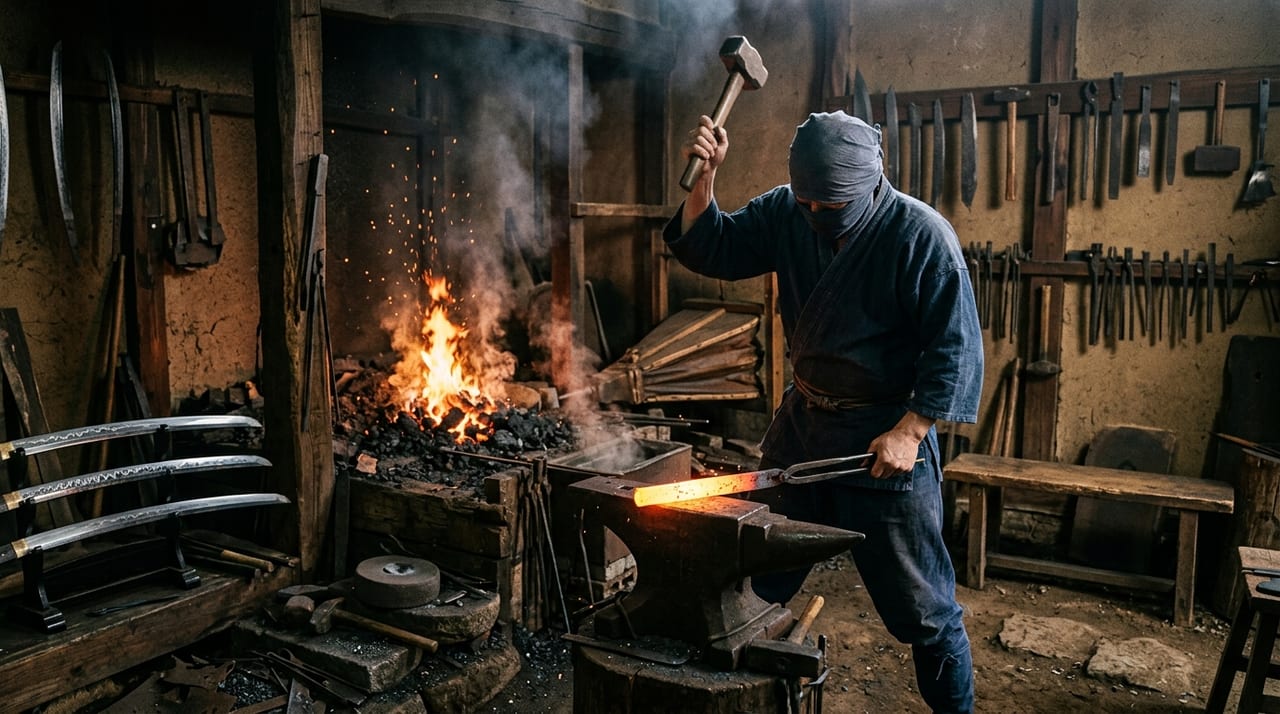
 * Image is for illustrative purposes only.
Ko-Bizen Nobufusa
古備前信房
Description
Ko-Bizen Nobufusa was a swordsmith who worked in Bizen Province (present-day Okayama Prefecture) during the Late Heian Period and is known as one of the master craftsmen who supported the Ko-Bizen school during its formative period. The Ko-Bizen school was a group of swordsmiths centered around Tomonari, Masatsune, Houhei, Takahira, and Nobufusa who established the foundations of sword-making in Bizen from the Mid- to Late Heian Period, and became the source tradition for later schools such as the Bizen Osafune, Yoshioka Ichimonji, and Fukuoka Ichimonji schools.
Nobufusa's blades embody the distinctive characteristics of the Ko-Bizen school, possessing both powerful and archaic elegance. The jigane features a flowing o-itame grain structure with coarse ji-nie, showing characteristics typical of the Late Heian Period, along with the distinctive steel color and rich chikei common to the Ko-Bizen school. This rough forging texture is the product of primitive iron-making using iron sand and charcoal from the Sanyo region of the time, possessing a wild beauty fundamentally different from the refined jigane of later Bizen tradition blades. The hamon is mainly a gentle suguha pattern mixed with small ko-choji and small ko-midare, with large conspicuous nie along the blade edge, and kinsuji and sunagashi naturally appearing in the blade body, embodying the simple beauty characteristic of the Late Heian Period.
Ko-Bizen school swordsmiths all adopted the slender tachi form with pronounced koshizori as their basic design, typical of the Late Heian Period. Nobufusa's signed blades also display the typical proportions of this era—slender shinogizukuri with deep curve at the hilt and small ko-kissaki—and are highly regarded as works in which the aesthetic sensibility of Late Heian nobility and warrior culture crystallized in blade form.
Nobufusa's signed blades are rare, and among most Heian Period swords which are unsigned or have uncertain provenance, examples with a confirmed "Nobufusa" signature are of particular value. Extant examples include those designated as Important Cultural Properties and Important Art Objects, and are housed in the Tokyo National Museum, Kyoto National Museum, and collections of historic residences throughout Japan. As a member of the Ko-Bizen school, Nobufusa's blades continue to be important historical sources documenting the earliest period of Japanese sword-making.
Famous Works
- 太刀 銘 信房(重要文化財)
- 太刀 銘 信房(重要美術品)
- 太刀 無銘 伝古備前信房(重要刀剣)