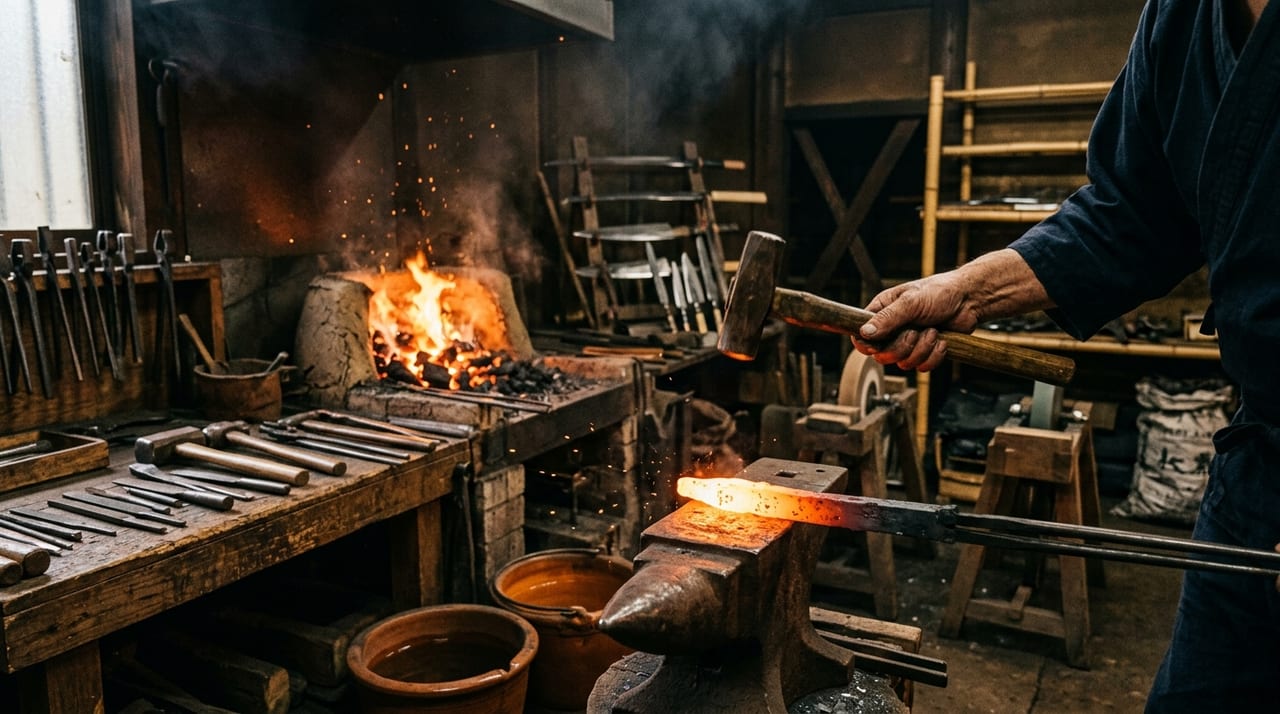
 * Image is for illustrative purposes only.
Muramasa
村正
Description
Muramasa refers to a school of swordsmiths active from the late Muromachi period through the early Edo period, based in Kuwana in Ise Province (present-day Kuwana City, Mie Prefecture), as well as to their works. The oldest extant signed work dates back to around the Bunki through Eishō eras (early sixteenth century), and the first-generation Muramasa is thought to have been active roughly during the Bunki through Tenbun eras (ca. 1501–1555). Muramasa was not a single renowned master but a group of craftsmen who inherited the same name; it is said to have continued across six or more generations, including the second and third, and to have survived until around the Kanbun era of the Edo period. The school was also known as Senko Muramasa and the Senko school, prefixing the name with "Senko." The first generation is traditionally said to have come from Mino Province, and because his style shows affinity with Seki-mono, it is believed that a swordsmith deeply connected with the Mino tradition moved to Kuwana and founded a household.
The school's style is characterized by a foundation in the Mino tradition, which flourished in the late Muromachi period, while being strongly influenced by the neighboring Sōshū tradition. The jigane is itame-hada, and many show a whitish core. The hamon includes hako-midare, gunome, and notare patterns. The greatest point of interest is that the hamon on the front and back align well and appear at the same position, which is popularly called the "Muramasa hamon" (or "Senko hamon"). The nakago has a distinctive form that narrows sharply toward the nakago-jiri (tang end); this is likened to the belly of the tanago, a freshwater fish, and is called "tanago-bara-gata" (tanago-belly form). Besides the signature "Muramasa," examples are known where the place of residence is added, such as "Seishū Kuwana-jū Muramasa." A tachi in the collection of Kuwana Sōsha (Kasuga Shrine) bears the signature "Seishū Kuwana-gun Masuda-shō Fujiwara Asomi Muramasa saku," one of the longest signatures among extant Muramasa blades. The fact that there are more examples of wakizashi and tantō than tachi also reflects the school's tendency, mirroring practical use in the Sengoku period.
Among well-known transmitted works, first are the two Muramasa tachi transmitted by Kuwana Sōsha (Kasuga Shrine). Bearing a date of Tenbun 12 (1543), they were each dedicated to Kuwana Shrine and Nakatomi Shrine, and in Heisei 28 (2016) were designated as Mie Prefecture-designated Tangible Cultural Properties. The "Katana, Signature Muramasa" at the Tokugawa Art Museum is a single blade that was passed, as part of Tokugawa Ieyasu's estate known as the Sunpu Owakemono, to his ninth son Tokugawa Yoshinao, and was transmitted within the Owari Tokugawa house. Unusually for a Muramasa, it displays a hitatsura hamon, in which the temper covers the entire blade surface. Among the "demon sword" legends associated with the Tokugawa family, the kernel closest to historical fact is the incident in which Ieyasu's grandfather Matsudaira Kiyoyasu was cut down by a Muramasa blade wielded by a retainer of the Abe clan, which is recorded in the Mikawa Monogatari (completed around Kan'ei 3). The anecdote that his father Hirotada was wounded by a Muramasa blade first appears in the Matsudaira-ki, whose author is unknown. By contrast, the account that Ieyasu himself despised Muramasa blades and ordered them discarded appears only in transmissions after the Ochibo-shū (Kyōho 13), lacks evidence, and contradicts the fact that Ieyasu himself kept Muramasa blades and passed them on to the Owari Tokugawa house. The rumors of the demon sword became widely known in Edo by the late eighteenth century through forged works such as the Mikawa Go-fudoki, which was produced after the Shōhō era, and during the late Edo and Meiji periods the theme was also taken up by Kabuki.
Looking at later evaluations, in terms of artistic ranking Muramasa lacks works designated as National Treasures or Important Cultural Properties, and its highest designation remains Important Art Object. This reflects the fact that the school's works were wazamono, cutting tools made for practical use rather than aesthetic appreciation. On the other hand, its reputation for cutting ability was high, and Sengoku warlords prized it as a practical blade. However, it is said that the name Muramasa was omitted from the wazamono rankings in the Kaihō Kenshaku and Kokon Kaji Bikō, compiled from test-cutting results by the Yamada family in the late Edo period, presumably out of deference to the Tokugawa house. Paradoxically, the negative fame of being a demon sword raised its renown; from the late Edo period onward Muramasa gained popularity, copies were actively made, and the name Muramasa remains widely known today as a byword for practical swords.
Famous Works
- Katana, signed Muramasa (Tokugawa Art Museum; Owari Tokugawa family provenance)