Distinctive Nakago Forms: How Kiji-mata-gata, Funa-zoko-gata, and Tanago-hara-gata Reveal Era and School
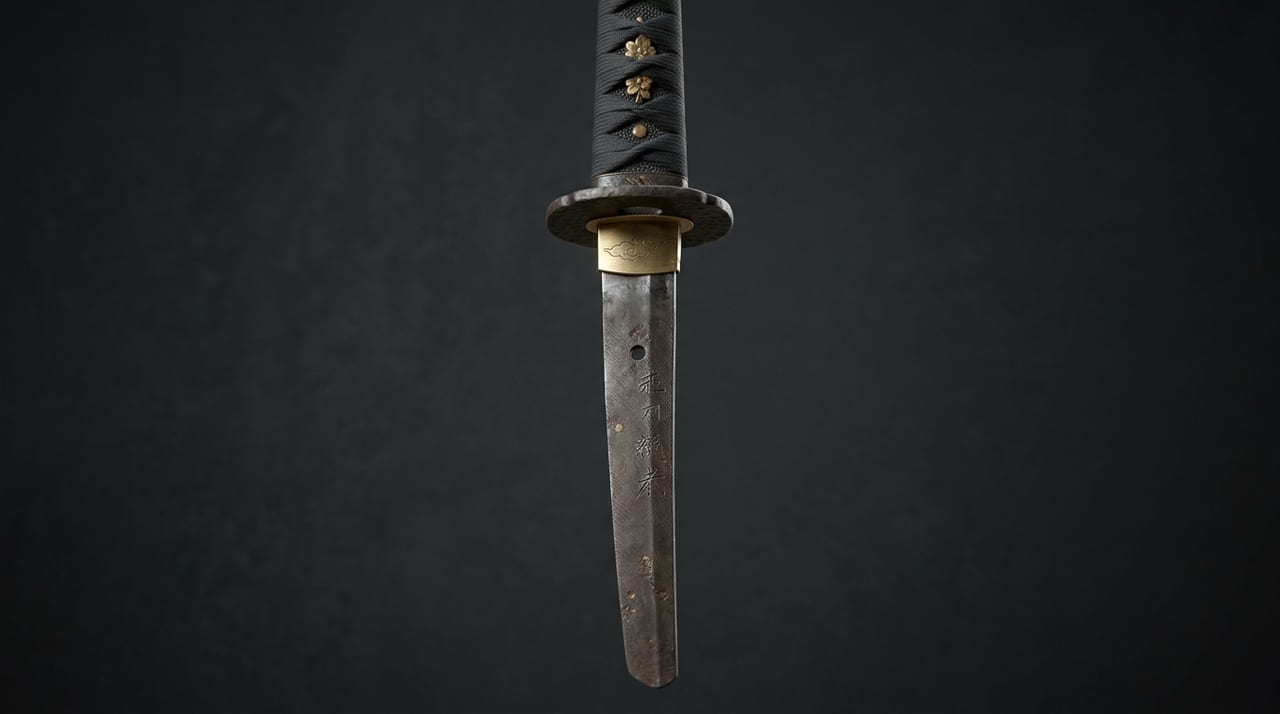 * Image is for illustrative purposes only.
Table of Contents
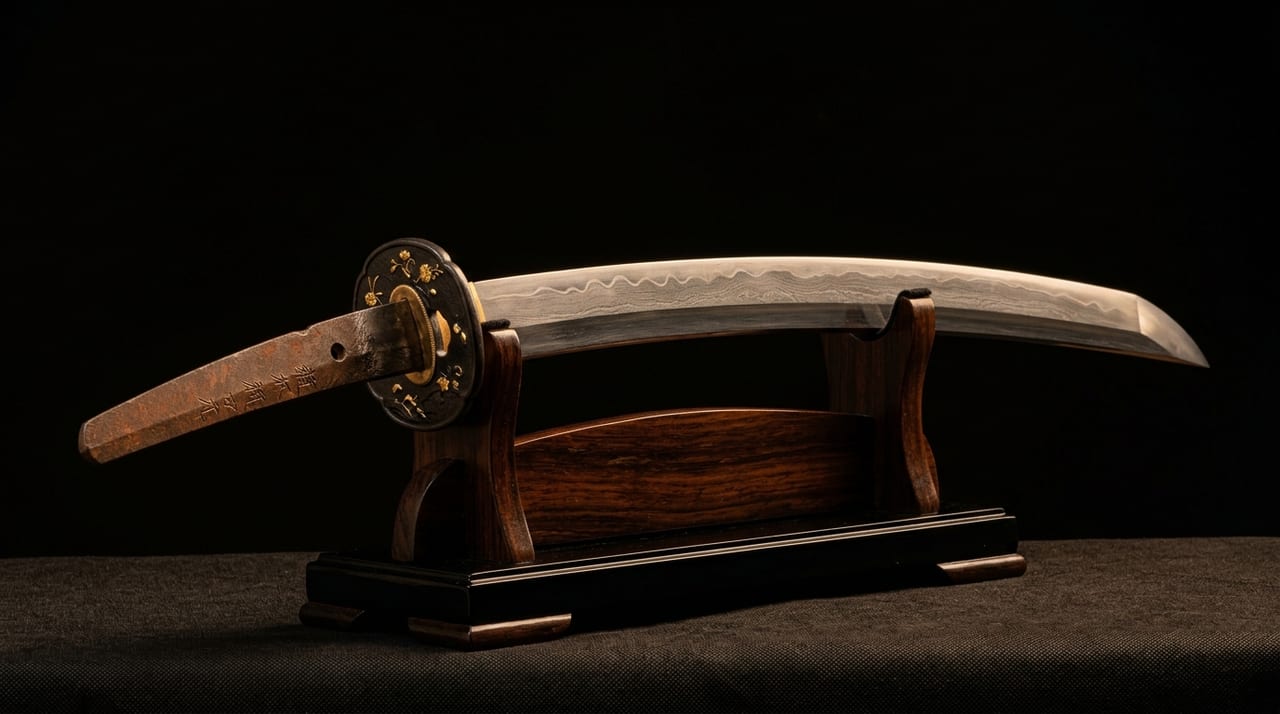
The nakago of Japanese swords typically has a straightforward contour that gradually narrows toward the tip. However, there are also nakago with distinctive contours that clearly differ from the norm. The kijimomogata, funazokogata, and tanago-haragata are representative examples of such special forms, and with practice in observing the blade's appearance, they become clues for considering the era and school of origin.
| Nakago Form | Contour Characteristics | Era/School Tendencies |
|---|---|---|
| kijimomogata | Width suddenly narrows at a certain point | Tachi from the Heian to Kamakura periods |
| funazokogata | The ha-side is broad, with a contour resembling the view of a boat's bottom | Soshu Masamune and his school from the late Kamakura period (sōden nakago) |
| tanago-haragata | The ha-side is broad in the upper half and narrows in the lower half | Muramasa and his school from the Muromachi period, Heianjō Nagayoshi and the Shimohara school |
| furisode-gata | Curves in a way that bends backward toward the ha-side | Tanto from the Kamakura period |
The Significance of Focusing on the Nakago Contour
The nakago is a part of the blade's extension that the sword smith forges and shapes in the final stage. Normally, both the ha-side and mune-side gradually narrow in width from the ha-moto toward the nakago-saki. However, by altering this narrowing or broadening pattern, a distinctive contour emerges. Since the nakago contour strongly reflects the sword smith's hand habits and school traditions, when viewed together with the signature and yasuri-me, it becomes material for considering the lineage of a work.
Kijimomogata
Kijimomogata is said to be a form of nakago frequently seen on tachi from the Heian to Kamakura periods. While normally the width gradually narrows from the ha-moto to the nakago-saki, kijimomogata shows a sudden narrowing at a certain point. Its contour is named from its resemblance to the thighs of a pheasant. As a form characteristic of older tachi, it serves as one benchmark for assessing the age of a blade.
Funazokogata
Funazokogata is a nakago with a broad ha-side, with a contour that resembles viewing the bottom of a boat. It is said to be a characteristic found on works by Soshu Masamune and his school from the late Kamakura period, and is sometimes called "sōden nakago." It is one of the useful nakago forms to consider when studying the lineage of work known as the Soshu tradition. Note that determining a specific blade requires the signature and comprehensive appraisal; here we confine ourselves to positioning it as a school tendency.
Tanago-haragata
Tanago-haragata is a nakago with a contour reminiscent of the belly of a tanago fish. The ha-side is broad in the upper half of the nakago and narrows in the lower half. It is said to be common among works by Muramasa and his school from the Muromachi period, and is also seen in works by Heianjō Nagayoshi and the Shimohara school. The distinctive broadening in the upper half and narrowing in the lower half becomes the key to identification.
Furisode-gata—A Special Form for Tanto
Another special form worth remembering is furisode-gata. The nakago curves in a way that bends backward toward the ha-side, displaying a contour reminiscent of the sleeves of a furisode kimono. It is said to be a form found on tanto from the Kamakura period, and the gentle curve of the modest nakago resonates with the overall softness of the tanto's appearance. Knowing that tanto nakago also have unique forms, alongside the special forms of tachi and uchi-gatana, broadens the scope of observation.
Suriage: The Greatest Pitfall
One factor that absolutely cannot be overlooked when examining nakago form is the issue of suriage. Suriage refers to shortening a long blade by cutting and reducing the tang side, and refinishing the nakago. A suriage nakago has already lost the contour of its original state. In other words, if one cannot distinguish whether the nakago form now visible is "ubu" (original, as made) or a later refinishing, applying classifications like kijimomogata or funazokogata loses all meaning. Determining whether a nakago is ubu or suriage based on factors such as the number and position of mekugi-ana, the remaining signature, and the pattern of the yasuri-me is the first step in observation.
Combining with Other Observations of the Nakago
The nakago contains information beyond its contour.
- Yasuri-me are file marks applied to the surface of the nakago, with customs specific to each school such as katte-sagari, suji-chigai, and hinoki-gaki
- The shape of the nakago-jiri—such as kuri-jiri, ken-gata, and ichimonji—similarly serve as clues
- The patina color of the nakago reflects the passage of time, with older works showing deep, settled patina
Since the patina of the nakago is an important observation that tells of the era, the cardinal principle of sword handling is never to remove the patina. When considering acquisition, one should confirm whether clear photographs of the nakago are displayed and cross-check the number of mekugi-ana and the presence or absence of a signature with the description.
Tips for Viewing the Nakago in Photographs
When examining Japanese swords online, the nakago must be observed through photographs. Since the broadening and narrowing of the contour will appear distorted unless photographed from directly above, one should first confirm whether a frontal overall view is provided. While sudden narrowing such as kijimomogata is relatively easy to discern in photographs, the subtle broadening of funazokogata or tanago-haragata can be exaggerated or disappear under lighting shadows. If a particular work of interest is found, it is best to confirm details such as images from different angles and nakago dimensions with the seller.
Principles of Observation and Judgment
These special nakago forms are most easily understood by viewing them from the perspective of "how they differ from normal, straightforward narrowing." One should focus on the contour changes: whether the width suddenly narrows (kijimomogata), the ha-side is broad like a boat's bottom (funazokogata), or the upper half swells (tanago-haragata).
However, nakago form alone cannot definitively establish the maker or date. Evaluating and appraising works based on the signature, yasuri-me, mekugi-ana, jigane, and hamon—combined with other observations—is the fundamental approach. It is precisely in the nakago, a part usually hidden from view, that information quietly telling of a work's lineage is engraved.