Osoraku-zukuri — The Tantō Blade Geometry Where the Yokote Drops and the Kissaki Becomes Large, and Sunshu Sukemune
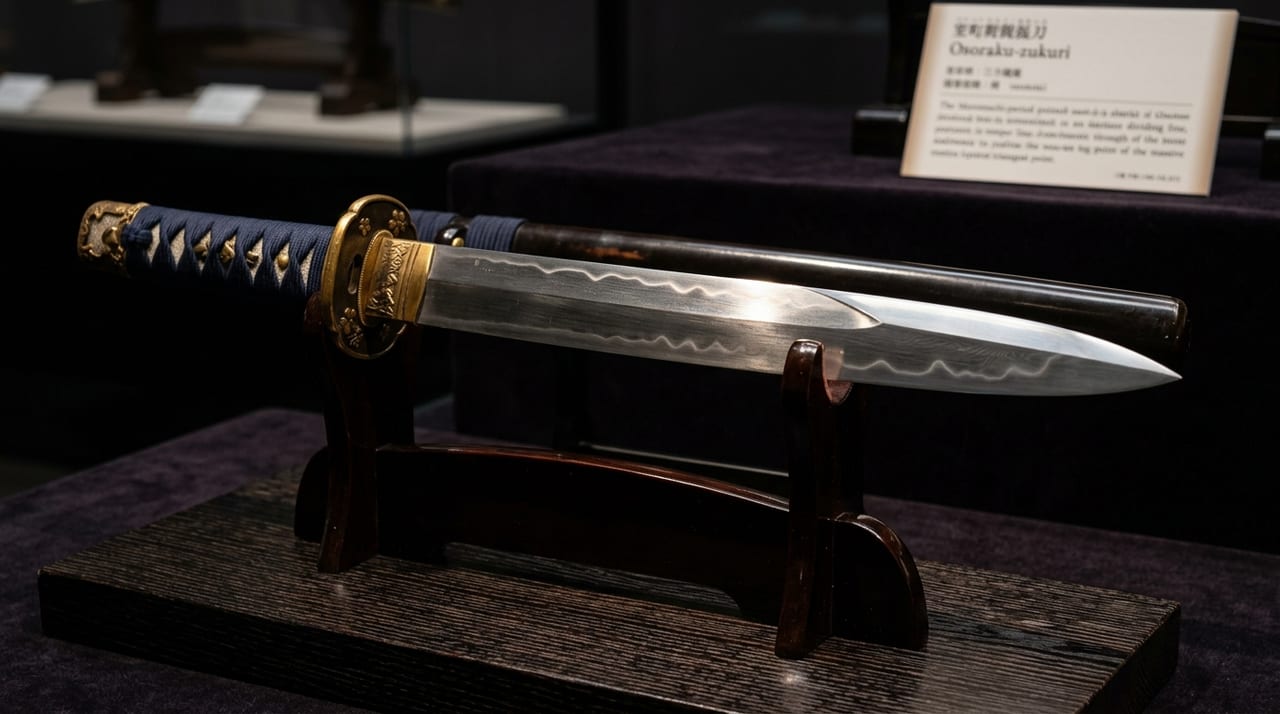 * Image is for illustrative purposes only.
Table of Contents
Among the blade geometries of Japanese swords, there are rare examples whose names trace back to a single blade. Osoraku-zukuri is one such geometry, known for its distinctive appearance — found rarely on tantō and wakizashi — in which the kissaki extends to an extreme length.
The Form of Osoraku-zukuri
The defining characteristic of osoraku-zukuri is the markedly low position of the yokote. On an ordinary blade, the yokote is drawn at the very base of the kissaki, beyond which a small bōshi is formed. In osoraku-zukuri, however, the yokote drops to near the center of the blade or even toward the hamachi, with the result that the kissaki appears to extend so greatly that it occupies nearly half the blade.
This can be described as an even more extreme form of the ōkissaki (large kissaki). Despite being a tantō, the blade takes on a tense appearance in which a sharp triangle at the tip dominates most of the blade. It is a geometry strongly conceived for thrusting, and it conveys a visually piercing impression.
Sunshu Sukemune, Said to Be the Origin of the Name
The name osoraku-zukuri is said to derive from a tantō by Sukemune, a tōkō of Sunshu (Suruga Province, present-day central Shizuoka Prefecture) during the Muromachi period. It is said that because the mei on this tantō with this geometry read "osoraku," the term became established as the name for the geometry. "Osoraku" is written with the character for "fearful" (osoreru), said to express a terrifying sharpness, but there are various interpretations of the mei, and a definitive conclusion should be avoided.
In any case, the fact that a specific work and its mei became the name of the geometry itself makes this an interesting example of the naming culture of Japanese swords. For questions of provenance and designated status, one should rely on verified sources; here it is introduced only in terms of the connection between the geometry's name and its form.
Yokote and Bōshi — A Terminology Guide for Observation
It is helpful to understand the terminology around the kissaki in order to appreciate osoraku-zukuri. The yokote is the line separating the kissaki from the blade below it; on a shinogi-zukuri blade it appears as a ridge running straight across. The bōshi refers to the hamon fired in the kissaki area and is a feature given great weight as the conclusion of hamon appreciation.
On an ordinary blade, the area beyond the yokote is only a very small region. In osoraku-zukuri, however, because the yokote drops far toward the handle, the area corresponding to the bōshi extends to nearly half the blade. This geometry can thus be restated as "the geometry in which the bōshi becomes the main character." Being able to appreciate, across a large canvas, the activities of the yakiba spread over a wide surface — such as midarekomi and the depth of the kaeri — is an experience found in no other blade geometry.
Points of Appreciation on Tantō and Wakizashi
Osoraku-zukuri is exceedingly rare and a geometry with few opportunities to be seen. The essential point of observation comes down to confirming where the yokote is drawn. If the yokote is located not at the base but considerably lower on the blade and the kissaki appears unusually long, the possibility of osoraku-zukuri is high.
On the greatly extended kissaki, a correspondingly wide bōshi — the hamon in the kissaki — appears. Being able to appreciate the activities of the bōshi and the kaeri across a large surface is a pleasure unique to this geometry.
Its Place Among Variant Blade Geometries
Among the variants of blade geometry seen on tantō, the following are known.
- Kanmuriotoshi-zukuri and unokubi-zukuri, in which the material on the mune side is cut away
- Moroha-zukuri, in which a cutting edge is also applied to the mune side at the tip
Whereas these are devices that alter the cross-section or the treatment of the mune, osoraku-zukuri has its own uniqueness in that it transforms the entire silhouette by moving the "dividing line" of the yokote's position.
Viewing them side by side, one can clearly see how extraordinarily diverse the designs that tōkō attempted within the same basic form of the tantō. Variant blade geometries are a domain where practical demands and the playful inventiveness of form-making intersect.
Checkpoints When Verifying from Images
When verifying whether a blade is osoraku-zukuri from images, it is good to proceed in the following order.
- First, look at the position of the yokote relative to the entire blade. If the yokote is at the midpoint of the blade or even closer to the handle, this matches the characteristics of this geometry.
- Next, observe the bōshi area and trace what activities can be seen within the wide yakiba.
- Finally, cross-reference against the nakago and mei information and the content of any kanteisho to confirm there are no contradictions with the item description.
With these in mind, one can make a composed judgment even when encountering the geometry for the first time.
The Relationship Between Togi and Silhouette
For blade geometries featuring a yokote, the skill of correctly reestablishing the yokote during togi greatly affects the impression of the silhouette. In a geometry like osoraku-zukuri, where the yokote divides a large bōshi, the quality of the togi is even more directly tied to the points of appreciation. If the line of the yokote is slack, or if the finish of the bōshi surface is uneven, the distinctive silhouette will not come to life. When viewing or purchasing, one should pay attention not only to the geometry itself but also to the condition of the togi that sets it off.
Understanding the Diversity of Blade Geometries
An extreme variant such as osoraku-zukuri speaks to how remarkably diverse the blade geometries of the Japanese sword were. Built upon the basic forms of shinogi-zukuri and hira-zukuri, a wide variety of silhouettes were created from practical requirements, design intentions, and the ideas of individual tōkō. Knowing the name of each blade geometry is nothing other than expanding one's vocabulary for reading the form of a sword.
This site lists swords offered for sale together with images in an online catalogue. It can be used as a starting point for comparing the varying length of kissaki and differences in blade geometry through images.