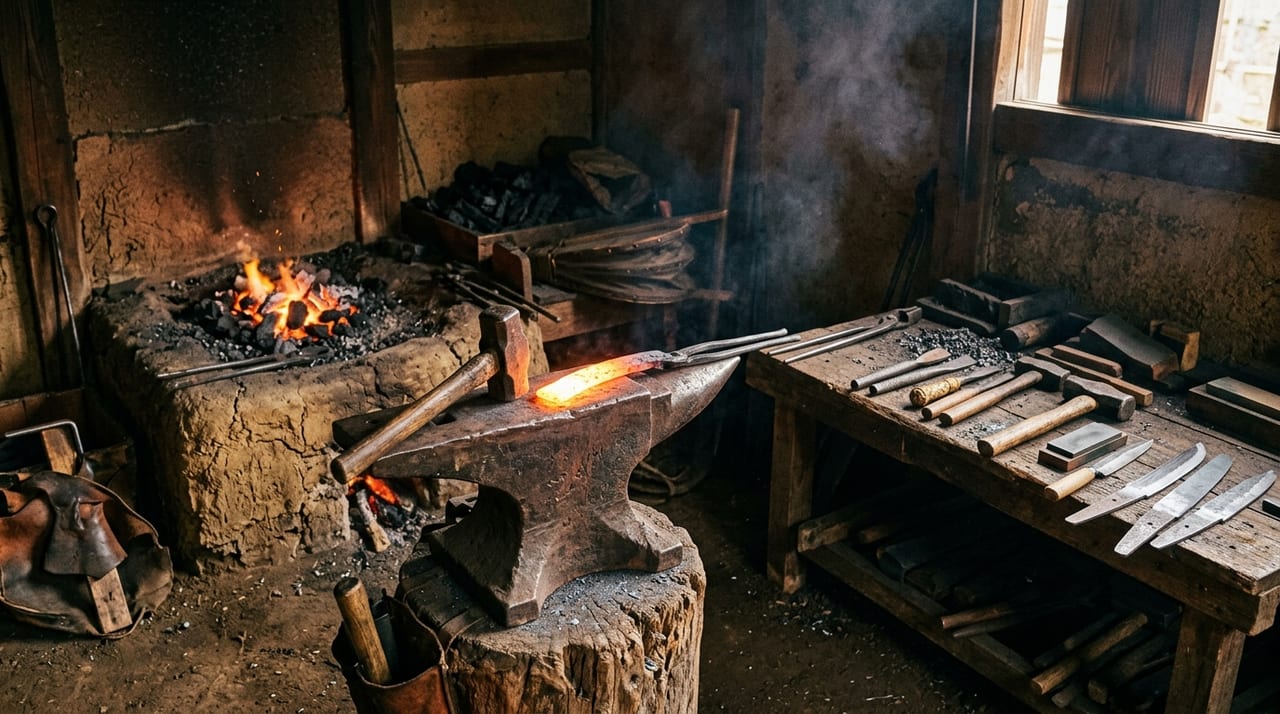
 * Image is for illustrative purposes only.
Osafune Morimitsu
長船盛光
Description
Historical Background of the Ōei Bizen Period and Osafune Morimitsu's Position
The Ōei era (1394–1427) of the early Muromachi period was a turning point for sword production by the Bizen Osafune school. While inheriting the glorious traditions of the Kamakura Bizen smiths Mitsutada, Nagamitsu, Kagemitsu, Sanenaga and others, it also explored new styles that responded to changing times. The Bizen Osafune smiths of this era are collectively called "Ōei Bizen." Among its representative smiths, Morimitsu and Yasumitsu are recorded in sword history as the twin pillars.
Osafune Morimitsu is highly regarded as the foremost smith of Ōei Bizen, a smith who represents the era, and this assessment remains unshaken in modern sword appraisal. Morimitsu is said to have been the son of Moromitsu, and he went by the title Shuri-no-suke.
Morimitsu's Style and Technical Characteristics
Morimitsu's swords display a style representative of Ōei Bizen while also possessing outstanding technical qualities as an individual. The jigane is itame with mokume mixed in, and it has the orthodox Bizen-den hallmark of clearly visible ji-utsuri. Morimitsu's ji-utsuri are mostly linear and are described as bō-utsuri, which gives the entire blade a distinctive dignity.
As for the hamon, many show midare-ba in which gunome, chōji and ko-midare are mixed, and many are nioi-deki. Morimitsu's midare-ba has height variation in its individual patterns and possesses the rare quality of a composition rich in dynamic change while maintaining overall balance.
Of particular note is the brightness of the blade edge. Morimitsu's hamon has a bright, lucid nioiguchi, and when the light source is changed, various changes of light can be seen within the blade. This sae is the greatest point of appreciation in Morimitsu's works, and it is the focal point expert appraisers use when first identifying a Morimitsu work.
The bōshi often turns midare-komi and then becomes ko-maru-gaeri, and there are examples where the bōshi shape differs subtly between the omote and ura sides. Many nakago are inscribed with the long signature "Bishū Osafune Morimitsu," and examples bearing an era name also survive. These signature styles serve as important material for dating in later research.
Comparison of Morimitsu and Yasumitsu
Morimitsu and Yasumitsu (Osafune Yasumitsu) are commonly named together as the twin pillars of Ōei Bizen. They worked in the same Osafune during the same period yet showed different styles. Generally, Morimitsu is characterized by the refinement of the jigane and the brightness and sae of the hamon, while Yasumitsu is said to be characterized by the orderly regularity of gunome and overall stability. Which is superior is a matter of preference, and in evaluations of cutting performance, both are counted among the Ō-wazamono.
Morimitsu's Representative Works and Holdings
Morimitsu's works have been transmitted to art museums and museums across various regions. The Tokyo National Museum holds a tachi signed "Bishū Osafune Morimitsu" that bears the date Ōei 23 (1416). In addition, Morimitsu tachi with ubu-nakago that have been handed down through former daimyo families and shrines are especially prized. Their form retains the legacy of the Kamakura period while showing Muromachi-era change, and it is evaluated as demonstrating the artistic achievement of Ōei Bizen.
Osafune Morimitsu at TOUKENZA
At TOUKENZA, Morimitsu is presented as the supreme smith standing at the turning point where the brilliant tradition of the Bizen Osafune school was carried across from the glory of Kamakura to the new era of Muromachi. His overwhelming technical level, and the name inscribed as the byword of Ōei Bizen, continue to shine eternally in the history of Japanese swords.
Famous Works
- Tachi signed Bishū Osafune Morimitsu, dated Ōei 23, 8th month (Tokyo National Museum)