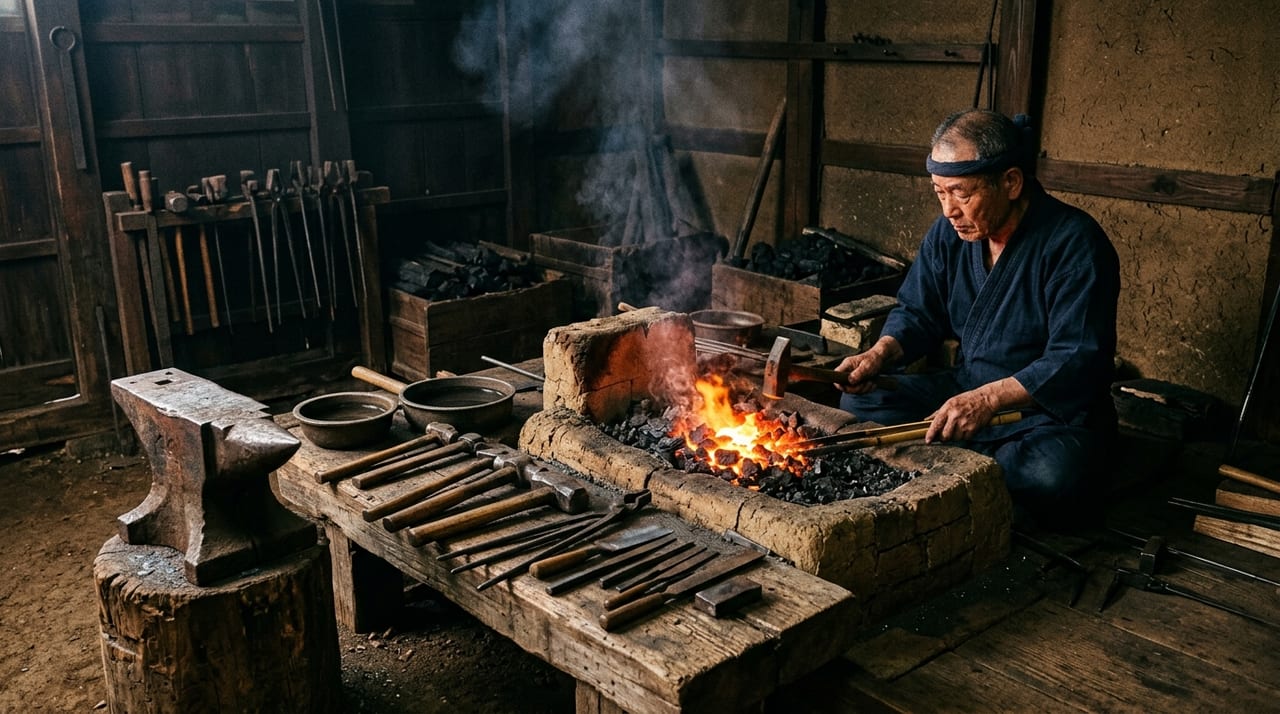
 * Image is for illustrative purposes only.
Aoe Tametsugu
青江為次
Description
Aoe Tametsugu was a swordsmith who was active from the late Heian to the early Kamakura period, based in Aoe in Bitchū Province (present-day Kurashiki City, Okayama Prefecture). He is remembered in the history of Japanese swords as the celebrated smith behind ‘Kitsunegasaki Tametsugu,’ a leading representative of Ko-Aoe. The Aoe school is a lineage of smiths, including Moritsugu, Tametsugu, Sadatsugu, Tsunetsugu, and Suketsugu, whose members share the character tsugu (次) in their names. It flourished from the late Heian period through the Nanbokuchō period as the representative group of smiths of Bitchū Province.
Style — sumi-hada and chirimen-hada
A feature of the Aoe school as a whole is a distinctive appearance in the jigane called sumi-hada. It consists of dark, color-shifting patches, called jifu, appearing within the clear blue jigane, and it is regarded as the highlight of this school. Tametsugu’s ‘Kitsunegasaki’ has a finely packed ko-itame jigane with a slightly raised grain, the so-called chirimen-hada, with thick jinie and prominent midare-utsuri. The hamon of Ko-Aoe are often suguha-chō or ko-midare mixed with ko-chōji. ‘Kitsunegasaki’ is ko-midare with dense ashi and yō, and its bōshi is nie-kuzure. The overall form is a tachi with high koshi-zori and a sturdy stance, and ‘Kitsunegasaki’ also has pronounced sori in the ubu nakago.
Representative work: ‘Kitsunegasaki’
Tametsugu’s best-known representative work is the National Treasure ‘Tachi, mei Tametsugu’ (gō: Kitsunegasaki; held by the Kikkawa Historical Museum). It is said to be the sword that Kikkawa Tomokane carried when, during the Kajiwara Kagetoki Incident in Shōji 2 (1200), he struck down the Kajiwara Kagetoki faction at Kitsunegasaki in Suruga Province. The blade was passed down through the Kikkawa family from then on. The existence of this single blade is a solid clue that Tametsugu was a smith active from the late Heian to the early Kamakura period, roughly from the late 12th to the first half of the 13th century.
The rise and decline of the Aoe school and Tametsugu’s place
The Aoe school arose in the provincial region of Bitchū. From the late Heian through the Kamakura period, it boasted a high level of craftsmanship that rivaled Ko-Bizen and Awataguchi, but it died out after the Muromachi period. Tametsugu, who carried the school through its formative period, is known for a style with especially archaic dignity within the school. He is regarded as one of the Ko-Aoe craftsmen who laid the foundation for the Aoe school, which later continued into Naka-Aoe and Sue-Aoe.
Evaluation
Within the rare lineage of Bitchū-den smiths that is the Aoe school, Tametsugu is a representative of Ko-Aoe and attracts high attention from sword enthusiasts and researchers. The signed work ‘Kitsunegasaki’ is designated a National Treasure.
Famous Works
- Tachi signed Tametsugu (National Treasure, named Kitsunegasaki, Kikkawa Historical Museum collection)