Osafune Nagamitsu: The Late-Kamakura Master Swordsmith of Bizen Who Made the Daihannya Nagamitsu
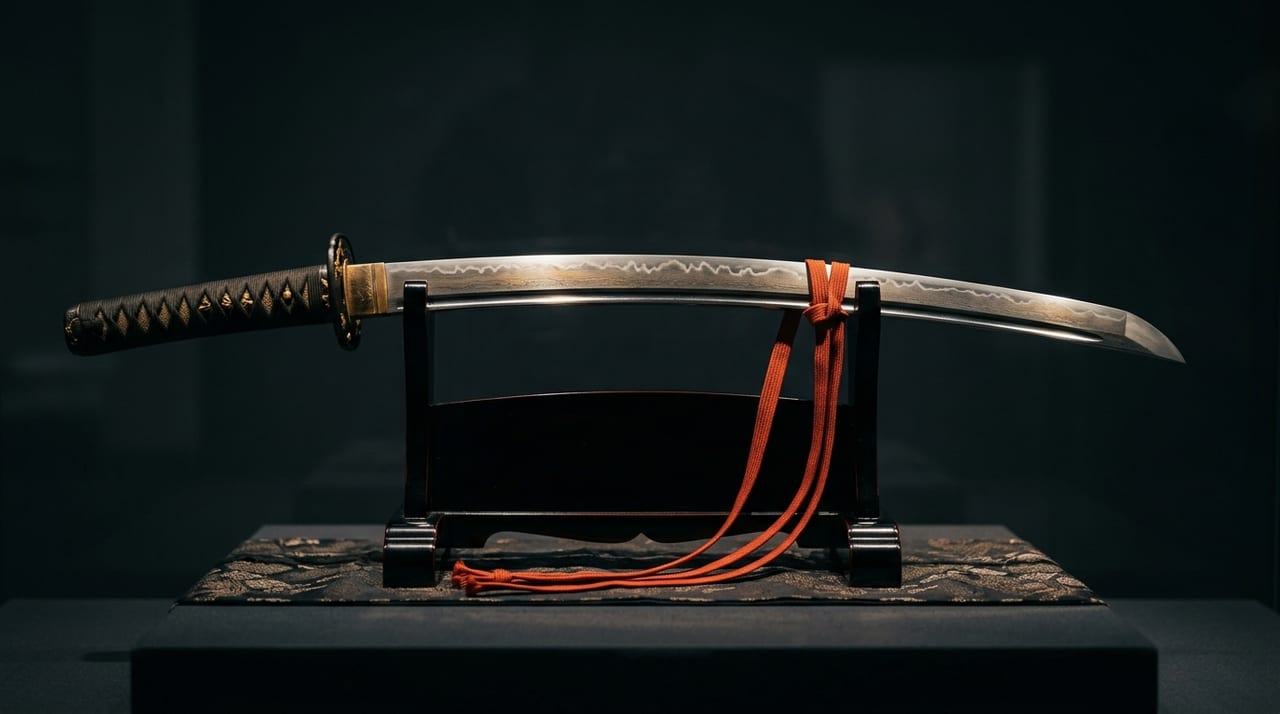 * Image is for illustrative purposes only.
Table of Contents
A Giant Star of the Late Kamakura Period Who Carried the Bizen Osafune School
Nagamitsu was a sword maker of the late Kamakura period, representing the Bizen Province Osafune region (present-day Osafune-chō, Setouchi City, Okayama Prefecture). He is said to have been the son of Mitsutada, who laid the foundation of the Osafune school, and while further developing the aesthetic sense of the chōji hamon inherited from his father, he pioneered diverse styles of workmanship. In the world of old swords, the number of extant signed pieces by him is remarkably numerous, and his diverse styles continue to be treated as important materials in sword research by later generations.
The area around Osafune-chō was blessed with abundant iron sand resources and the waterway of the Yoshii River, making it a prime sword-producing region. The Osafune school style established by Mitsutada reached technical and aesthetic maturity in Nagamitsu's time, further solidifying the foundation of the Osafune clan that would flourish from the later Nanboku-chō through the Muromachi period. After Nagamitsu, many master craftsmen such as Kagemitsu and Kanemitsu would emerge from the clan, but it was the sword maker Nagamitsu who embodied the refined style that became their point of departure. When discussing the golden age of sword production in Bizen Province, Nagamitsu's name invariably emerges as an indispensable point that cannot be overlooked.
A Broad Range of Work—From Straight Blades to Irregular Blades
When discussing Nagamitsu's works, one must always mention his remarkably broad range of styles. Not only the chōji hamon characteristic of the Bizen tradition, but also gently opening gunome, and even gentle straight blades, he displays such diverse characteristics that one might not believe they came from a single craftsman's hand. This not only demonstrates his broad technical repertoire, but can also be interpreted as reflecting Nagamitsu's flexible craftsmanship in responding to commissions from various regions.
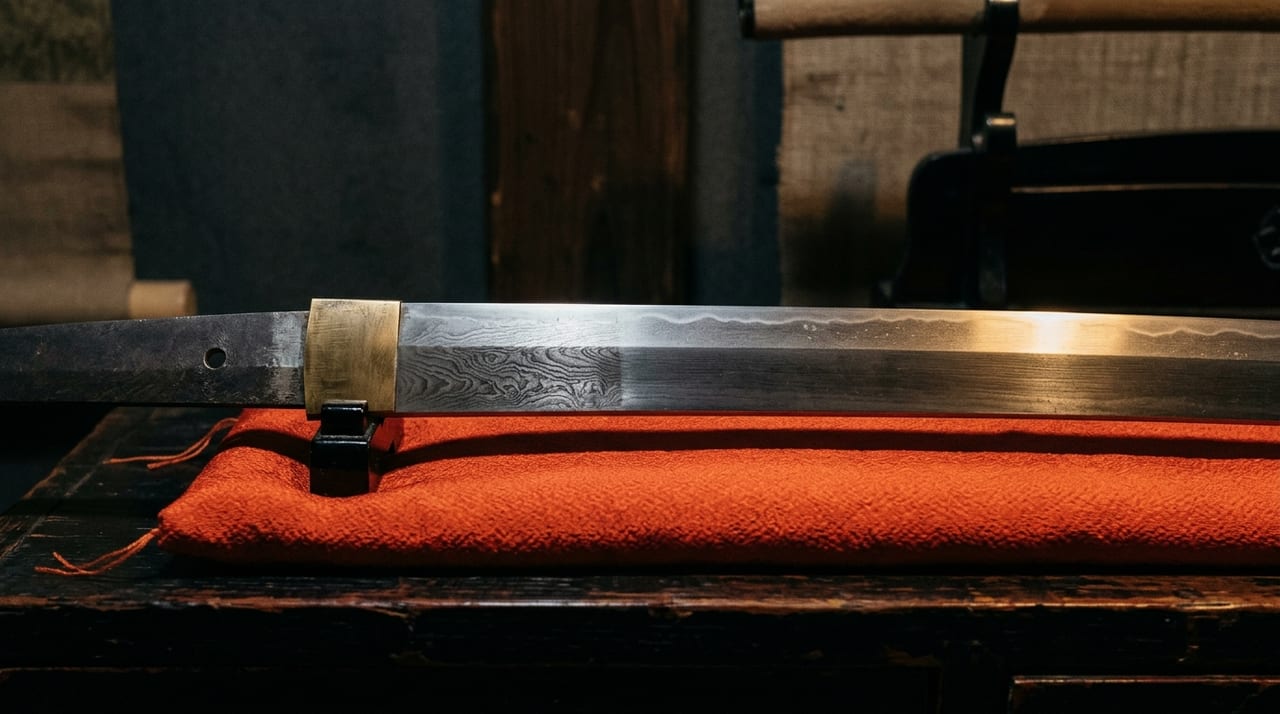
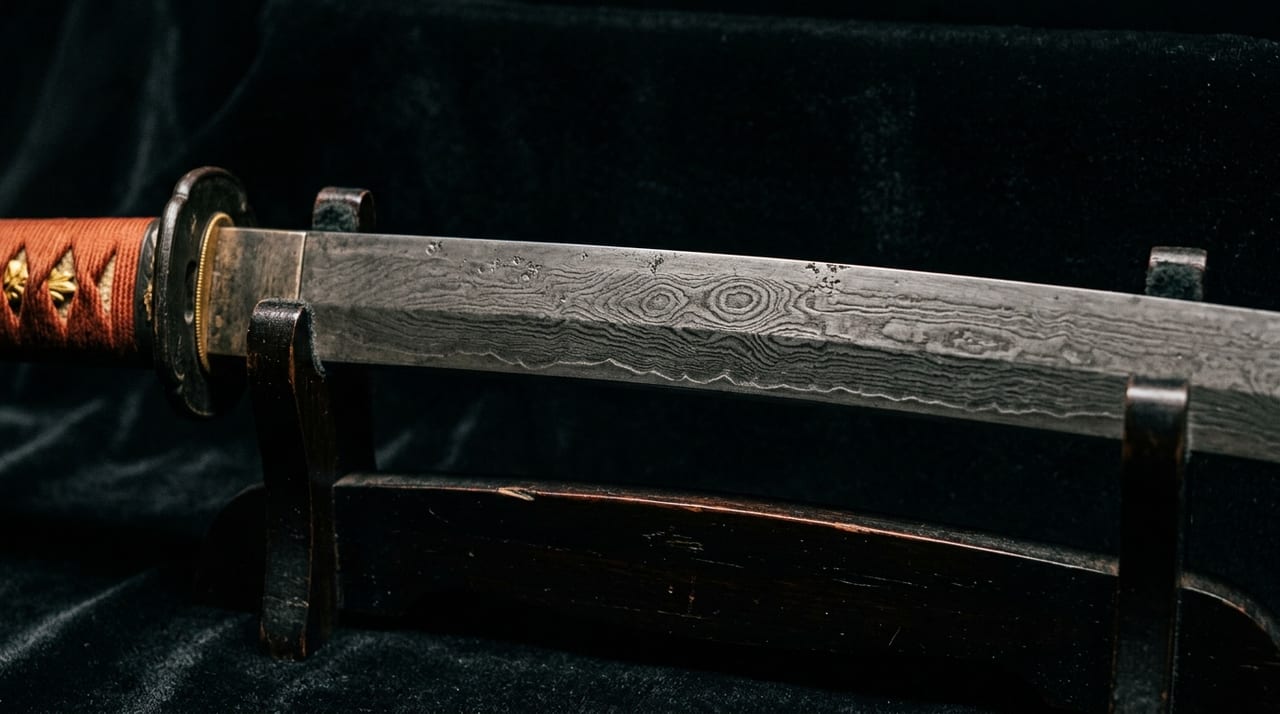
Regarding the jigane, he primarily employed tightly packed ko-itamehada, with lustrous jinioe rising finely across the entire surface, and many examples show the distinctive chikei characteristic of the Bizen tradition. Regarding the hamon, while using the chōji elements inherited from his father Mitsutada as the foundation, he ranged from elegant irregular blades where large chōji overlap to gently flowing straight blades, seemingly using them flexibly according to the commissions and purposes of the era. The finishing of the kissaki also displays the refined quality characteristic of the late Kamakura period, and the characteristic of maintaining dignity while varying from one piece to another is noted as a hallmark of Nagamitsu's work.
It is believed that this breadth of expression was linked to the diverse demand in Bizen Province at the time. His continued responsiveness to a wide range of patrons—from the warrior class of the Kamakura shogunate to powerful daimyo across the land—while maintaining an aesthetic completion above a certain standard, along with the abundance of extant signed pieces, has secured Nagamitsu's reputation unquestionably.
Masterpiece "Daihanjō Nagamitsu"—A National Treasure Beloved by Rulers of the Land
The work that immortalized Nagamitsu's name is the tachi "Daihanjō Nagamitsu," designated as a National Treasure. The origin of its poetic name is that it was traded for 600 kan (a unit of currency) in the Muromachi period, which is said to match the number of volumes (600 scrolls) of the Daihannya Haramitakyō (the Great Prajñāpāramitā Sūtra). This naming is unique to the Muromachi period when the custom of bestowing poetic names on great swords remained, and represents an elegant expression combining the value of the sword itself with the authority of Buddhist scripture.
The provenance of "Daihanjō Nagamitsu" is also noteworthy. Its provenance of being continuously owned by the most powerful figures from the Warring States period through the early Edo period clearly attests to the high status of this blade in its time.
- It was revered as a treasure of the Ashikaga shogunal house,
- passed into the hands of the rulers of the Warring States period, and according to historical records, Oda Nobunaga possessed this tachi,
- and records also show that Tokugawa Ieyasu held it,
- Currently it is housed in the Tokyo National Museum, where it is widely known as one of the museum's representative sword collections.
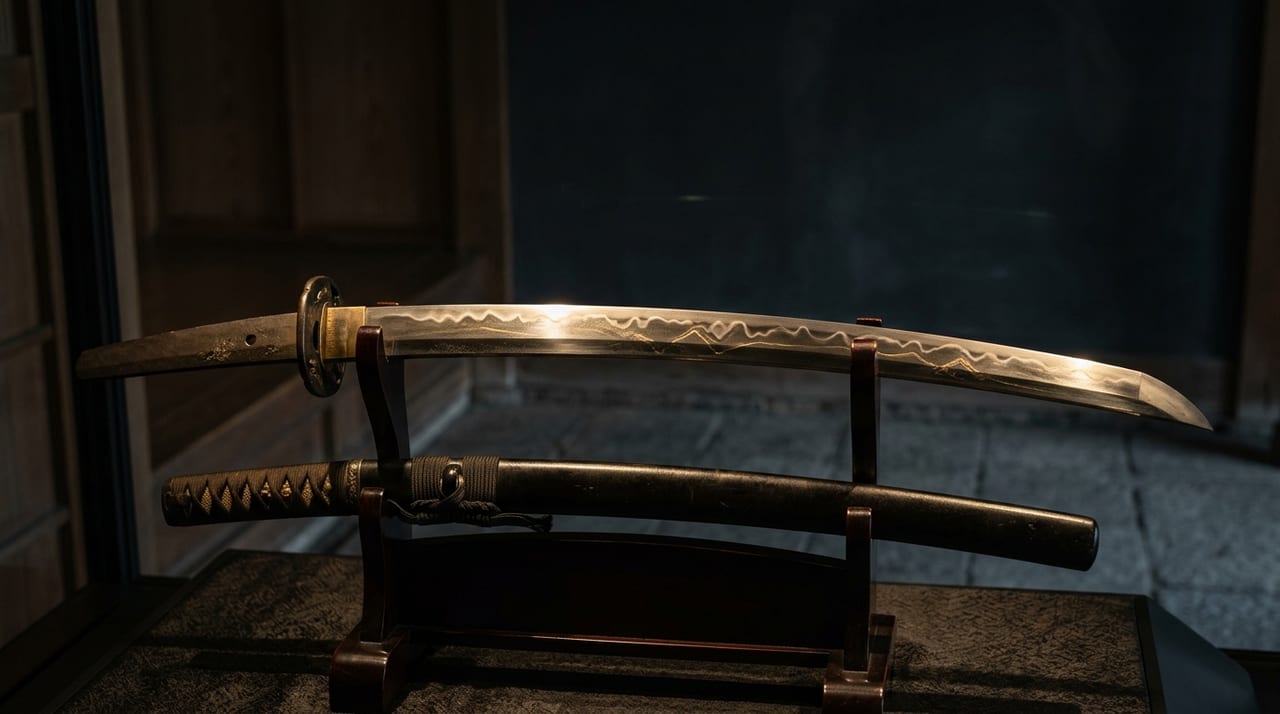
The shape of the blade follows the typical tachi form of the late Kamakura period, with excellent curve at the base and graceful lines throughout. The hamon is a variegated irregular blade, and the texture of the jigane is also of high quality, and it has been highly valued as one of the most accomplished pieces in Nagamitsu's body of work. The fact that such a weighty history is inscribed in a single blade demonstrates that a great sword can transcend being mere craftsmanship and become a vessel of history itself.
What Nagamitsu Passed Down to Posterity
Nagamitsu's achievement extends beyond the existence of outstanding individual pieces. He systematically developed the aesthetic sense of the Bizen chōji that his father Mitsutada had pioneered, and through numerous successors, connected it to the long-term prosperity of the Osafune clan. Later Osafune craftsmen such as Kagemitsu and Kanemitsu, who were active in the Nanboku-chō period, inherited as their standard the broad range of styles and technical level that Nagamitsu demonstrated. As a figure supporting the continuity of the major production center that was Bizen Osafune, Nagamitsu's name should be understood not as that of a solitary genius, but as a central figure who formed the backbone of the school.
The fact that numerous signed pieces have survived brings immeasurable benefit to sword research today. While carefully examining the authenticity of signatures as a prerequisite, the existence of numerous comparative materials enables concrete discussion of stylistic changes and the breadth of Nagamitsu's work. Among old sword makers, many have few or no surviving signed pieces, so the abundance of Nagamitsu's surviving works is a precious asset for research.
In sword authentication, Nagamitsu's works are repeatedly referenced as exemplary cases when discussing the Bizen tradition. The density of the jigane, the appearance of chōji and gunome, the shape of the kissaki, and so on, each element's combination differs from work to work, and careful observation of each of Nagamitsu's blades also serves as a shortcut to deepening understanding of the entire Bizen tradition.
Questioning the Bizen Aesthetic in the Modern Era
The Bizen techniques embodied by Nagamitsu—tightly packed jigane, hamon rich in variation centered on chōji, and the refined tachi form of the late Kamakura period—continue to be important standards for sword appreciation transcending time. The fact that many works by Bizen Osafune makers are found among the surviving National Treasures and Important Cultural Properties proves how consistently high the standard of sword culture in this region has been maintained. Behind the fact that a single blade like "Daihanjō Nagamitsu" attracted so many powerful figures must have been not only pure aesthetic perfection but also the accumulated reputation that Osafune as a production center had built.
At toukenza, with this historical background in mind, we carefully introduce swords from various schools, starting with the Bizen tradition. Refocusing on the aesthetic level reached by Japanese swords of the late Kamakura period, with the sword maker Nagamitsu as the central axis, would be a great help in reading more deeply into the featured swords.