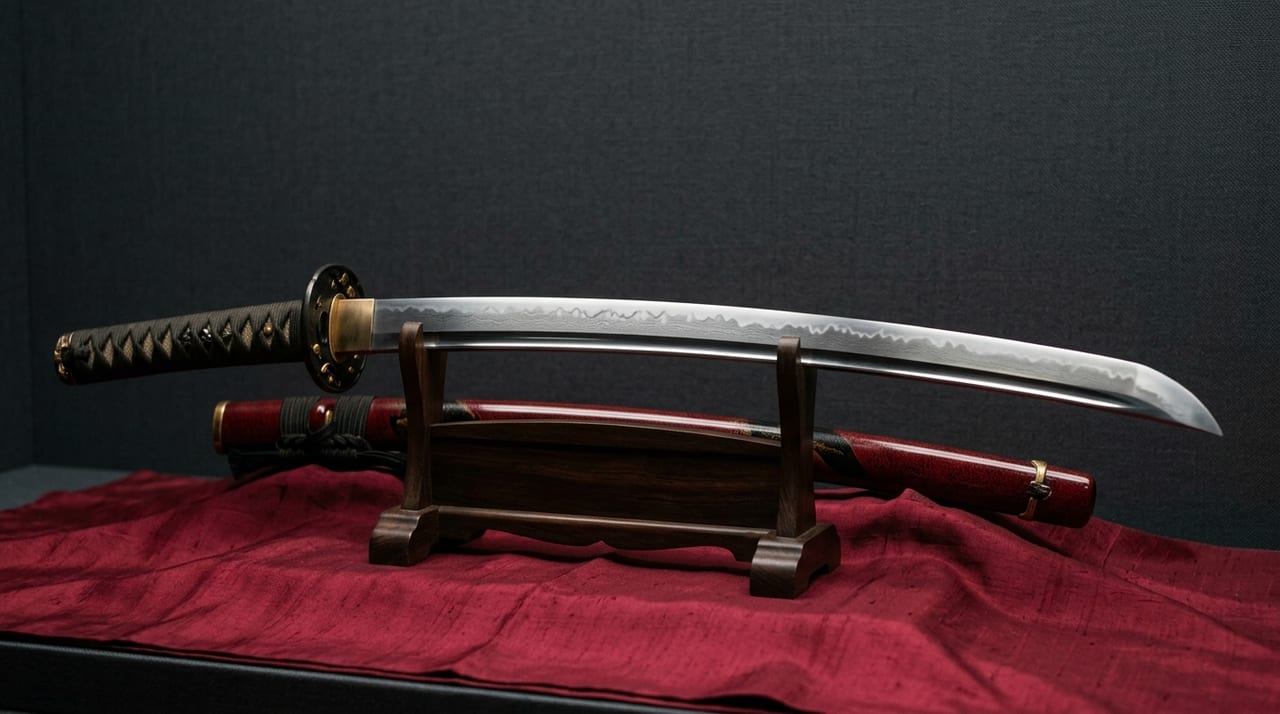
 * Image is for illustrative purposes only.
Ōkanehira
大包平
Also known as: Ōkanehira · Yokozuna of Japanese Swords
Description
Overview
Ōkanehira is a tachi forged by the swordsmith Kanehira of the Ko-Bizen school, who was active in Bizen Province (present-day Okayama Prefecture) in the late Heian period. It is one of the pinnacles of Japanese swords, designated as a National Treasure, and is also called the "yokozuna of Japanese swords." Although it is an imposing long tachi with a blade length of 2 shaku 9 sun 4 bu (approximately 89.2 centimeters), its blade is forged thin, making it surprisingly light and tough. The greatest feature of this piece lies in this point. The high-level reconciliation of size and lightness, and of practical use and beauty, is regarded as a miracle of swordsmithing skill.
Style and Characteristics
The maker Kanehira belonged to the Ko-Bizen school and is renowned as the most outstanding swordsmith within it. The Ko-Bizen school is the collective name for Bizen swordsmiths from the late Heian to early Kamakura period, before the Osafune school arose; it is a group of pioneering master smiths who produced Tomonari and Masatsune. Few of Kanehira's securely signed works survive, but Ōkanehira is considered the finest masterpiece among them. The jigane is a fine ko-itame-hada, densely packed, with fine ji-nie; the steel color is clear and has a moist luster, and a faint midare-utsuri stands out. The hamon is a dignified work of ko-midare mixed with ko-chōji; the nioi-guchi is deep and crisp, and ashi and yō are well present. The bōshi is midare-komi returning shallowly. The nakago is ubu and bears a long inscription, "Made by Kanehira of Bizen Province." Since Kanehira usually cut only the two-character inscription "Kanehira," this long inscription is rare. The sori is about 3.5 centimeters. The high koshi-zori and sturdy form are typical of late Heian tachi, but the wide mihaba and imposing taihai are unusual for that era, suggesting Kanehira's own aesthetic sense. The prefix "Ō" in "Ōkanehira" is said to have been added to distinguish this particularly outstanding piece from the other works by Kanehira that exist.
Designation and Collection
Ōkanehira was designated a National Treasure in Shōwa 26 (1951). The date when it entered the Ikeda family is uncertain. There is an anecdote that Ikeda Mitsumasa, lord of Okayama domain, obtained it by earnestly requesting it from Kumazawa Banzan, and also a theory that it had already been handed down in the Ikeda family in the time of his grandfather Ikeda Terumasa, lord of Harima Himeji domain. Thereafter, as a family treasure of the Okayama domain Ikeda family, it was carefully passed down together with famous swords such as Ikeda Masamune. In Shōwa 42 (1967), the Ministry of Education (at the time) purchased this tachi for 65 million yen and housed it at the Tokyo National Museum. The appraisal was exceptional for that time. It has remained in that museum's collection to the present day. It is sometimes called one of the "two yokozuna of east and west," alongside the famous Dōjigiri Yasutsuna (held by the same museum). It is also often set beside Mikazuki Munechika, another famous sword held by the same museum, as a contrast of elegance and grandeur. While Mikazuki Munechika embodies the elegant beauty of the imperial court, Ōkanehira is regarded as the pinnacle of technique combining grandeur and fine detail, and the contrasting charms of the two swords have been discussed.
Anecdotes and Provenance
The name "Ōkanehira" is said to have been given the prefix "Ō" (great) to distinguish this unrivaled masterpiece from the other works by Kanehira that have been transmitted. Befitting its name, although it measures an imposing approximately 89 centimeters, its weight of about 1.35 kilograms is remarkably light. Later generations have praised it as the "yokozuna of Japanese swords" because it combines size and lightness, and grandeur and fine detail, in one sword. In terms of provenance, although the date of its entry into the Ikeda family is uncertain, it was preserved as a treasure of the Okayama domain Ikeda family and passed down within the family through the Meiji, Taishō, and Shōwa periods. In Shōwa 42 (1967) it became state property through purchase by the Ministry of Education (at the time), was housed in the Tokyo National Museum, and has now become a nationally renowned treasure that the general public can view. The path by which a family treasure of samurai households passed for centuries to a public museum's most precious items also reflects one aspect of modern sword history, in which Japanese swords changed from private treasures to cultural property for everyone.
Legends & Stories
Legends and Anecdotes
Ōkanehira's greatest mystery and greatest appeal lie in its astonishing lightness. Although it is a large tachi with a blade length of about 89 cm and a moto-haba of about 3.7 cm, its weight of about 1.35 kg (about 1350 g) is remarkably light for a tachi of the same length. Tachi of such length and size usually weigh more than 2 kg, but Ōkanehira achieves a high degree of both length and lightness by forging its kasane thin, and it is highly valued as proof of the high level of its swordmaking technique. Despite the thin kasane, it retains its strength, and its balance is also excellent, so it feels lighter and easier to wield than its figures suggest. Ikeda Terumasa (1565–1613) was a warrior who served Oda Nobunaga, Toyotomi Hideyoshi, and Tokugawa Ieyasu, and he was a great daimyo granted 520,000 koku of Harima Himeji domain for his achievements at the Battle of Sekigahara. The date when Ōkanehira entered the Ikeda family is uncertain. There is an anecdote that Ikeda Mitsumasa, lord of Okayama domain, obtained it by earnestly requesting it from Kumazawa Banzan, while there is also a theory that it had already been handed down in the Ikeda family in Terumasa's time. The Ikeda family continued to carefully protect this sword as the foremost treasure of the house. The practical significance of Ōkanehira's lightness is also important. Being a long tachi of about 89 cm that weighs about 1.35 kg with excellent balance made it possible to combine the overwhelming reach of a long tachi with the handling of an ordinary tachi, which shows that it was one of the ideal weapons on the battlefield. It is this perfect coexistence of practicality and artistry that makes Ōkanehira the "yokozuna of Japanese swords." The Tokyo National Museum also holds Mikazuki Munechika. If Mikazuki Munechika embodies the aesthetic sense of the Heian nobility, Ōkanehira embodies the meritocratic ethos of the Heian warriors. That these two swords are together in the same museum is a blessing for Japanese sword culture and the reason they continue to attract sword enthusiasts from around the world.