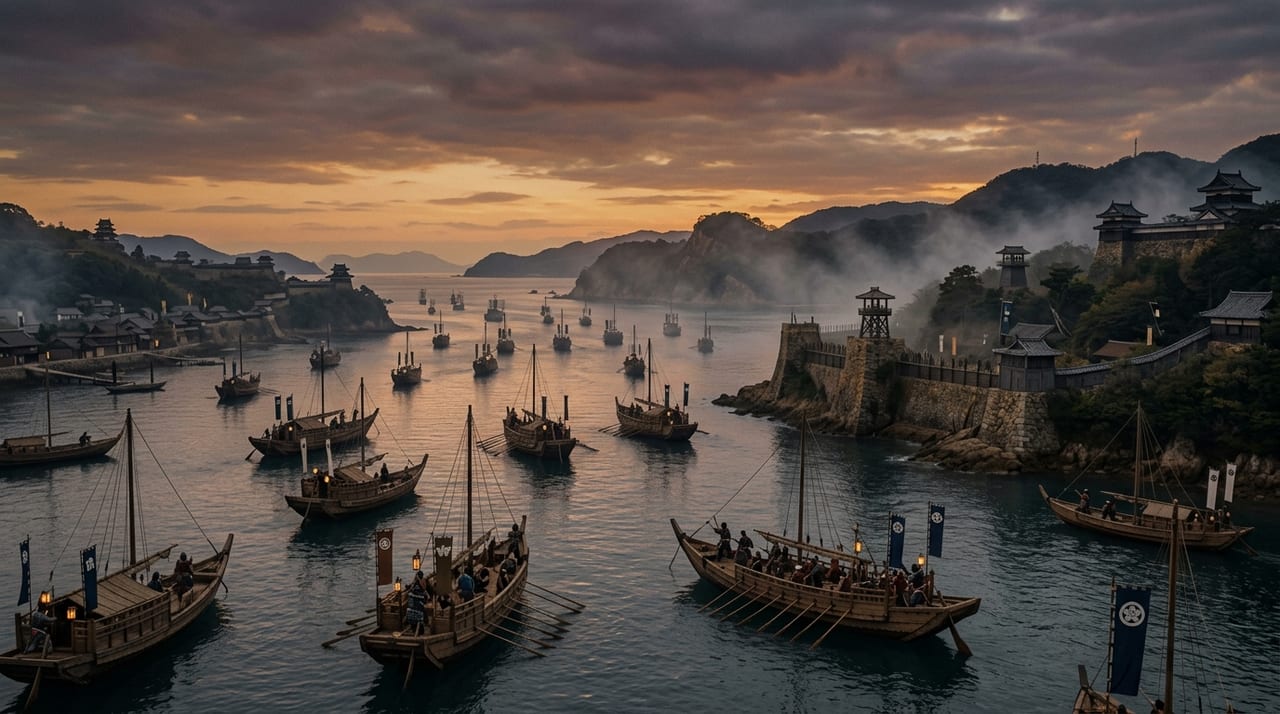
 * Image is for illustrative purposes only.
Taira Naval Forces and Sea-Battle Swords
平家水軍と海戦の刀剣
The naval campaigns of the Taira clan, culminating in the Battle of Dan-no-ura (1185), shaped how swords were used in close-quarters sea combat and left a legacy of celebrated Taira-associated blades that resonated through later Japanese culture.
Description
The Genpei War and Naval Combat
The conflict between the Taira and Minamoto in the Genpei War (Jishō-Juei War, 1180–1185) was a large-scale civil war that included full-scale naval battles between fleets. At the Battle of Yashima (1185) and the Battle of Dan-no-ura (1185), the Taira navy clashed with the Minamoto, making use of its knowledge of the Seto Inland Sea. The special combat space aboard ships imposed distinctive constraints and demands on the use of swords.
The Role of Swords in Naval Combat
In hand-to-hand fighting aboard ships, short swords (tanto) and hip swords (koshigatana) gained usefulness over the long tachi because of their greater maneuverability. Combat styles different from those on land were required, including fighting on wet decks, cutting across gunwales, and thrusting in crowded ship interiors. It is also thought that the reduced protective value of armor caused by seawater (rust and added weight) influenced the choice of swords.
Famous Swords Associated with the Taira
Members of the Taira house, including Taira no Kiyomori, Taira no Munemori, and Taira no Tomomori, as leaders of the warrior households, owned and bestowed many famous swords. The representative example is Kogarasu-maru (a treasured heirloom of the Taira house and an Imperial Household property). It was considered lost after the Battle of Dan-no-ura, but was found to have been passed down in the Ise family, a branch of the Taira line, during the Edo period. Its old-style tachi form with little curvature preserves the sword style of the Heian period.
Dan-no-ura and the Loss of Swords
On 25 April 1185 (Genryaku 2/3/24), in the final battle at Dan-no-ura (present-day Shimonoseki, Yamaguchi Prefecture), the Taira house sank into the sea together with Emperor Antoku. Among the Three Sacred Treasures, the sacred sword (the katashiro replica of Kusanagi-no-Tsurugi) also sank into the sea at that time and was not recovered. This episode, as the most dramatic historical event showing the sacredness and national symbolism of swords, deeply influenced later views of swords.
The Tale of the Heike and Sword Culture
The Heike Monogatari (The Tale of the Heike) includes dramatic scenes involving swords, including the death of Taira no Atsumori. These tales formed the ideal image of the medieval warrior and established the cultural foundation that positions the sword as the 'soul of the warrior' beyond a mere weapon. Descriptions of swords in the Heike Monogatari have continued to influence later sword appraisal and identification culture.
Characteristics of This Era
- Improved practicality of short swords and hip swords: In the confined spaces aboard ships, long tachi were difficult to handle, so tanto and koshigatana were heavily used.
- Survival of old-style tachi forms: Many of the swords active at Dan-no-ura were old-style tachi with koshi-zori curvature, unchanged since the Heian period.
- Connection to the Three Sacred Treasures: The sinking of the sacred sword (the katashiro replica of Kusanagi-no-Tsurugi) expressed the sacredness of swords at the highest level and decisively reinforced the notion of 'swords as sacred treasures and symbols of the nation.'
- Cultural amplification by the Heike Monogatari: Descriptions in the war chronicle gave real swords added value as 'famous swords of tales,' making provenance and legend important elements in appraisal, and became one of the origins of this practice.