New Arrivals — Browse our catalog for the latest authentic Japanese sword arrivals. Browse →
January 15, 1181 (Jishō 4, 12th month, 28th day)
Nara, Yamato Province (Tōdai-ji, Kōfuku-ji, and the Narazaka and Hannya-ji area)
Forces
Taira army
Monastic forces of Nara (Tōdai-ji and Kōfuku-ji)
About 13 min read
The Burning of Nara (Nanto yakiuchi) was an incident on the 28th day of the 12th month of Jishō 4 (1180), when Taira forces under Taira no Shigehira, acting on the orders of Taira no Kiyomori, attacked the great temples of Nara and burned most of the main halls of Tōdai-ji and Kōfuku-ji. "Nanto," the southern capital, is the name for Nara in contrast to Kyoto to the north. The attack is known as one of the greatest losses of cultural property in the Jishō-Juei War. The day corresponds to January 15, 1181 in the Julian calendar.
After the Heiji Rebellion, Taira no Kiyomori brought Yamato Province under his control and pressed down on the privileges the temples of Nara had long held. The conflict deepened through the political coup of Jishō 3 (1179) and Prince Mochihito's uprising of Jishō 4. During that uprising, monks of Kōfuku-ji took the prince's side.
Following the year of Jishō 4 in order: in the 3rd month the communities of Onjō-ji and Kōfuku-ji planned to surround the residences of Go-Shirakawa and Retired Emperor Takakura, but the plan was discovered in advance and failed. In the 5th month, Prince Mochihito and Minamoto no Yorimasa left Onjō-ji for Kōfuku-ji in Nara, intending to join its community and regroup, but were overtaken and defeated by a Taira army at Uji on the 26th. On the 17th day of the 8th month Minamoto no Yoritomo raised troops, and the anti-Taira movement spread across the provinces.
Then, in the 12th month, the Taira burned Onjō-ji (Mii-dera). The communities of Onjō-ji and Kōfuku-ji had both been involved in anti-Taira risings. For the Taira, who had just struck Onjō-ji, Kōfuku-ji was a target that the situation made hard to avoid.
The Tale of the Heike puts the Taira army at 40,000 and the defenders of Nara at 7,000. The contemporary courtier's diary Sankaiki, by contrast, puts the Taira army at several thousand.
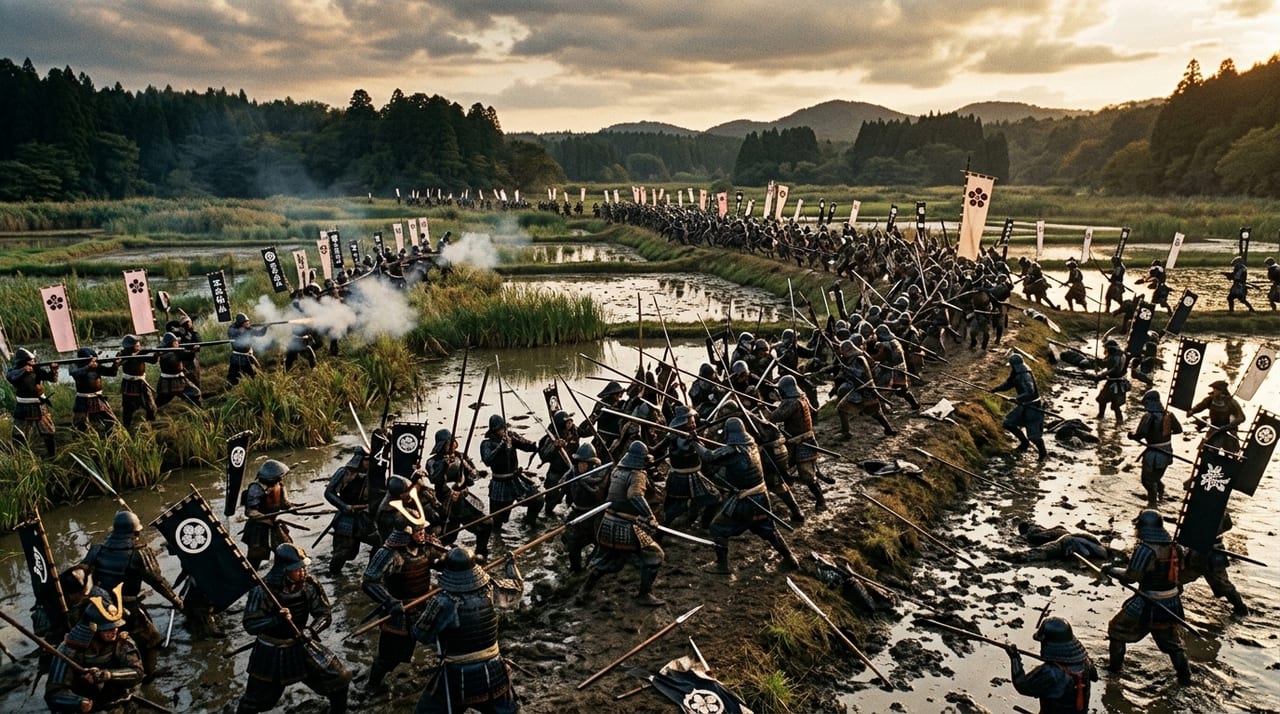
Shigehira's army broke through the defensive lines at Kizu, Narazaka and Hannyazaka in turn, and he set up headquarters at Hannya-ji. The Nara side built defenses and resisted, but the Taira army entered the town and fought the monks. It is said that the Taira side had in mind the use of fire as a means of gaining the upper hand in the fighting.
A few terms need explaining. A daishu is a body of monks belonging to a temple, including armed warrior-monks. A shōen is an estate held privately by a temple or noble family, whose income supported the institution. Kizu, Narazaka and Hannyazaka all lie on the northern approaches to Nara from the Kyoto side, and were key points for those defending the old capital.
On the night of the 28th, fire broke out on the Taira side. Whipped by strong winds, it spread through the town and the temple precincts. The Tale of the Heike says that when Shigehira called for light in his camp, his men set fire to the houses around them. On the other hand, burning the monks' quarters had been part of the plan from the start of the campaign, and the fire is thought to have been set as a tactic. Its spread, however, is said to have exceeded what the Taira expected.
The Tale of the Heike also says that before the campaign the monks of Nara seized and beheaded more than sixty men of Senoo Kaneyasu, whom Kiyomori had sent, but this story does not appear in contemporary records such as Gyokuyō and Sankaiki.
At Tōdai-ji, most of the main halls, beginning with the Great Buddha Hall, were burned. The Great Buddha was badly damaged, and its head and hands are said to have fallen. At Kōfuku-ji, about 38 buildings are said to have burned, with the five-story pagoda and the Fukūkenjaku Kannon of the Nan'endō recorded among the losses. Neighboring sites also suffered.
The damage to the Great Buddha of Tōdai-ji went beyond the loss of buildings: with its head and hands fallen, restoring the image became a major undertaking separate from rebuilding the halls. Later repairs were layered on in the Kamakura period and again in the Edo-period Genroku era, so the present Buddha carries that history. At Kōfuku-ji, the Nan'endō was a hall with a long history as the home of the Fukūkenjaku Kannon, and that image was lost as well.
The death toll differs sharply between sources, and how to read the figures depends on the nature of each source. The Tale of the Heike gives over 3,500, while the Azuma Kagami, based on the report of a monk who was in Nara during the attack, gives just over 100 burned to death at the two temples. Which is closer to the truth cannot be settled today.
In Jishō 5 (1181) the Taira confiscated the estates of the Nara temples but revoked the measure in the 3rd month of the same year. The change in the political situation after the deaths of Retired Emperor Takakura and Kiyomori lay behind this.
The reconstruction of Tōdai-ji began when Go-Shirakawa appointed the monk Shunjōbō Chōgen, then 61, as daikanjin (chief fundraiser) in Yōwa 1 (1181). Through Chōgen's vigorous activity and the support of Minamoto no Yoritomo, who took power in place of the Taira, the work advanced. The Great Buddha was restored, and its eye-opening ceremony (a rite welcoming the spirit into the image) was held in Bunji 1 (1185) in the presence of Go-Shirakawa and others. Obtaining timber for the Great Buddha Hall was difficult, but work is said to have gone quickly once Suō and Bizen Provinces were assigned as the temple's construction estates. The ridge-raising ceremony was held in Kenkyū 1 (1190), and the dedication ceremony in Kenkyū 6 (1195), with Yoritomo and others attending.
The rebuilding of Kōfuku-ji's main halls took about thirty years and was largely in place by around Kenryaku 2 (1212).
The Great Buddha Hall rebuilt in the Kamakura period was burned again on the 10th day of the 10th month of Eiroku 10 (1567) in the fighting between the Miyoshi Three and Matsunaga Hisahide (the Battle of the Tōdai-ji Great Buddha Hall). The Buddha then stood in the open under temporary repairs for several decades; in the Edo period, through the efforts of the monk Kōkei, the Buddha was repaired (Genroku era) and the hall rebuilt (Hōei 6, 1709). That the great precinct reached the present after two fires is a notable feature of the temple's history.
To summarize the above in date order (old-calendar dates; Jishō 4, 1180, unless noted):
- 3rd month: the communities of Onjō-ji and Kōfuku-ji plan to surround the two retired sovereigns' residences; the plan is discovered and fails. - 5th month, 26th day: Prince Mochihito is killed in the fighting at Uji and Minamoto no Yorimasa takes his own life. - 8th month, 17th day: Minamoto no Yoritomo raises troops. - 12th month: the Taira burn Onjō-ji. - 12th month, 28th day: Taira no Shigehira's army breaks through Narazaka, Hannyazaka and other lines, and fire spreads through Nara. The Great Buddha Hall of Tōdai-ji and many halls of Kōfuku-ji burn. - Jishō 5 (1181): the estates are confiscated and the measure revoked; Chōgen is appointed daikanjin. - Bunji 1 (1185): eye-opening ceremony of the Great Buddha. - Kenkyū 6 (1195): dedication of the Great Buddha Hall. - Around Kenryaku 2 (1212): the rebuilding of Kōfuku-ji's main halls is largely complete. - Eiroku 10 (1567): the rebuilt Great Buddha Hall burns again in the fighting between the Miyoshi Three and Matsunaga Hisahide (rebuilt in Hōei 6, 1709).
Laid out this way, it is clear that the burning of Onjō-ji and the attack on Nara formed one continuous movement, and that recovery took well over a decade. Accounts still differ on troop numbers and casualties.