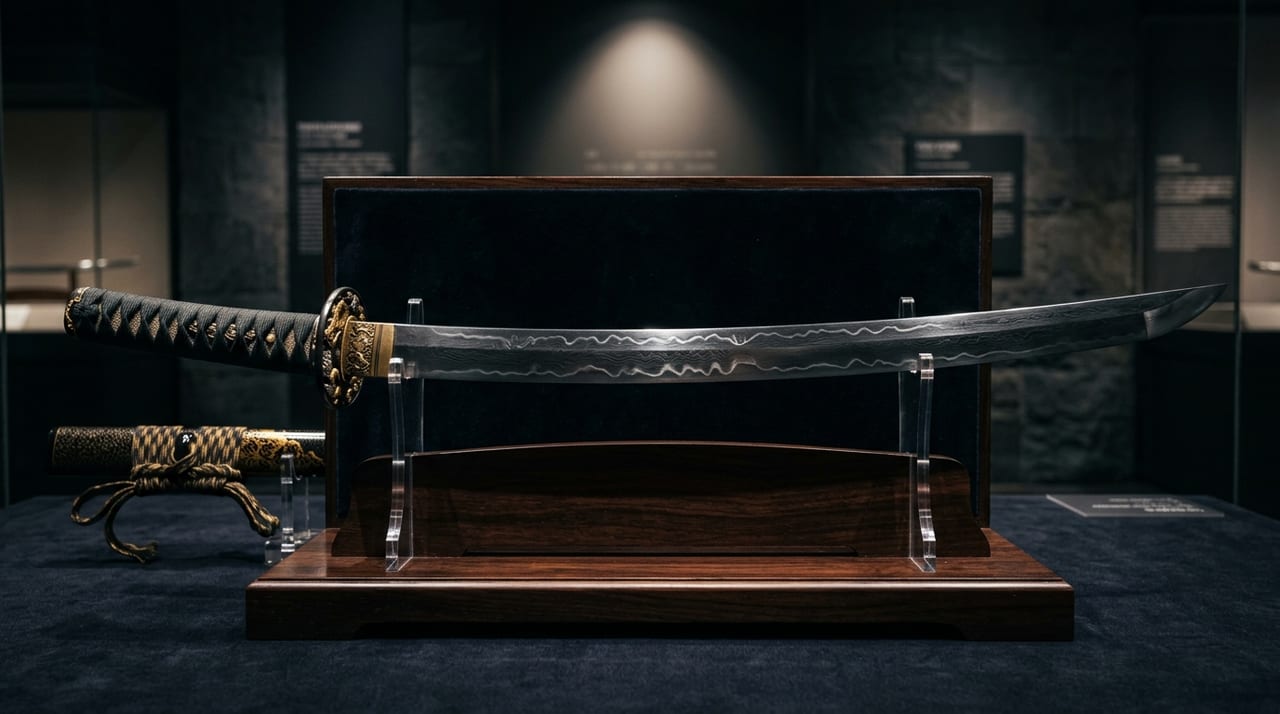
 * Image is for illustrative purposes only.
Ōdenta Mitsuyo
大典太光世
Also known as: Great Denta
Description
Overview of the Sword
One of the Five Greatest Swords and the most imposing in bearing among them, this renowned tachi commands a powerful presence. With a blade length of approximately 65.1 cm, it is relatively short among the Five Greatest Swords; however, its broad blade and thick construction, commanding in appearance, impart an overwhelming sense of weight and presence to whoever grasps it.
The Craftsman
The maker, Miike Tenta Mitsuyo, was a swordsmith of the late Heian period who lived in Miike, Chikugo Province (in the vicinity of present-day Ōmuta City, Fukuoka Prefecture), and founded the Miike school. His work, while bearing regional characteristics, possessed a distinctive and powerful aesthetic sensibility. The origin of the 'Ō' (great) in 'Ōdenta' is unclear: one view holds that it denotes the finest work of the first rank (Satō Kanzan), while another holds that it derives from the sword's imposing form.
Manufacturing Method and Characteristics
The jigane shows flowing ō-itame (large wood-grain) patterning. The hamon is a fine straight hamon of nie-deki character, with a hint of hotsure, slight ashi entering, and niju-ba (double edge) patterns mixed in near the monouchi. The nakago bears the three-character signature 'Mitsuyo saku' (made by Mitsuyo), cut with a heavy chisel.
History of the Sword
Its provenance traces to the Ashikaga shogun house, where it was jealously guarded as a treasured blade throughout the Muromachi period. After being presented by Ashikaga Yoshiaki to Toyotomi Hideyoshi, the sword was, according to the Kyōhō Meibutsuchō, given by Hideyoshi to Maeda Toshiie on account of the illness of Gō-hime, Toshiie's daughter who had become Hideyoshi's adopted daughter. For the Maeda clan of Kaga, ruling a domain of one million koku, Ōdenta Mitsuyo represented the supreme treasure demonstrating the clan's rank and status, and was thereafter carefully preserved and transmitted as the clan's most precious heirloom for more than four hundred years. Particularly noteworthy is that within the Maeda household, Ōdenta Mitsuyo was regarded not merely as a famous sword but as a sacred talisman against illness and pestilence. There is a tradition that placing it at the bedside of a sick person cures the illness, and its miraculous efficacy has been passed down through the generations.
Current Custody
The Maeda Ikutokukai Foundation (Meguro Ward, Tokyo) currently holds the sword, and it is sometimes exhibited at the Ishikawa Prefectural Museum of Art and elsewhere. Designated a National Treasure in 1957, it continues to maintain its sacred presence as a treasure handed down from the Kaga Maeda family.
Legends & Stories
Legends and anecdotes
The core of the legends surrounding Ōdenta Mitsuyo lies in the spiritual power it is said to possess to dispel illness. Since Maeda Toshiie received this sword, the Maeda clan of Kaga has revered Ōdenta Mitsuyo not merely as a famous sword, but as a kind of sacred object. Legend has it that placing the sword at a sick person's bedside cured the illness, and returning it brought a relapse. The most famous anecdote is the story of Gō-hime's illness, recorded in the Kyōhō Meibutsuchō. When Gō-hime, Toshiie's daughter who had been adopted by Toyotomi Hideyoshi, had the sword placed at her bedside, her illness was cured. When it was returned to Hideyoshi, the illness recurred, so the sword was repeatedly lent and returned, until, on the third occasion, Hideyoshi gave it to Toshiie outright. In another account, after Hideyoshi gave the sword to Tokugawa Ieyasu, Tokugawa Hidetada and third-generation lord Maeda Toshitsune lent it back and forth for the illness of Tama-hime, Toshitsune's legitimate wife. These legends further deepened the Maeda clan's faith in Ōdenta Mitsuyo. Moreover, after the sword came into Toshiie's hands, it is said to have been kept in a karabitsu chest with a shimenawa sacred rope stretched around it. There is also an anecdote that during the Shōwa-era deliberations on its designation as a National Treasure, the actual sword was not brought to the meeting and was reviewed only through photographs. The Maeda clan handled Ōdenta Mitsuyo with great caution. The very fact that a daimyo house of a million koku maintained such respect for over four hundred years proves Ōdenta Mitsuyo's status as a spiritual sword. Among the Five Greatest Swords, if Mikazuki Munechika symbolizes "beauty" and Dōjigiri Yasutsuna symbolizes "martial prowess," then Ōdenta Mitsuyo symbolizes "protection." Not a sword for cutting, but a sword for guarding—its serene yet powerful spirituality continues to live on even now, transcending four hundred years alongside the prosperity of the Maeda clan. The lineage it followed from the Ashikaga shogunate to Toyotomi Hideyoshi and then to the Maeda clan demonstrates that this sword was always under the protection of the highest authority, yet its treatment by the Maeda clan was based on a deeper spiritual bond unlike that of any other previous owner. At exhibitions at the Ishikawa Prefectural Museum, documents from the Maeda family collection are sometimes presented together to show how carefully Ōdenta Mitsuyo was cherished in Kaga, allowing visitors to touch upon a four-hundred-year story shared between a great sword and a great clan.