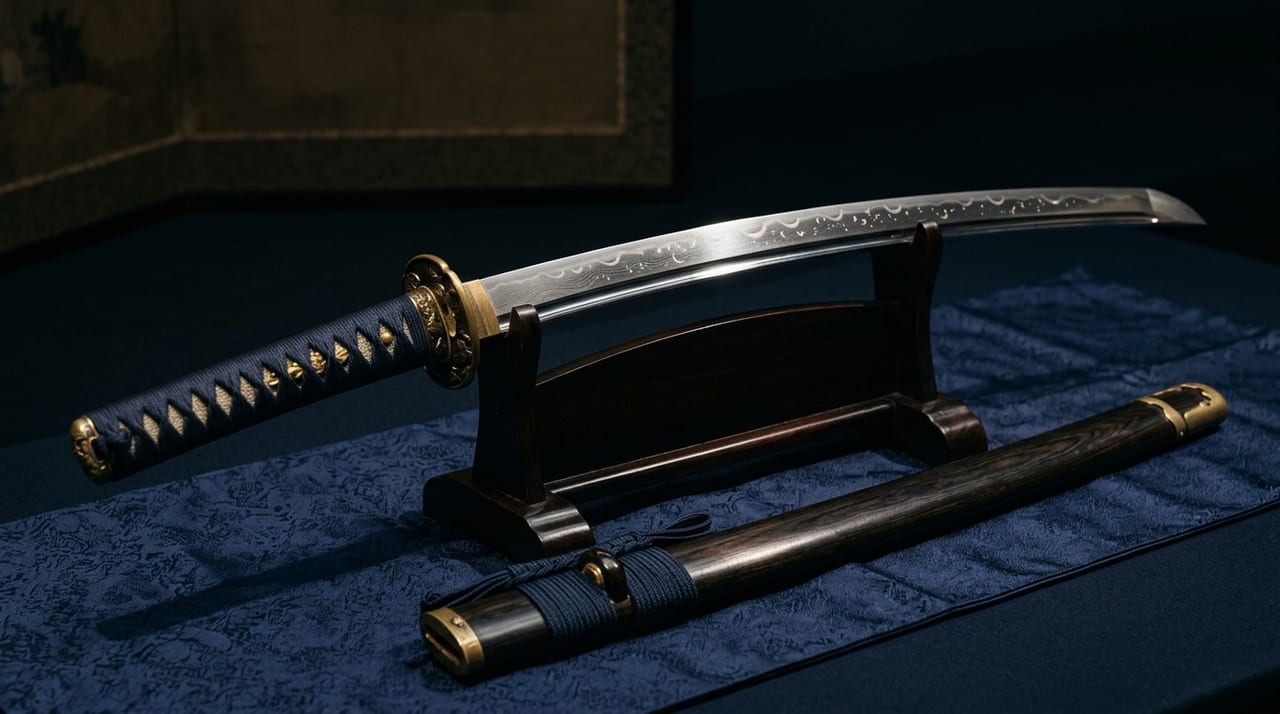
 * Image is for illustrative purposes only.
Mikazuki Munechika
三日月宗近
Also known as: Mikazuki; One of the Five Great Swords Under Heaven; Meibutsu among Meibutsu
Description
Sword Overview
One of the Tenka Goken, the Five Great Swords Under Heaven, and reputed to be the most beautiful of them, a famous blade. With a blade length of 2 shaku 6 sun 4 bu (approx. 80.0 cm) and a curvature of 9 bu (approx. 2.7 cm), it has the imposing form of a tachi, yet its koshizori is deep, forming an elegant curve with a sturdy, firm bearing. Its presence seems to seal within the blade itself the refined dignity that the court culture of the Heian period exuded. The crescent-shaped uchinoke floating across the blade gives it its name, and the countless half-moon-shaped patterns of light scattered in large and small forms along the habuchi are as ethereal as the night sky itself, bathed in moonlight. After a thousand years, they still take the breath away from those who look upon them.
Construction and Features
The jigane is a tight ko-itame hada, with patches of ō-hada mixed in. The ji-nie is thickly deposited, and chikei appear within it. The hamon is a ko-midare with uchinoke overlapping, creating a scene unlike any other. The nakago is ubu (unshortened), and the two-character signature "Sanjō" is cut with a fine chisel. Sanjō Munechika was a swordsmith who lived in Sanjō in Yamashiro Province during the Heian period, and he is regarded as a master at the pinnacle of the dawn of Japanese swordmaking. Munechika's style is elegant and dignified, and he is said to have laid the foundations of the later Yamashiro-den. However, very few securely signed works survive, and this Mikazuki Munechika is positioned as the greatest masterpiece among them.
Provenance of the Sword
There is a tradition that the sword was held by the Ashikaga shogunal family of the Muromachi period, especially by the thirteenth shogun, Ashikaga Yoshiteru, but reliable records are scarce. Yoshiteru was a sword master so accomplished that he was called the Kengō Shōgun (Swordsman Shogun). During the Eiroku Incident (1565), when he was attacked by the forces of Miyoshi Yoshitsugu and the Miyoshi Triumvirate, he is said to have fought fiercely, driving his blade into the tatami mat. Some hold that the Mikazuki Munechika was present on that occasion, but no contemporary record mentions the name Mikazuki Munechika. Its provenance is reliable only from the time it was held by Kōdai-in, the principal wife of Toyotomi Hideyoshi. After Kōdai-in's death, it was presented to Tokugawa Hidetada in 1624 (Kan'ei 1) and passed to the Tokugawa shogunal house.
Current Holdings
Within the Tokugawa house, it was carefully preserved as a renowned treasure of the realm, and it is recorded even in the Kyōhō Meibutsuchō. It remained with the Tokugawa family after the Meiji Restoration as well. Later, it left that family, passed through private ownership, and in 1992 (Heisei 4) it was donated to the Tokyo National Museum. It is now displayed regularly in the Tōkenshitsu (Sword Gallery) on the first floor of the museum's main building. During exhibition periods, it becomes a near-hallowed presence to which sword enthusiasts flock from across the country. In 2018 it was also exhibited at the Kyoto National Museum's special exhibition "Kyō no Katana." Its fame, such that even people unfamiliar with Japanese swords know its name, is proof of the overwhelming presence befitting its standing as one of the Tenka Goken.
Legends & Stories
Legends and Anecdotes
The legends surrounding Mikazuki Munechika are as profound and multilayered as the beauty of the blade itself. The uchinoke that gave the sword its name is a type of hamon formed during quenching. Unlike ordinary uchinoke, however, Mikazuki Munechika's displays an unparalleled phenomenon: countless half-moon shapes, large and small, rise along the habuchi. Even today, sword researchers have not fully explained why this uchinoke forms, and it is presumed that some special process in Munechika's forging technique was involved. This fantastical scene, as though moonlight had come to dwell in the blade, is the greatest reason it has continued to captivate people for a thousand years.
Into the Hands of Warriors
During the Muromachi period, this tachi is said to have been passed down as a treasured sword of the Ashikaga shogunal house and to have been one of the favored swords of the 13th shogun, Ashikaga Yoshiteru. On the 19th day of the 5th month of Eiroku 8 (1565), during the Eiroku Incident (Eiroku no Hen), when the forces of the Miyoshi Triumvirate and Matsunaga Hisamichi attacked Nijō Palace, Yoshiteru is recorded in the Ashikaga Kiseiki and other sources as having fought fiercely while switching, one after another, the swords he had driven into the tatami mats. Those sources, however, describe them only as "ritō" (sharp swords) and never call them famous swords. Several theories exist about which sword Yoshiteru wielded, but the tradition that Mikazuki Munechika was also one of the swords driven into the tatami is a later account, and there is no historical evidence to support it.
From Kōdai-in to the Tokugawa House
After Yoshiteru's death, there is also a transmission holding that the sword was bestowed by Ashikaga Yoshiaki upon Toyotomi Hideyoshi, but there is no historical evidence for this. The provenance that can be confirmed begins with its possession by Hideyoshi's wife, Kōdai-in (Nene). After Kōdai-in's death, the sword was presented to Tokugawa Hidetada as a keepsake in Kan'ei 1 (1624), and thereafter it was handed down within the Tokugawa shogunal house as a sword worn by the head of the household.
Custody under the Edo Shogunate
The Kyōhō Meibutsuchō, compiled during the Kyōhō era, records the name "Mikazuki Munechika," and the sword was officially certified as a famous treasure of the realm.
Modern Times and the Present
It was designated a National Treasure in 1951 (Shōwa 26), and in 1992 (Heisei 4), Mr. Watanabe Seiichirō, who had been its owner, donated it to the Tokyo National Museum. Even today, the popularity of Mikazuki Munechika shows no sign of fading. In the game Tōken Ranbu, the character Mikazuki Munechika, known as "the Beautiful Elder of the Tenka Goken," has won overwhelming support and has become a social phenomenon, with fans flocking to see the actual sword on display in ever greater numbers. Having been passed down through a thousand years, the famous blade Mikazuki Munechika continues to stand as a symbol of Japanese swordmaking culture itself.