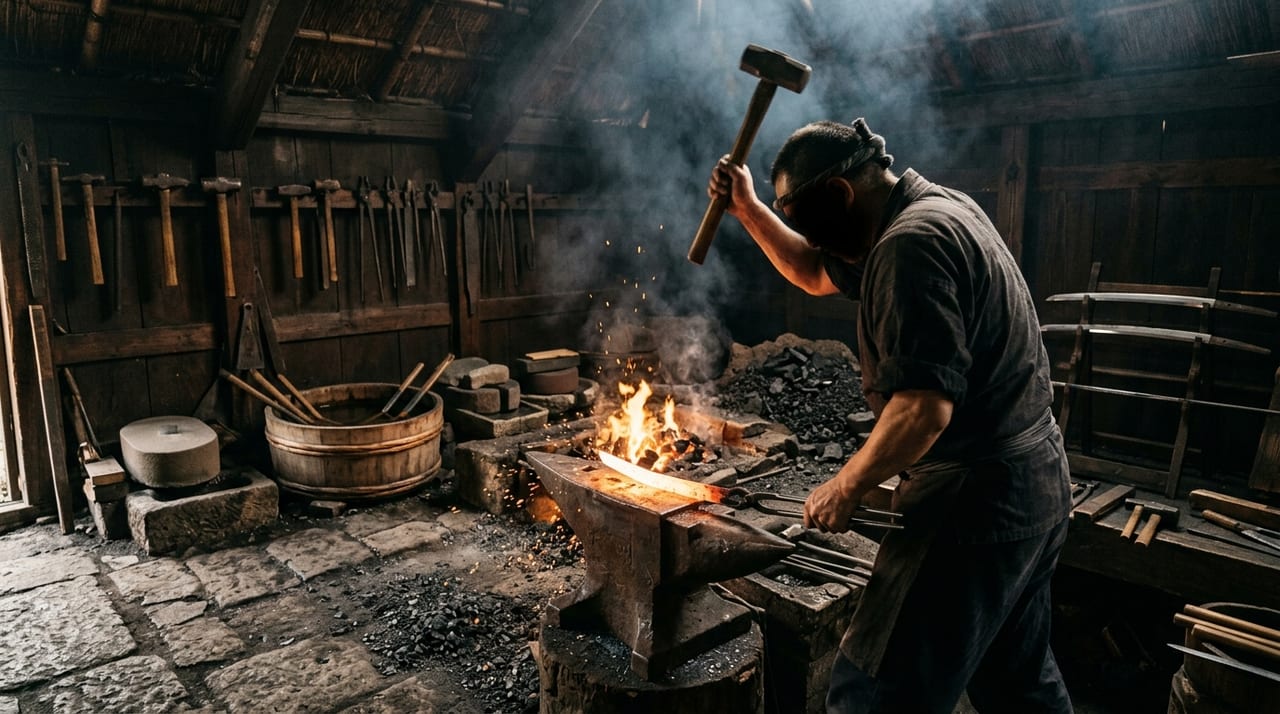
 * Image is for illustrative purposes only.
Sanjō Munechika
三条宗近
Description
Sanjō Munechika was a swordsmith active from the mid to late Heian period in Sanjō, Yamashiro Province (the area around present-day Nakagyō Ward, Kyoto City), and is revered by later generations as the founder of the Yamashiro tradition and one of the most legendary master smiths in the history of Japanese swords. The forging legend of his greatest masterpiece, Kogitsunemaru, recurs in Noh plays and traditional lore, and his extant work Mikazuki Munechika, designated a National Treasure as one of the Tenka Goken (Five Great Swords under Heaven), is the highest-ranking famous sword in the history of Japanese swords.
The greatest characteristic of Munechika's swordsmithing lies in the combination of elegant jigane and hamon that embodies the refinement of Heian aristocratic culture. The jigane is composed of finely packed ko-itame and presents an overall moist, bluish tint. The hamon is mainly komidare, with deep nioi and frequent fine ko-nie, and shows a gentle, dignified yaki-ire. In particular, the crescent-shaped uchinoke seen in the hamon of Mikazuki Munechika is an original design without parallel, and it is highly praised by sword researchers as a clear demonstration of Munechika's individuality and technical achievement.
Mikazuki Munechika is a tachi with a blade length of about 80 cm and an elegant form, and its deep koshi-zori and ko-kissaki display the pinnacle of the Heian style. After passing through the possession of Kōdai-in, the principal wife of Toyotomi Hideyoshi, it passed to the Tokugawa shogunal family as a bequest in Kan'ei 1 (1624). It is now held by the Tokyo National Museum and is made available to researchers and enthusiasts in Japan and overseas. Among National Treasure swords, it enjoys particularly high artistic and historical esteem, and there are also voices praising it as "the finest sword in Japan."
As for Kogitsunemaru, the other representative work, there is a famous legend that Munechika, receiving an imperial command from Emperor Ichijō (reigned 986–1011), forged it with the assistance of a white fox, the messenger of Inari Ōkami. This tale was taken up in the anonymous Noh play Kokaji, composed in the Muromachi period, and became widely known to later generations. Kogitsunemaru, said to have been handed down to the Kujō family, has since been lost, and its whereabouts are unknown.
Kyoto in the mid-Heian period, when Munechika established his residence in Sanjō, corresponded to the height of the Sekkan (regency) government, an era in which aristocratic culture reached its greatest maturity. In this environment, Munechika is regarded as one of the earliest swordsmiths to elevate swords from mere weapons into cultural assets with spiritual and artistic value.
At present, very few extant works by Munechika bear a mei (signature), and there are "Munechika" mei and "Sanjō" mei. In addition to Mikazuki Munechika, a tachi with a "Sanjō" mei at Nangū Taisha and a tachi at Wakasahiko Shrine (attributed to Munechika) are designated Important Cultural Properties, and a tachi with a "Munechika" mei is handed down as an Imperial Household collection (gyobutsu). Because of their rarity and artistic value, Munechika's works hold a unique status even among Japanese sword collections, and they continue to draw the attention of researchers as the ultimate goal of sword research.
Famous Works
- Tachi, signed Sanjō (named Mikazuki Munechika) (National Treasure, Tokyo National Museum)
- Tachi, Kogitsune-maru (whereabouts unknown, legendary sword)
- Tachi, signed Sanjō (Important Cultural Property, Nangū Taisha)