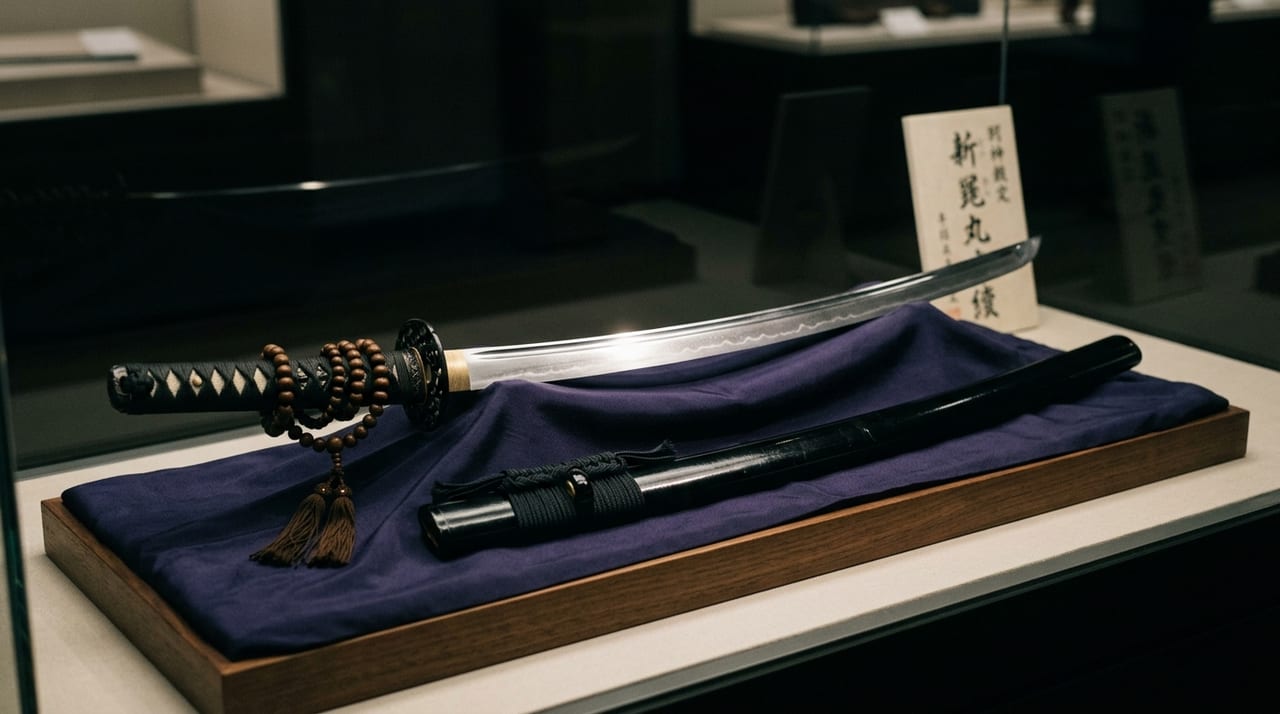
 * Image is for illustrative purposes only.
Juzumaru Tsunetsugu
数珠丸恒次
Also known as: Rosary Blade
Description
Overview of the Sword
A celebrated long sword (tachi) and one of the Tenka Goken, with an unparalleled religious background as the sword worn by Nichiren Shōnin, the founder of Nichiren-shū. With an approximate blade length of 83.7 cm and curvature of about 3.0 cm, its imposing tachi form fully conveys the dignity of an early Kamakura-period ko-tachi.
The Swordsmith
The maker, Aoe Tsunetsugu, was a swordsmith of Bitchū Province (present-day western Okayama Prefecture) and is regarded as one of the representative smiths of Ko-Aoe. However, because of differences in style, there is also a theory that it is a work by Tsunetsugu of the Ko-Bizen school.
Forging Method and Characteristics
The Aoe school was a group of smiths based in Aoe (Kurashiki) in Bitchū Province (present-day Kurashiki city). It had a distinctive style different from the Bizen tradition, and it is especially known for the beauty of its jigane. Tsunetsugu's work is characterized by the clear jigane of the Aoe school: the ko-itame hada is tightly packed, the ji-nie is fine, and the iron color is clean. The hamon is based on suguha with a slight admixture of ko-midare. It is a refined workmanship that, though not flashy, holds deep dignity and stillness. The name "Juzumaru" derives from the fact that prayer beads were wrapped around the tsuka. Nichiren is said to have been captivated by the beauty of the blade, wrapped prayer beads around its tsuka, and worn it as a sword of haja kenshō (shattering evil and revealing the truth). Nichiren Shōnin (1222–1282) was a monk of the Kamakura period who taught faith in the Lotus Sutra and founded Nichiren-shū. His propagation drew fierce persecution from those in power, and he faced mortal danger many times, including exile to Izu and Sado and an attempted execution at Tatsunokuchi (the Tatsunokuchi Persecution). This sword is said to have been given to him by believers as protection when he entered Mount Minobu (present-day Minobu Town, Yamanashi Prefecture) in his later years. After Nichiren's death, Juzumaru was dedicated to Kuon-ji on Mount Minobu, but during the Kyōhō era it went missing from the temple. Around 1919 (Taishō 8), Sugihara Shōzō, a sword enthusiast living in Amagasaki, found it among items put up for sale from a kazoku (aristocratic) collection. When Kuon-ji refused its return, saying its authenticity was doubtful, it was donated to Honkō-ji in Amagasaki, Hyōgo Prefecture, where it remains to this day. In 1922 (Taishō 11) it was designated a National Treasure under the former system, and it is now an Important Cultural Property. It is the only one of the Tenka Goken held by a shrine or temple, and it carries a religious solemnity different from the treasure swords of warrior houses.
Legends & Stories
Legends and Anecdotes
The legend of Juzumaru Tsunetsugu is the most philosophical story in the history of Japanese swords, standing at the intersection of opposing concepts: martial and Buddhist, violence and compassion.
Into the Hands of Warriors
In the Kamakura period, Nichiren Shōnin, who spread the teachings of the Lotus Sutra at the risk of his life, was repeatedly persecuted by those in power because of his fiercely uncompromising proselytizing. After presenting the Risshō Ankoku Ron in 1260 (Bunnō 1), he incurred the anger of monks of other sects and of the shogunate, and his hermitage at Matsubagayatsu was burned in a raid. In 1261 (Kōchō 1) he was exiled to Izu. In 1271 (Bun'ei 8) he was nearly executed at Tatsunokuchi but miraculously escaped (the Tatsunokuchi Persecution), and he was then sentenced to exile on Sado. After his pardon, in 1274 (Bun'ei 11), Nichiren entered Mount Minobu in Kai Province, and it was at this time that this sword was given to him by believers as protection. Nichiren was captivated by the beauty of the blade. He is said to have wrapped prayer beads around its tsuka and worn it as a sword of haja kenshō. When Nichiren passed away in 1282 (Kōan 5), Juzumaru was dedicated to Kuon-ji on Mount Minobu. However, during the Kyōhō era it went missing from the temple. The circumstances of its departure are unknown. The disappearance of one of the Tenka Goken has been passed down as a great mystery in the history of swords. Around 1919 (Taishō 8), Sugihara Shōzō, a sword enthusiast living in Amagasaki, is said to have found Juzumaru among items put up for sale from a kazoku collection. He tried to return it to Kuon-ji, but it was not accepted on the grounds that its authenticity was doubtful. It was therefore donated to Honkō-ji, the head temple of the Hokke-shū Honmon-ryū, in Amagasaki, Hyōgo Prefecture, which is near Sugihara's residence. Since then, Honkō-ji has preserved Juzumaru Tsunetsugu carefully as a temple treasure. As the only "religious sword" among the Tenka Goken, Juzumaru Tsunetsugu is an unparalleled presence that speaks to the depth of spirituality dwelling in the sword.