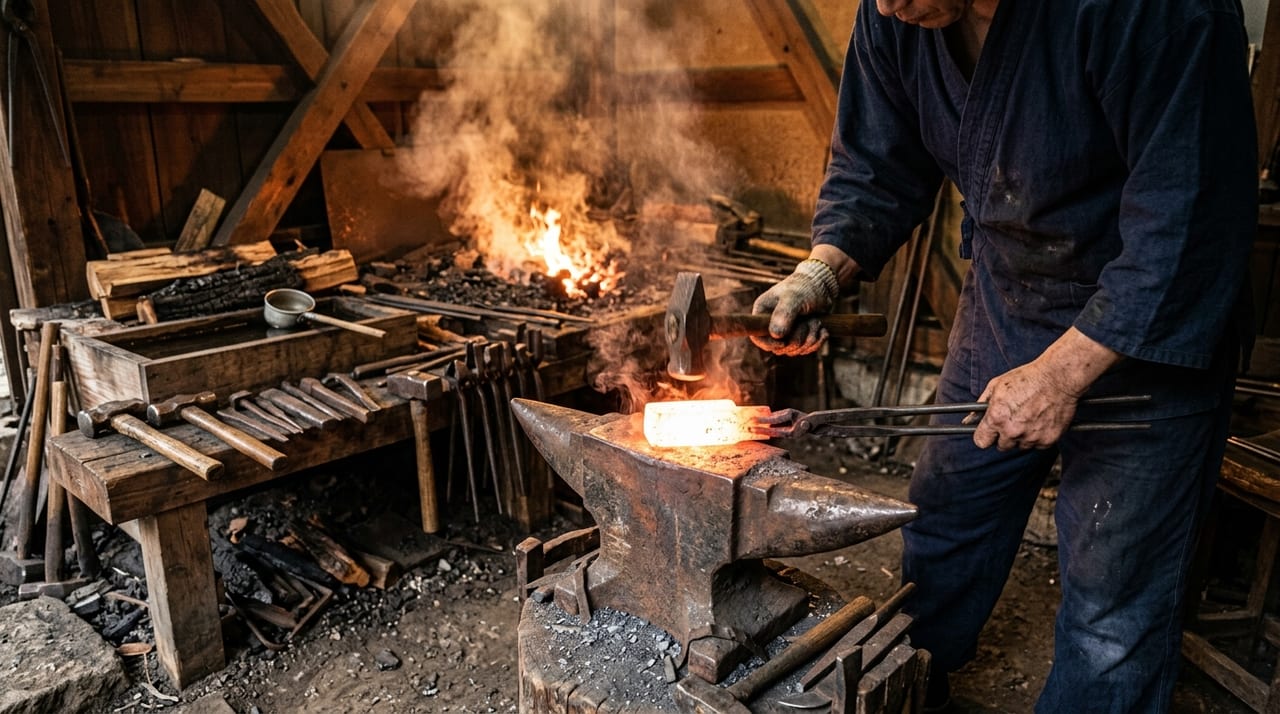
 * Image is for illustrative purposes only.
Miike Tenta Mitsuyo
三池典太光世
Description
Miike Denta Mitsuyo was a swordsmith active in the late Heian period, based in Miike, Chikugo Province (present-day Ōmuta City, Fukuoka Prefecture), and is regarded as the founder of the Miike school of Kyushu. He is said to have lived around the Eihō era (1081–1084), though the precise dates of his life and death are unknown. "Denta" was his common appellation, while "Mitsuyo" was his personal name. Among ancient swordsmiths of Kyushu, he has long been held in exceptional regard as a master craftsman, and his work is ranked among the finest achievements. However, since the signature "Mitsuyo" was perpetuated by later generations of his school, among extant signed works, examples that can be reliably attributed to the first-generation Mitsuyo are exceedingly rare.
His style relates to Kyushu and Bungo works, possessing an ancient and refined quality. The ground steel exhibits well-forged itame grain, and the oily, lustrous surface quality with ground forge activity is characteristic of Miike work. Examining his representative work, the tachi "Daidenta Mitsuyo," the form differs from the slender and graceful tachi configuration typical of the late Heian period; instead, it exhibits a wide blade with a thick spine, displaying bold and sturdy construction. The hamon is a fine, straight pattern with forge activity, interspersed with slight feet, and displays a double-hamon effect in the striking section. It is also characteristic to have a broad, shallow groove—the "Miike groove," which has served as an identifying feature in later authentication.
What has immortalized the name of Miike Denta Mitsuyo is the tachi "Daidenta Mitsuyo," counted among the Tenka Goken. The blade measures approximately 66 centimeters in length (about 2 shaku 2 sun), with a curvature of approximately 2.7 centimeters and a base width of about 3.5 centimeters; the breadth of the blade and its imposing presence set it apart strikingly among works of the period. It was designated a National Treasure in Showa 32 (1957) and is currently in the collection of the Maeda Ikutoku Foundation (Tokyo), a public interest incorporated foundation dedicated to preserving the Maeda family's transmitted cultural properties. As to its provenance, the prevailing account relates that it passed from the Ashikaga shogunate through the hands of Ashikaga Yoshiaki, the last shogun, to Toyotomi Hideyoshi, who then granted it to Maeda Toshiie; thereafter, it was inherited in succession by the Maeda lords of Kaga domain (though various theories exist regarding the interim circumstances).
On the other hand, this blade has attracted numerous spiritual sword legends that must be distinguished from historical fact. The most representative anecdote tells that when a member of the Maeda household fell ill, placing this tachi at the bedside effected a cure; when it was returned, the illness worsened. This led to repeated cycles of borrowing and returning, until finally the sword was given to the Maeda family. Various accounts exist as to the identity of the patient—one attributes it to Gōhime, foster daughter of Toyotomi Hideyoshi and daughter of Toshiie; another to Tamahime, principal wife of Maeda Toshitsune, the second-generation Kaga domain lord. There also exists the tradition of the "warehouse where birds will not perch"—a saying that even birds would not approach the storehouse where this tachi was kept. These are all popular traditions that arose in later periods and are not substantiated by historical sources. However, the very fact that such numerous anecdotes were transmitted is itself evidence that the Daidenta Mitsuyo has been revered from antiquity as a "spiritual sword" and "supreme sword among swords." As one of the Tenka Goken standing alongside Mikazuki Munechika, Dōji Kiri Yasutsugi, Onikiri Kunitsuna, and Juzumaru Tsunetsugu, its reputation remains unshaken to the present day.
Famous Works
- 大典太光世(国宝)