New Arrivals — Browse our catalog for the latest authentic Japanese sword arrivals. Browse →
May 23, 1213 (2nd day, 5th month, Kenryaku 3)
Kamakura, Sagami Province (present-day Kamakura City, Kanagawa Prefecture)
Forces
Wada Yoshimori's Forces
Hōjō Yoshitoki / Shogunate Forces
About 13 min read
In the 5th month of Kenryaku 3 (1213), an internal conflict erupted within the shogunate in Kamakura. This “Wada Rebellion” was an incident in which Wada Yoshimori, who as head of the Samurai-dokoro (the chief of the shogunate's military and police organization) held the military foundation of the Kamakura shogunate, rose in armed rebellion against the shikken (regent) Hōjō Yoshitoki. Yoshimori was a senior warrior who had occupied a central position in the shogunate since the time of Yoritomo, but this rebellion destroyed the Wada clan, and Hōjō control of the shogunate became decisive.
The early Kamakura period coincided with the golden age of old swords (kotō) in Japanese swordmaking, an era when smiths from provinces such as Bizen, Yamashiro, and Yamato competed with one another.
Wada Yoshimori was a warrior who was active from the early days of the Kamakura shogunate. As a member of the Miura clan, he held a firm power base in Sagami Province, and he was one of the principal supporters when Minamoto no Yoritomo established the shogunate in Kamakura. From Yoritomo's rising in Jishō 4 (1180), he followed his lord and supported the military framework of the shogunate as its first head of the Samurai-dokoro. He also took part in the Battle of the Fuji River and in the western campaign against the Taira, a self-made warrior who had risen from the ranks.
Yoshimori was known as a man of martial prowess.
However, after Yoritomo's death (1199), the power structure of the shogunate began to change. When the second shogun, Yoriie, was removed by Hōjō Tokimasa and his son Yoshitoki, and the third shogun, Minamoto no Sanetomo, took office, real power rapidly concentrated in the Hōjō clan. Yoshimori remained a powerful figure in the shogunate with a certain position, yet he continued to be wary of the rise of the Hōjō clan. The opposition between Yoshitoki and Yoshimori was a struggle over the fundamental power structure of the shogunate.
The direct trigger of the Wada Rebellion was the arrest, in Kenryaku 3 (1213), of Wada Tanenaga, a member of the Wada clan and nephew of Yoshimori, on suspicion of joining an anti-Hōjō conspiracy. Yoshimori petitioned Sanetomo for Tanenaga's pardon, but Yoshitoki refused and further inflicted an insult by punishing Tanenaga publicly in front of Yoshimori and his men. This public humiliation before Yoshimori's eyes fundamentally wounded his honor as a warrior.
Tanenaga's arrest resulted from his being implicated in the conspiracy known as the Izumi Chikahira no ran (the Izumi Chikahira conspiracy), which had been uncovered in the 2nd month of the same year. Yoshimori's sons Yoshinao and Yoshishige were also seized, but both had already been pardoned. Furthermore, Yoshitoki temporarily entrusted Tanenaga's confiscated residence to Yoshimori, but later gave it to one of his own housemen (kenin) and drove out Yoshimori's deputy. There are various theories as to whether Yoshitoki deliberately exploited this situation to corner Yoshimori. Yoshimori's side was thus forced to choose between rising in revolt or submitting and losing their status and honor.
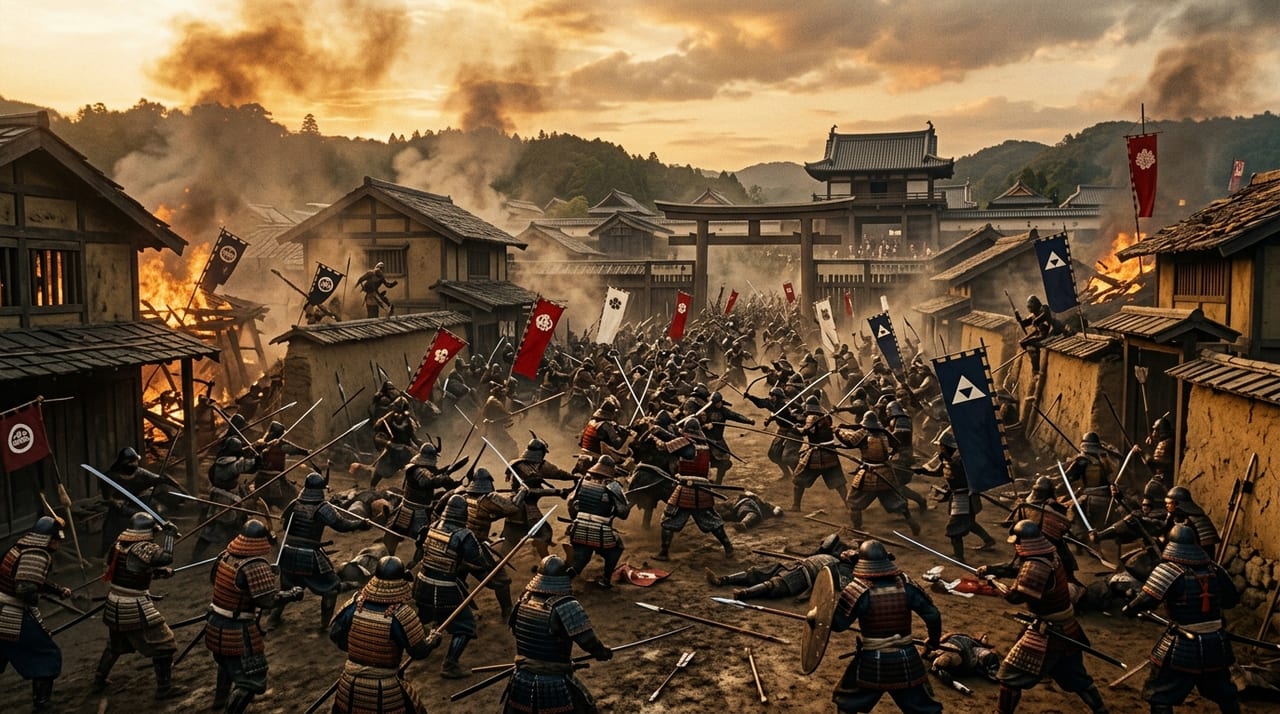
On the 2nd day of the 5th month of Kenryaku 3 (1213), Yoshimori raised his forces. The Wada army, about 150 mounted warriors divided into three groups, attacked the Ōkura Palace of the shogun Sanetomo and the residences of Hōjō Yoshitoki and Ōe no Hiromoto. The battle was fought within the streets of Kamakura. Through the valiant fighting of Yoshimori's third son, Asahina Yoshihide, the palace went up in flames, and Sanetomo fled to the Hokkedō (Yoritomo's memorial hall). As the fierce fighting unfolded, Yoshimori's forces and the Hōjō forces clashed violently in various parts of Kamakura.
Miura Yoshimura (Yoshimori's cousin) had sworn to act as one with Yoshimori and had even written an oath (kishōmon) to that effect. However, on the day of the uprising, after consulting with his younger brother, Miura Taneyoshi, he reported Yoshimori's rising and sided with the shogunate. With the powerful Miura clan on the Hōjō side, the Wada army had to fight with insufficient forces. In the early morning of the 3rd day of the 5th month, the Yokoyama band, more than 3,000 mounted warriors related to Yoshimori by marriage, joined the battle, and the Wada forces regained momentum. However, gokenin who had received a directive (mikyōsho) from the shogun Sanetomo joined the shogunate's side one after another.
The exhausted Wada army collapsed in the evening of the 3rd day of the 5th month. According to the Azuma Kagami, when his beloved son Yoshinao was slain, the 67-year-old Yoshimori cried out in lament, “There is no point in fighting anymore,” and was then struck down by a retainer of Ōe no Yoshinori who attacked him there. At Yuigahama (present-day Kamakura, Kanagawa Prefecture), where Yoshimori fell, Wadazuka still remains today.
The greatest historical significance of the Wada Rebellion lies in its completion of the Hōjō clan's shikken politics. After Yoshimori's death, Hōjō Yoshitoki concurrently held the post of head of the Samurai-dokoro and, by gaining control of both that office and the head of the Mandokoro, completed his power as shikken. From then on, the Kamakura shogunate became a system of shikken politics, in which the Hōjō clan effectively governed in the name of the shogun. This system also repelled the anti-shogunate movement of the retired emperor Go-Toba in the Jōkyū War (1221), and it produced a stable warrior government that lasted more than half a century afterward.
The political peace brought about by the stable rule of the Hōjō clan promoted the flowering of sword culture in the Kamakura period. Under the stability of shikken politics, it is said that smiths were invited to Kamakura from Yamashiro and Bizen, and in Sagami Province the foundation was laid for the “Sōshū den” tradition, which produced Masamune. The shikken system of the Hōjō clan, established through the Wada Rebellion, was precisely the political foundation that supported the sword culture of Kamakura's golden age.
Viewing the opposition between Yoshimori and Yoshitoki from a “bushidō” perspective reveals an interesting contrast. Yoshimori was a typical “ko-bushi” (old-style warrior) who valued martial strength and chivalrous spirit, and his principles of action were based on traditional bushidō: “loyalty to one's lord and duty to one's comrades.” Yoshitoki, on the other hand, was a “politician-type warrior” who gave top priority to cool political calculation and decisive action at the right moment. The concept of “the soul of the warrior” (bushi no tamashii), which the Japanese sword symbolizes, is most strongly associated with the image of the “old-style warrior who values giri and jōgi” (duty and human feeling), as embodied by Wada Yoshimori. In that sense, the Wada Rebellion holds a special place in the history of the Japanese sword as a clash between power and chivalry in “the age of the soul of the warrior.”
Hōjō Yoshitoki
Hōjō Yoshitoki — who suppressed the Wada Rebellion and thereby completed his consolidation of regency power
Hōjō Masako
Hōjō Masako — Yoshitoki's sister, embodiment of shogunal authority, who supported the Hōjō consolidation after Wada
Hatakeyama Shigetada
Hatakeyama Shigetada — Yoritomo's loyal retainer and Yoshimori's contemporary, destroyed by Hōjō machinations two years earlier; the pattern repeated at Wada
Minamoto no Sanetomo
Minamoto no Sanetomo — the third shogun in whose name the battle was fought, increasingly a figurehead for Hōjō authority