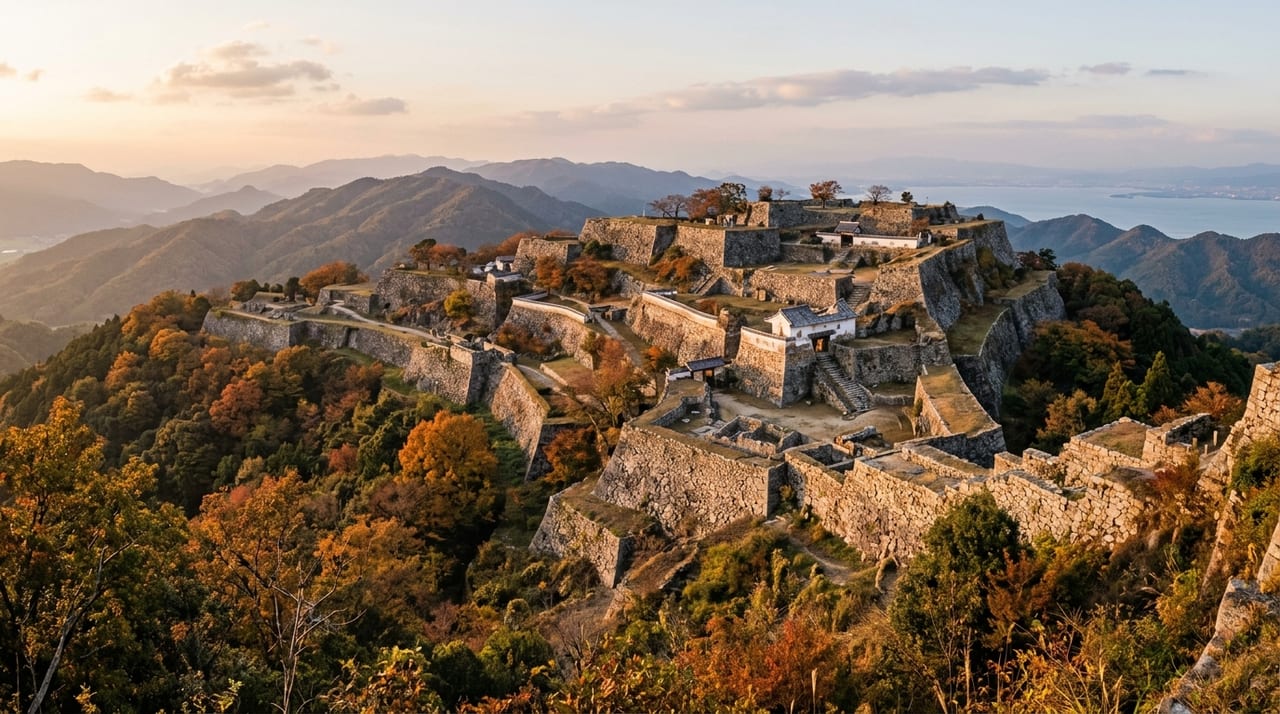
 * Image is for illustrative purposes only.
Kannonji Castle
観音寺城
Kannonji Castle is a historic castle in the Kansai region (First recorded in the Nanbokuchō period (14th century); developed in the first half of the 16th century). Its lord was Rokkaku Sadayori / Rokkaku Yoshikata / Rokkaku Yoshiharu.
Overview
About the Castle
Kannonji Castle is a mountain castle built on Mount Kinugasa (Kinugasa-yama, approximately 432 m above sea level) in Ōmihachiman, Shiga Prefecture. It was the seat of the Rokkaku clan, which ruled the southern half of Ōmi, and it is known for its vast remains, among the largest medieval mountain castle ruins in Japan. It first appears in the Taiheiki as a camp of the Sasaki clan (Rokkaku clan) during the Nanboku-chō period, and in the first half of the 16th century (the 1530s to 1550s) it was developed as a seat that made heavy use of stone walls. The scale of stone walls covering the entire mountain was unprecedented for a mountain castle of its time, and the sight of more than a hundred enclosure sites stepping down the mountainside from the summit of Mount Kinugasa shows the highest achievement of medieval castle architecture.
Rise of the Rokkaku Clan
The Rokkaku clan was a powerful shugo daimyō of the Muromachi shogunate that ruled the southern half of Ōmi. Under Rokkaku Sadayori in particular, the clan held great influence over the political situation in Kyoto through skillful statecraft. Sadayori functioned as the de facto guardian of shogunal power, for example by protecting the shogun Ashikaga Yoshiharu, and at its height the clan's power extended from the Tōsandō into the Kinai. Kannonji Castle was not merely a military fortress. It had the character of a castle town, in which many retainers established residences within the castle and at its foot, and its developed urban functions are regarded as a forerunner of the castle towns of the later early modern period.
Confrontation with Nobunaga
In Eiroku 11 (1568), when Oda Nobunaga, aiming to enter Kyoto, invaded Ōmi with a large army, Rokkaku Yoshiharu withdrew from Kannonji Castle, and the castle was in effect forced to surrender without bloodshed. This episode, in which Kannonji Castle, proud of its mountain defenses, abandoned resistance in the face of Nobunaga's great army, is regarded by historians as an event symbolizing a military paradigm shift in the Sengoku period. Nobunaga then built a new castle (Azuchi Castle) at Azuchi, close to Kannonji Castle, and created a castle town with continental design and the most advanced architectural techniques.
Scale and Value of the Remains
The remains of Kannonji Castle still survive across the entire mountain of Mount Kinugasa, and stone walls, enclosures, koguchi (gate entrances), and horikiri (dry moats) are preserved in remarkably good condition. In particular, the stone walls around the honmaru are impressive examples of the nozura-zumi technique, conveying to the present day the high level of medieval stone-wall technology. On the mountain stands an old temple, Kannonshō-ji, and this castle, in which castle and temple form a single unified structure, occupies a special position in the history of medieval Japanese castles.
Culture and Transportation of Ōmi
Ōmi has long been a key crossroads of east-west traffic, prospering as the point where the Tōkaidō, Nakasendō, and Hokurikudō intersect. This geographic advantage contributed not only to logistics but also to the accumulation of culture, and the lords of Kannonji Castle were in an ideal position to gather the goods, crafts, and swords of every part of Japan. Today, trails to Mount Kinugasa have been developed, and the route that follows the castle ruins via Kannonshō-ji is a special historical experience in which one can feel the fusion of medieval castle and religion.
Connection to Swords
As one of the provinces closest to Kyoto, Ōmi is where the culture of the capital and the military power of the east intersect. The shugo daimyō who governed Ōmi, controlling the supply routes to Kyoto, the greatest consumer of swords, held an important position in sword distribution. After Nobunaga entered Kannonji Castle without bloodshed and built Azuchi Castle, this area became an even more important stage of sword culture. Azuchi Castle is the symbol of Nobunaga's tenka fubu. At the Shiga Prefectural Azuchi Castle Archaeological Museum, near the Azuchi Castle ruins, archaeological materials related to arms and swords of Sengoku-period Ōmi are on display, and together with Kannonji Castle it is a core facility for a journey through Ōmi's castles and sword culture. When you climb Kannonji Castle and look out over Lake Biwa and the Ōmi Plain below, you can feel as if the medieval scene of swords worn by Rokkaku warriors catching the light in the wind still lives on in the air of this place.
Highlights
- More than a hundred enclosure sites and stone walls — one of Japan's largest medieval mountain castle ruins, with nozura-zumi stone walls preserved throughout
- Kannonshō-ji — an old temple that existed within the castle grounds, still visited by pilgrims today as the 32nd temple of the Saigoku Thirty-Three Kannon Pilgrimage
- Views of Lake Biwa and the Ōmi Plain from Mount Kinugasa — a panorama of southern Ōmi, which the Rokkaku clan ruled
- Azuchi Castle ruins (within walking distance or by car) — a contrast with the castle of all under heaven that Nobunaga built in place of Kannonji Castle
- Shiga Prefectural Azuchi Castle Archaeological Museum — displays arms and archaeological materials of Sengoku-period Ōmi
* Opening hours and admission fees are subject to change. Please check the official website before visiting.