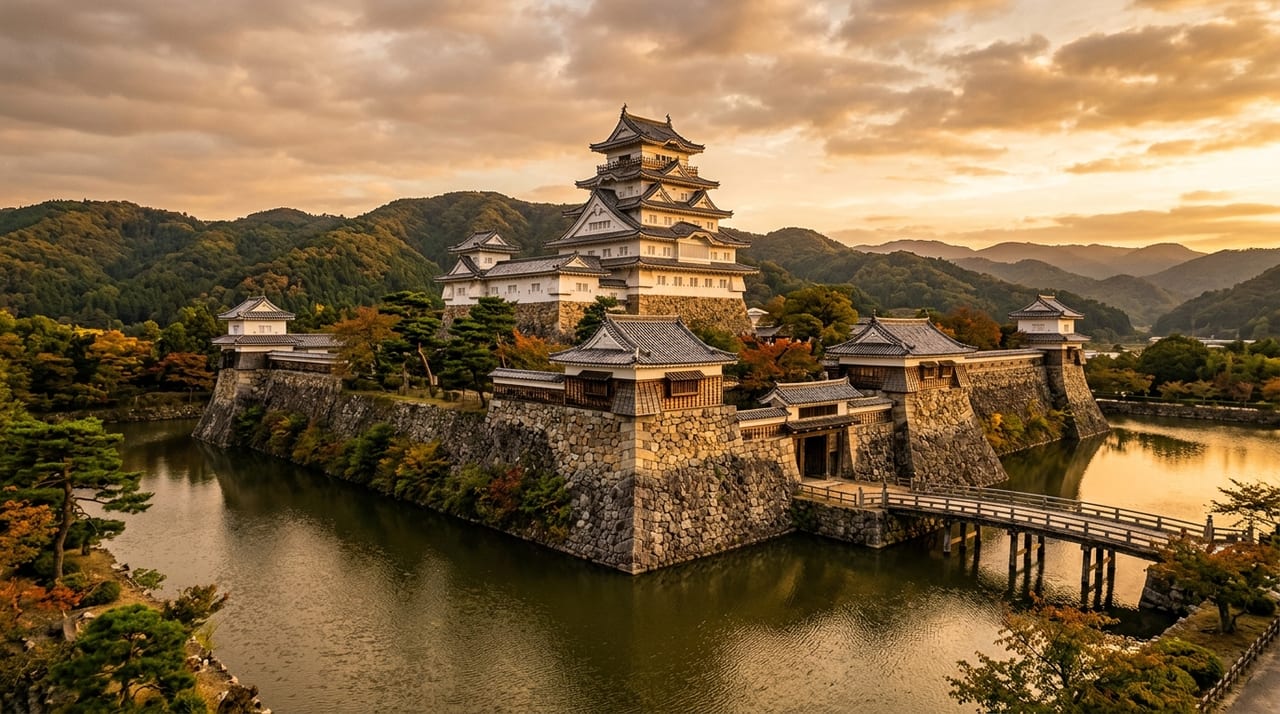
 * Image is for illustrative purposes only.
Sasayama Castle
篠山城
Sasayama Castle is a historic castle in the Kansai region (Built in 1609 (Keichō 14)). Its lord was Matsudaira Yasushige (first lord of Sasayama domain).
Overview
About the Castle
Sasayama Castle is a strategic fortress that Tokugawa Ieyasu built in 1609 (Keichō 14) as a western-domain-suppression castle to restrain the western daimyo. Located in the center of the Sasayama Basin in Tamba Province, this castle once served as the 'Stronghold of Tamba,' controlling a key transportation hub linking the San'indō and San'yōdō routes, and it played a role in monitoring the movements of Toyotomi remnants and western daimyo. Ieyasu had the castle built through a construction system called tenka bushin, which mobilized daimyo from across the country, and it was completed in a short period of about six months. Tōdō Takatora was in charge of the design, and the beautiful stone walls and moats, in which his outstanding castle-building skill was fully displayed, are the greatest highlight of Sasayama Castle.
Tōdō Takatora's Castle-Building Art
Tōdō Takatora is known as a 'master of castle construction' who designed and renovated more castles than anyone from the Sengoku period through the early Edo period, and he worked on many famous castles, including Imabari Castle, Uwajima Castle, and Iga-Ueno Castle. Takatora's design for Sasayama Castle is characterized by straight stone walls and expansive moats that pursue the rationality of castle defense, and castle researchers highly regard it as an exemplary case of early modern castle architecture. The structure, in which the Honmaru, Ninomaru, and Sannomaru are protected in layers by water-filled and dry moats, shows Takatora's true essence, with both offense and defense carefully calculated. The Ōshoin was reconstructed in wood in 2000 (Heisei 12), and was revived as a magnificent building that faithfully reproduces the design of early Edo-period samurai shoin-zukuri architecture.
The Culture and Landscape of Tanba Sasayama
Tanba Sasayama is a basin surrounded by rich nature, known for its diverse food and agricultural culture, including Tanba black soybeans, Tanba chestnuts, Tanba Sasayama matsutake mushrooms, mountain yam, and Dekansho Bushi. 'Dekansho Bushi' was originally a song that young men of Sasayama Domain sang and danced to, and it is said to derive either from philosophers (also the initials of Descartes, Kant, and Schopenhauer) or from the lively call 'dekansho.' The castle town preserves samurai residences, townhouses, and old shopping streets, and it has been designated as an Important Preservation District for Groups of Traditional Buildings at the national level. The natural environment of Tanba Sasayama, where samurai culture and agricultural culture merge, also adds its own distinctive color to sword culture.
Tanba Swords and Samurai Culture
Because Tanba Province had long been an important transportation hub, it fostered its own distinctive samurai culture while being influenced by Kyoto's sword culture. Samurai of Sasayama Domain trained diligently at swordsmanship dojo in the castle town and passed on the spirit of bushidō to the next generation. In the Edo period, the Aoyama clan (later period) handled domain governance at Sasayama Domain, and under its earnest domain character, both martial arts and scholarship were encouraged. At the Tamba-Sasayama City Museum of History and Art, arms and armor passed down in the castle town are on display, centered on the household collection of the Aoyama family, lords of Sasayama Domain.
Preservation of the Castle Town and Tourism
The Sasayama Castle ruins are protected as a national historic site, and the castle town is protected as an Important Preservation District for Groups of Traditional Buildings. As a rare castle town where Edo-period streetscapes remain in many places, it attracts tourists from across the country. Especially during the autumn harvest season for black soybeans and Tanba chestnuts, many travelers visit, and it is highly regarded as a model of castle-town tourism where visitors enjoy strolling the castle ruins and gourmet food. Sasayama Castle is both a product of Ieyasu's strategy aimed at the western domains and a masterpiece of Tōdō Takatora, a genius castle builder, and it is a living historical space where the essence of Edo-period castle-town culture still lives on. Visiting Tanba Sasayama is also a journey to discover the richness of Japan's regional culture, in which samurai culture, agricultural culture, and food culture come together as one.
Connection to Swords
The connection between Sasayama Castle and sword culture starts with its close ties to Tokugawa Ieyasu, Japan's greatest sword collector and connoisseur. Ieyasu loved swords throughout his life. The most famous is the 'Monoyoshi Sadamune,' and Sadamune is a figure who receives the highest acclaim as a disciple of Masamune, the late Kamakura-period master who stood at the peak of the Sōshū tradition. Ieyasu is said to have always kept famous swords at hand, both on the battlefield and when reading, and this attachment to swords was directly reflected in the Edo shogunate's sword policies and views on swords. Castle construction at Sasayama was carried out for the political and military purpose of restraining the western daimyo. At the Tamba-Sasayama City Museum of History and Art, arms and armor passed down in the castle town are on display, centered on the household collection of the Aoyama family, lords of Sasayama Domain. When visiting Sasayama Castle, we recommend also visiting the nearby history museum along with the exhibits in the Ōshoin, and appreciating them while comparing Tanba's sword culture with the daily life of samurai. This land, which Ieyasu chose to suppress the western domains, is a place where the martial will is concentrated, and that martial spirit still resides in each stone of this castle's walls.
Highlights
- Sasayama Castle Ōshoin (wooden reconstruction, 2000 (Heisei 12)) — A magnificent building faithfully reproducing early Edo-period samurai shoin-zukuri architecture
- Beautiful stone walls and water moats — A masterpiece of early modern castle architecture where Tōdō Takatora's castle-building skill shines
- Tamba-Sasayama City Museum of History and Art — Exhibits arms and armor and works of arts and crafts, centered on the household collection of the Aoyama family, lords of Sasayama Domain
- Samurai residences and merchant houses in the castle town — A rare historic townscape where Edo-period streetscapes still remain
- Autumn Tanba black soybeans and Tanba chestnuts — Famous Tanba farm produce and castle-town gourmet food renowned throughout the land
- Dekanshō Festival (August) — A summer festival held at the Third Citadel Plaza of the Sasayama Castle ruins
* Opening hours and admission fees are subject to change. Please check the official website before visiting.