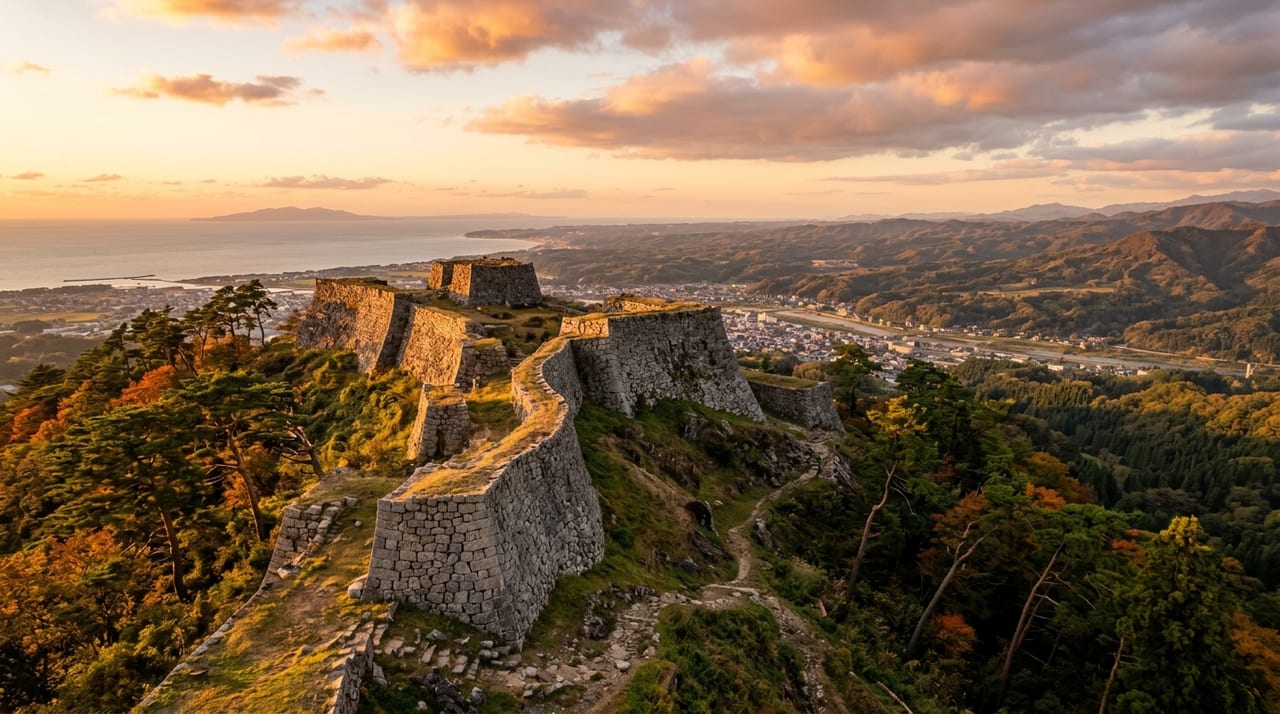
 * Image is for illustrative purposes only.
Hachimanyama Castle
八幡山城
Hachimanyama Castle is a historic castle in the Kansai region (Built in 1585 (Tenshō 13)). Its lord was Toyotomi Hidetsugu.
Overview
Hidetsugu's Phantom Castle
Hachimanyama Castle was a mountain castle that Toyotomi Hidetsugu, the nephew of Toyotomi Hideyoshi, built in Tenshō 13 (1585) on the summit of Mount Hachiman, at an elevation of 271.9 meters on the southeastern shore of Lake Biwa. At the same time that Hideyoshi abolished Azuchi Castle and established Jurakudai in Kyoto, Hidetsugu set up a new base in this place. In developing the castle town, Hidetsugu continued the rakuichi-rakuza policy and laid the foundations for Ōmihachiman, which promoted the growth of the Ōmi merchants. However, Hidetsugu moved to Kiyosu in Owari in Tenshō 18 (1590), and afterward, once Kyōgoku Takatsugu had become castle lord, the castle was abandoned in Bunroku 4 (1595) in connection with the Hidetsugu Incident.
Hidetsugu and the Birth of Ōmihachiman
The greatest legacy of the construction of Hachimanyama Castle is the birth of the castle town "Ōmihachiman." Hidetsugu laid out a grid-pattern town plan at the foot of Mount Hachiman and resettled merchants and artisans from the castle town of Azuchi. In particular, the merchants who moved from Azuchi, taking this relocation as their opportunity, formed the core of a commercial network that spread nationwide as the "Ōmi merchants." Under the rakuichi-rakuza policy, free commercial activity was guaranteed, and Ōmihachiman rapidly developed as a hub of Lake Biwa water transport via Hachiman-bori. Even after the castle was abandoned, the town continued to prosper on its own vitality, and throughout the Edo period it flourished as one of the home bases of the Ōmi merchants.
Toyotomi Hidetsugu, the Tragic Lord of the Castle
The life of Toyotomi Hidetsugu, lord of Hachimanyama Castle, is recorded in history as a dramatic tragedy of a fall from the summit of power. Hidetsugu was born as the child of Hideyoshi's elder sister, and in Tenshō 19 (1591) he became Hideyoshi's adopted son and succeeded to the post of kanpaku. However, in Bunroku 2 (1593), with the birth of Hideyoshi's biological son Hideyori, Hidetsugu's position rapidly deteriorated. In Bunroku 4 (1595), Hidetsugu was suspected of plotting rebellion, was ordered into confinement at Mount Kōya, and was then forced to commit suicide. He was only 28 years old at his death. This was followed by a brutal purge in which several dozen members of Hidetsugu's family, including his wives, concubines, and children, were executed at the Sanjō riverbed in Kyoto. The incident is passed down to later generations as an event symbolizing the ruthlessness of the power struggles of the late Sengoku period.
Hachimanyama Castle Today
Today, remains of stone walls are well preserved on the summit of Mount Hachiman, and visitors can ascend to the top using the Hachimanyama Ropeway. From the summit, one can take in a 360-degree panorama of all of Lake Biwa, Lake Nishinoko, and the Ōmi Plain, and this magnificent view captivates visitors. On the site of the main enclosure (honmaru) at the summit stands Murakumo Gosho Zuiryū-ji, a temple founded in Kyoto by Hidetsugu's mother, Nisshū-ni, to pray for the repose of Hidetsugu's family; it was moved to this site in Shōwa 38 (1963). It still welcomes worshippers today. Hachiman-bori around the castle ruins is a remnant of the water moat from that era, and the scene of whitewashed storehouses lining its banks is also renowned as a filming location for period dramas.
Connection to Swords
Toyotomi Hidetsugu served briefly as lord of Hachimanyama Castle before becoming kanpaku. Hidetsugu is said to have inherited Hideyoshi's cultural policies and to have actively collected swords, alongside the tea ceremony and Noh theater. Murakumo Gosho Zuiryū-ji, Hidetsugu's family temple, preserves relics associated with Hidetsugu, transmitting to the present day a glimpse of the warrior culture of that time.
Highlights
- Remains of summit stone walls — well-preserved stonework of an early-modern mountain castle
- Hachimanyama Ropeway — means of access from the foot of the mountain to the summit castle site
- 360-degree panorama of Lake Biwa and the Ōmi Plain — magnificent view from the summit observation deck
- Murakumo Gosho Zuiryū-ji — family temple of the Toyotomi Hidetsugu clan, founded by Nisshū-ni
- Hachiman-bori — remnant of the castle-town water moat, lined with whitewashed storehouses and a period-drama filming location
- Ōmihachiman townscape — historic landscape where the townscape of Ōmi merchants coexists with Western-style architecture
* Opening hours and admission fees are subject to change. Please check the official website before visiting.