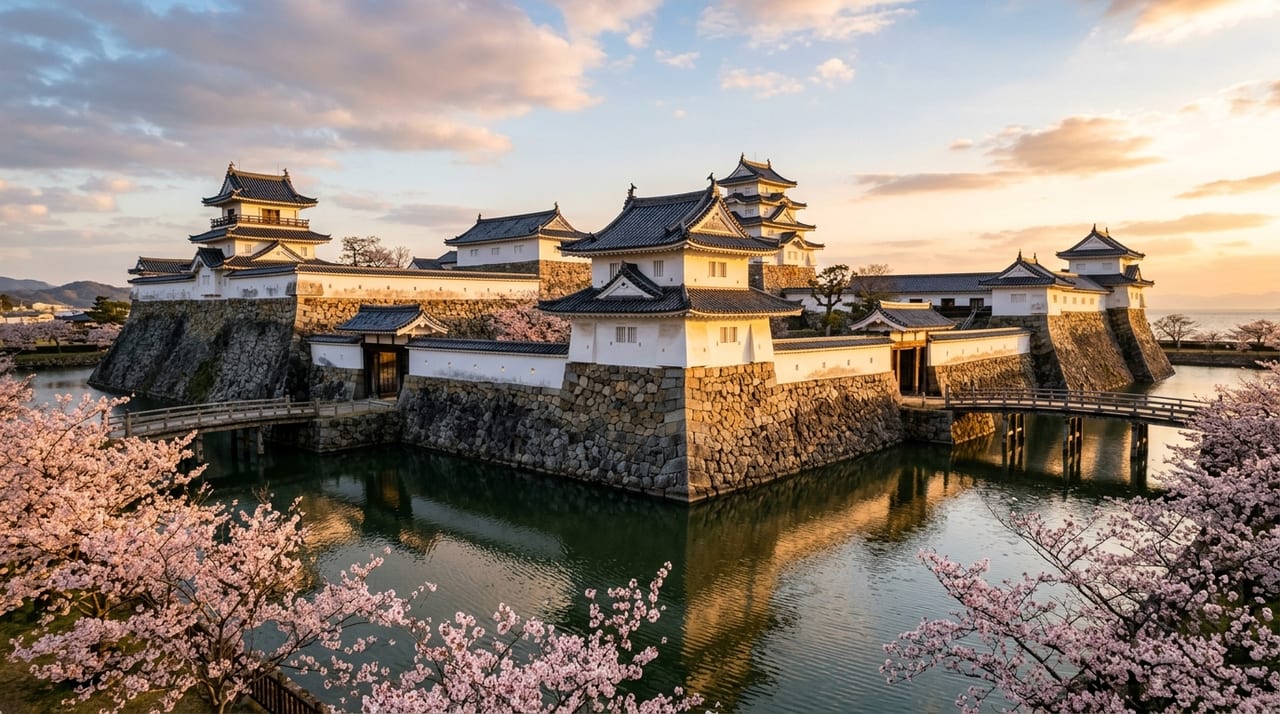
 * Image is for illustrative purposes only.
Yodo Castle
淀城
Yodo Castle is a historic castle in the Kansai region (Edo period (construction begun in 1623, largely complete by around 1625)). Its lord was Matsudaira Sadatsuna of the Hisamatsu-Matsudaira house; later the Nagai, Ishikawa, Toda and Matsudaira, and from Inaba Masatomo (installed 1723) the Inaba clan until the Meiji Restoration.
Overview
Overview
Yodo Castle was an Edo-period flatland castle in Yodo-Honmachi, Fushimi Ward, Kyoto. It stood at a strategic point on the southern edge of Kyoto where the Uji, Kizu and Katsura rivers converge, commanding both river traffic and overland routes. Throughout the Edo period it served as the seat of Yodo domain and guarded the southern approach to Kyoto.
Founding
In 1623, following the abolition of Fushimi Castle, the second shogun Tokugawa Hidetada ordered Matsudaira Sadatsuna to build a new castle here as a base for the defense of Kyoto. Sadatsuna moved that year from Kakegawa in Tōtōmi to found Yodo domain, and with shogunal support the castle was largely complete by about 1625 — in effect transferring to Yodo the defensive role that Fushimi had held.
Material Taken from Fushimi Castle
The Tokugawa Jikki records an order to move Fushimi Castle's halls to Yodo, and dismantling surveys of the main bailey and keep base have indeed turned up stones bearing masons' marks matching those found at the Fushimi Castle site. Tradition also holds that the keep itself was relocated from Nijō Castle. Said to have been a five-story, five-level keep with a basement in the renritsu watchtower style, it burned after a lightning strike in 1756 and was never rebuilt.
Succession of Lords
Matsudaira Sadatsuna was transferred to Ōgaki in Mino in 1633, after which the Nagai, Ishikawa, Toda and Matsudaira families held the castle in turn. Only with the arrival of Inaba Masatomo in 1723 did a single house settle in permanently, and the Inaba remained lords of Yodo until the Meiji Restoration. The Inaba house is connected by descent to Kasuga no Tsubone, the wet nurse of Tokugawa Iemitsu.
Not to Be Confused with Yodo Kojō
The castle famous as the birthplace of Toyotomi Hideyoshi's son Tsurumatsu, borne by his concubine Chacha (Yodo-dono), is a different fortress known as Yodo Kojō ("old Yodo Castle"), which stood roughly 500 meters north of the present ruins. Dating from the Muromachi and Azuchi-Momoyama periods, it was abolished in the wake of the Toyotomi Hidetsugu affair. It differs from the Tokugawa-era Yodo Castle in builder, period and location alike, and the two are often conflated.
Present State
After the Meiji era the castle buildings were lost, and urban growth and railway construction heavily altered the grounds. Even so, the stone walls and keep base of the main bailey and part of the inner moat survive in good condition and are preserved as Yodo Castle Ruins Park. The massive stones and masons' marks still visible convey the standard of castle engineering in the Kinai region under the early Tokugawa shogunate.
Connection to Swords
No sword is recorded as having been kept at Yodo Castle itself. The Inaba house, however — lords of Yodo from 1723 until the end of the Edo period — left its name on the history of the Japanese sword. A National Treasure blade attributed to Gō Yoshihiro of Etchū, one of the three smiths ranked as the "Tenka Sansaku," bears the sobriquet "Inaba-gō," a name derived from its ownership by Inaba Shigemichi, the uncle and adoptive father of Kasuga no Tsubone. In 1585 Shigemichi is said to have had the connoisseur Hon'ami Kōtoku authenticate it as Yoshihiro's work, and to have had the tachi shortened and remounted as a katana. The Inaba of Yodo descend from Inaba Masanari — husband of Kasuga no Tsubone — who married into the family as the son-in-law of Shigemichi, himself a son of Inaba Ittetsu; the house is thus tied by blood and marriage to the man whose name the blade carries. The sword itself, however, passed early to Tokugawa Ieyasu and is said to have been presented afterward to Yūki Hideyasu, so it was never held at Yodo Castle. It is today in the collection of the Kashiwabara Art Museum in Yamaguchi Prefecture and designated a National Treasure. No record links castle and blade directly, yet the fact that the name of Yodo's ruling house survives as the sobriquet of a famous sword illustrates one way in which daimyo families and swords were bound together.
Highlights
- Main bailey walls and keep base — stones bearing masons' marks matching the Fushimi Castle site
- Surviving inner moat — preserved in Yodo Castle Ruins Park, still evoking the water-filled defenses
- A stronghold at the river confluence — commanding the Uji, Kizu and Katsura rivers south of Kyoto
- Site of the five-story keep — destroyed by lightning in 1756, leaving only the stone base
- Distinct from Yodo Kojō — the Toyotomi-era "old Yodo Castle" stood about 500 m to the north
* Opening hours and admission fees are subject to change. Please check the official website before visiting.