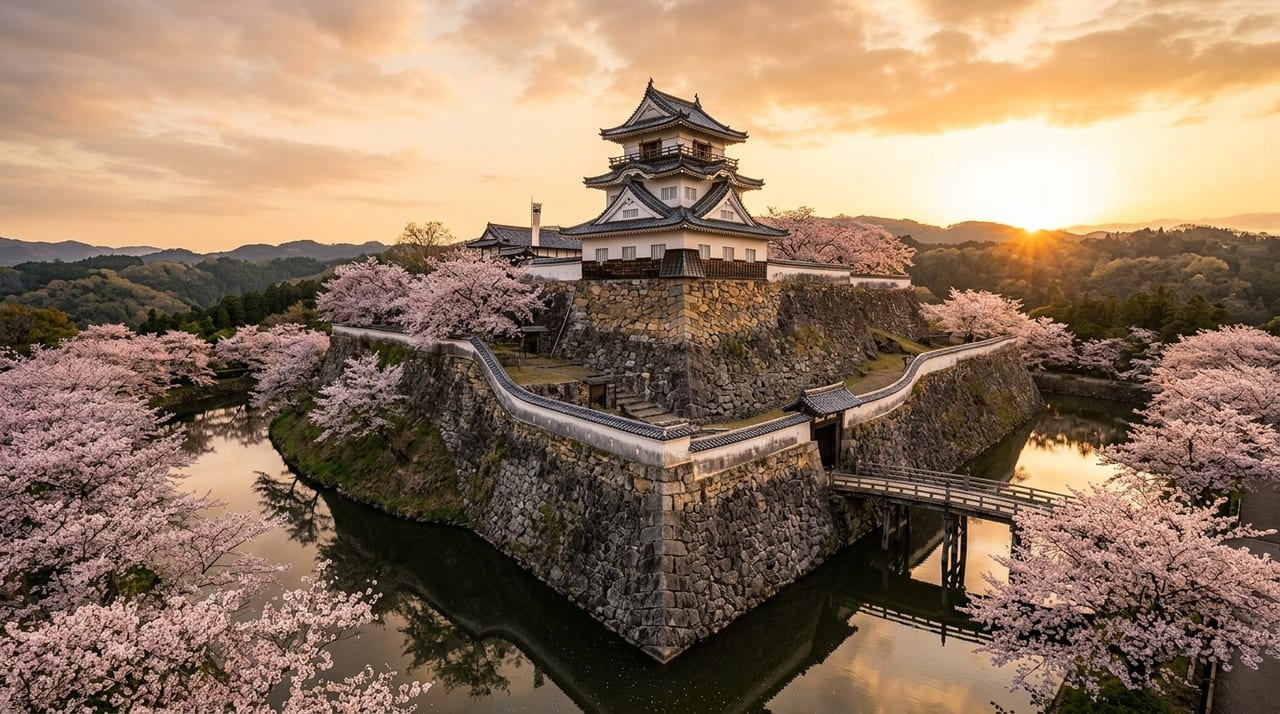
 * Image is for illustrative purposes only.
Negoro Castle (Iwade)
根来城(岩出)
Negoro Castle (Iwade) is a historic castle in Kansai dating from the Tenshō period (c. 1573–1592), whose lord was Negoro-ji / Negoro-shu.
Overview
Negoro-ji and the Negoro-shu
Negoro Castle (Iwade) is a unique historical site known as the stronghold of the Negoro-shu, the warrior-monk contingent of Negoro-ji, which wielded power in Kii Province. Negoro-ji was founded in the late Heian period by Kūkain (Kakuban) as an independent offshoot of the Shingon school called the Shingi Shingon sect, serving as its head temple. Throughout the medieval period, it dominated Kii as an armed religious power, controlling vast temple lands and commanding a large corps of warrior-monks. The Negoro-shu are particularly notable as Japan's first organized large-scale firearms unit. When firearms were introduced to Tanegashima by Portuguese in Tenbun 12 (1543), Negoro craftsmen refined and mass-produced them, making the Negoro-shu Japan's first organized firearms operators.
Firearms and the Sengoku Period
While Oda Nobunaga's famous three-line volley of firearms at the Battle of Nagashino (1575) devastated the Takeda cavalry corps, the Negoro-shu had already been employing firearms in actual combat beforehand. Along with the Saika-shu, the Negoro-shu worked as mercenary units hired by daimyo across the realm, and their firearms expertise transformed the Sengoku battlefield. During Toyotomi Hideyoshi's campaign against Kii in Tenshō 13 (1585), Negoro-ji was burned and the Negoro-shu were destroyed. However, Negoro firearms technology survived, and descendants of the Saika-shu and Negoro-shu became the gunmakers of the Edo period.
Negoro-ji Today
Today, Negoro-ji retains its Great Pagoda (National Treasure) and many Important Cultural Property structures that escaped Hideyoshi's burning, preserving Negoro's historical glory to the present day. Negoro's Tahō Pagoda (Great Pagoda), built in the Muromachi period, is the largest surviving wooden tahō pagoda in Japan; its grand architecture speaks to the prosperity of medieval Negoro-ji. An exhibition of Negoro lacquerware (negoro-nuri) within the temple precincts conveys a glimpse of Negoro's craftsman culture to the present. Negoro lacquerware is crafted by layering black lacquer beneath red lacquer, revealing the black underneath as the piece is used, creating a distinctive aesthetic that was prized in warrior society. Negoro-ji remains an active place of worship today, and the unique atmosphere created by the harmonious blend of nature and historic architecture within its precincts deeply moves history seekers.
Connection to Swords
While the Negoro-shu are famous as revolutionaries in firearms, their relationship with swords and blades is equally deep and fascinating. Negoro craftsmen possessed outstanding metalworking expertise developed through firearms manufacturing, and this skill was also applied to the production of katana and wakizashi. While carrying firearms, the Negoro warrior-monks also bore swords and blades as the soul of the warrior, employing a hybrid armament that combined both firearms and swords. Kii Province has long been known as a sword-making center called "Kishū mono" (Kii blades), and the legend of Kishū Masamune hints at the possibility that techniques passed by Sōshū Masamune to his disciples took root in Kii. Negoro-ji's vast wealth afforded it the means to acquire celebrated swords from across the realm, and it is said that its treasure vault concealed swords and blades accumulated by successive abbots. When Negoro-ji was burned during Hideyoshi's campaign against Kii, many treasures were lost, though some blades were carried away by fleeing warrior-monks and dispersed throughout the realm. The forging techniques cultivated by the Negoro-shu through firearms manufacturing were inherited by the blademaking industry of Wakayama Prefecture during the Edo period. Along with Negoro lacquerware, the metalworking techniques of Negoro formed the two wheels of Kii's craftsman culture, and as the home territory of Kishū Tokugawa, one of the Tokugawa cadet houses, it contributed to the sword culture of the Edo period. The Kishū Tokugawa house is renowned for its collection of celebrated swords, a collecting tradition supported by the accumulated craftsman techniques of Negoro and Sakai. The Wakayama Prefectural Museum houses swords and firearms related to Kii, along with Negoro artifacts, making it a valuable facility for surveying the evolution of weapon technology from blade to firearm.
Highlights
- Negoro-ji Great Pagoda (National Treasure) — the largest surviving wooden tahō pagoda, a masterpiece of Muromachi architecture
- Negoro-ji Temple Precincts — a sacred precinct dotted with Important Cultural Property structures that escaped Hideyoshi's burning
- Negoro Lacquerware (negoro-nuri) Craftsmanship — Negoro's distinctive lacquerware created by the dual layers of red and black lacquer
- Firearms Introduction and Negoro-shu History Exhibition — explaining the reality of Japan's first organized firearms unit
- Nature of Iwade Negoro Park — harmony between the deep forest encircling the temple precincts and historic architecture
- Wakayama Prefectural Museum (Wakayama City) — swords, firearms, and art crafts related to the Kishū Tokugawa house
* Opening hours and admission fees are subject to change. Please check the official website before visiting.