New Arrivals — Browse our catalog for the latest authentic Japanese sword arrivals. Browse →
18th day, 8th month, Bunkyū 3 (September 30, 1863)
Environs of the Imperial Palace, Kyoto (near the Sakaimachi Gate)
Forces
Satsuma-Aizu Alliance (Kōbu-gattai Faction)
Chōshū Domain and Radical Sonnō-Jōi Faction
About 13 min read
As the Sakuradamon Incident (1860) and the Sakashitamon Incident (1862) were followed by a series of political assassinations that shook the shogunate, the politics of Kyoto changed rapidly. By Bunkyū 3 (1863), Kyoto was at the height of the influence of the radical sonnō jōi faction (revere the emperor, expel the barbarians), centered on Chōshū domain.
In Bunkyū 2 (1862), Shimazu Hisamitsu (father of the lord of Satsuma domain) led troops to Kyoto and pressed for reform of the shogunate's government. During this process, tensions between Satsuma and Britain also rose, and the Namamugi Incident occurred. The shogunate carried out reforms such as the easing of the sankin-kōtai (alternate attendance) system and the creation of the posts of shogun's guardian and Supreme Councilor for Political Affairs. As a result, Hitotsubashi Yoshinobu and Matsudaira Shungaku (of Echizen) came to take part in the government of the shogunate.
In Kyoto, however, Chōshū domain began to carry out radical expulsion campaigns that invoked the authority of Emperor Kōmei. In Bunkyū 3 (1863), Shogun Tokugawa Iemochi, who had traveled to Kyoto, was pressed by the imperial court to carry out the expulsion of foreigners. He agreed to set the 10th day of the 5th month as the deadline for carrying it out. Chōshū domain actually fired on foreign ships passing through the Shimonoseki Strait, creating a record of having "carried out the expulsion."
In Kyoto at this time, political assassinations carried out in the name of "tenchū" (heaven's punishment) were rampant. Under the logic that "those who cooperate with the shogunate will receive heaven's punishment," many people were assassinated. Those regarded as pro-shogunate were cut down, and incidents in which their heads were displayed in public followed one after another, until even the Kyoto Deputy could not cope. Amid this tension, Chōshū domain came to hold enough influence in Kyoto to be entrusted with guard duties at the Imperial Palace.
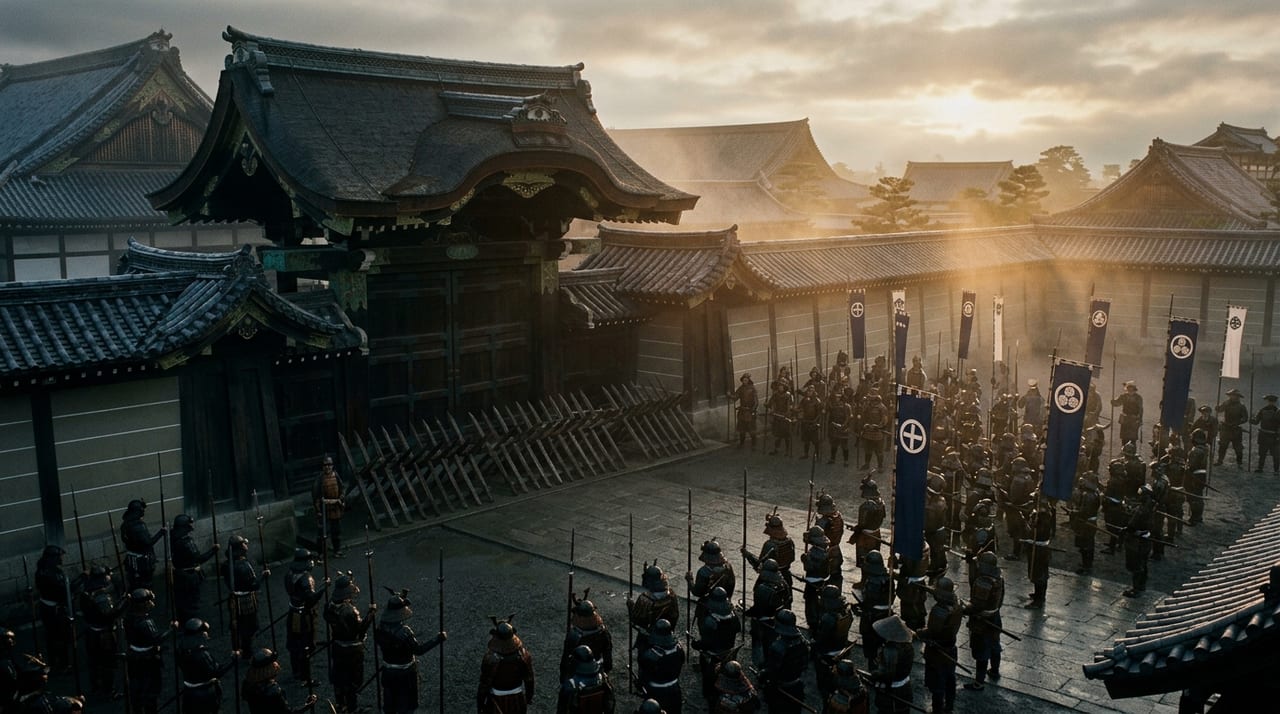
Before dawn on September 30, 1863 (Bunkyū 3/8/18), Satsuma and Aizu domains acted in coordination. Having obtained Emperor Kōmei's approval through Prince Nakagawa-no-miya Asahiko, the two domains quietly took control of each of the gates of the Imperial Palace.
When morning came, troops from Chōshū domain tried to take up their assigned duty of guarding the palace, but Satsuma and Aizu troops had already sealed all the gates. Chōshū domain was forbidden to enter the palace and lost its voice within the imperial court in a single night.
At the same time, the radical court nobles who had sided with Chōshū also lost their freedom of action. Sanjō Sanetomi, Sanjōnishi Suetomo, Higashikuze Michitomi, Mibu Motonaga, Shijō Takauta, Nishikinokōji Yorinori, and Sawa Nobuyoshi, seven radical court nobles known as the "Seven Nobles," lost their place in Kyoto after the Coup and fled to Chōshū. This Shichikyō-ochi (Flight of the Seven Nobles) came to symbolize the political defeat of the radical expulsion faction.
The cooperation between Satsuma and Aizu, which made the Coup of the 18th Day of the 8th Month a success, may look like a strange combination at first glance. Satsuma would later form the Satsuma-Chōshū Alliance with Chōshū and become the core of the movement to overthrow the shogunate, so why did it stand against Chōshū at this point?
Satsuma domain aimed at "kōbu gattai" (union of court and shogunate), a line that held that the shogunate should be reformed, not overthrown, to create a cooperative system between the shogunate and the imperial court. Satsuma judged the radical expulsion line of Chōshū to be unrealistic, and it sought to take the initiative in politics by removing Chōshū, which was disturbing the order of Kyoto. Aizu domain served as Kyoto Protector and was responsible for maintaining public order, so its original role was to suppress violent disorder in Kyoto. Prince Nakagawa, a member of the imperial family who enjoyed the deep trust of Emperor Kōmei, provided legitimacy from within the imperial court.
Planning for the Coup began when Takasaki Masakaze, a Satsuma samurai in Kyoto, asked Akizuki Teijirō, an officer of Aizu domain's liaison office (kōyōkata), for cooperation. Shimazu Hisamitsu was in his home domain at the time and not in Kyoto. Matsudaira Katamori, Kyoto Protector and lord of Aizu domain, mobilized approximately 1,800 Aizu troops and became the center of the Coup.
The Coup of the 18th Day of the 8th Month holds an important place in the history of Japanese swords as well. Immediately after the Coup, the Shinsengumi began full-scale activity as the organization responsible for maintaining order in Kyoto.
The Shinsengumi was organized after the Coup from the Mibu Rōshigumi, a faction from Shieikan that traveled to Kyoto in the 2nd month of Bunkyū 3 (1863) as the shogunate's Rōshigumi. Its commander, Kondō Isami, its vice-commander, Hijikata Toshizō, and its first unit leader, Okita Sōji, were all skilled practitioners of Tennen Rishin-ryū swordsmanship.
The swordsmen of the Shinsengumi were, in the sense that they "resisted the age with the sword," the last bearers of the sword culture of the late Edo period. Tennen Rishin-ryū was a practical swordsmanship practiced by warriors from farming villages, and it valued surviving real sword fights over the refinement of dōjō swordsmanship.
The sword most famously associated with Kondō Isami is the "Kotetsu." This blade, bearing the signature of Nagasone Okisato, is passed down as the sword that Kondō used in many fights, including the Ikedaya Incident. The prevailing view is that Kondō's Kotetsu was not a genuine work of Okisato, but the legend of "the famous blade loved by the strongest swordsman of the late Edo period" survives to this day.
Chōshū domain, which had been driven out of Kyoto by the Coup of the 18th Day of the 8th Month, attempted to retake Kyoto in the 7th month of Genji 1 (1864) and started the Kinmon Incident (Hamaguri Gate Rebellion). In this armed clash, Chōshū troops fought against Satsuma and Aizu troops, and the city of Kyoto was reduced to ashes. Chōshū domain was defeated decisively, and it then came under attack by the shogunate in the First Chōshū Expedition (1864).
However, Chōshū domain carried out military reform through measures such as Takasugi Shinsaku's founding of the Kiheitai, and in the Second Chōshū Expedition (1866) it repulsed the shogunate's army. Later, through the Satsuma-Chōshū Alliance (1866), the Meiji Restoration was realized. The starting point of all of this was the Coup of the 18th Day of the 8th Month, Bunkyū 3 (1863).
Sanjō Sanetomi, who fled to Chōshū during the Shichikyō-ochi, would return as one of the most powerful figures in the new Meiji government. The history of the late Edo period thus ends with a reversal in which those who had been driven out came back.
Katsura Kogorō
Chōshū leader expelled in the coup (later known as Kidō Takayoshi)
Kusaka Genzui
Chōshū radical leader expelled in the coup, killed in the Kinmon Incident the following year
Matsudaira Katamori
Aizu lord serving as Kyoto protector who led the visible face of the coup
Saigō Takamori
Satsuma strongman who backed the coup
Kondō Isami
Shinsengumi commander who began full operations immediately after the coup
Hijikata Toshizō
Shinsengumi vice-commander who enforced order in Kyoto after the coup
Okita Sōji
Shinsengumi first-unit captain and celebrated swordsman active in post-coup Kyoto