New Arrivals — Browse our catalog for the latest authentic Japanese sword arrivals. Browse →
January 15, 1455 (Kyōtoku 3, 12th month, 27th day) – Bunmei 14, 11th month (1483)
Entire Kantō region (Musashi, Sagami, Kōzuke, Shimotsuke, Kazusa, Shimōsa, Hitachi provinces)
Forces
Koga Kubō Forces (Ashikaga Shigeuji)
Kantō Kanrei Uesugi Forces and Shogunate
About 12 min read
On the 27th day of the 12th month of Kyōtoku 3 (January 15, 1455), the fifth Kamakura kubō, Ashikaga Shigeuji, invited the Kantō kanrei, Uesugi Noritada, to his residence in Kamakura and had him murdered. This sudden assassination triggered the Kyōtoku War, which for roughly 28 years drew the entire Kantō region into turmoil. Together with the Ōnin War that began in the capital in 1467 (1467–), this long civil conflict marked the point at which Japan entered the nationwide Sengoku period, and it signaled the de facto beginning of the Sengoku period in the east.
From the perspective of sword history, the Kyōtoku War had a serious impact on the swordsmith communities of the Kantō and eastern Japan. The 28 years of warfare raised demand for weapons, but they also fundamentally shook the existing system of sword production.
The fundamental cause of the Kyōtoku War lay in the contradiction of a dual power structure: the Muromachi shogunate (Kyoto) and the Kamakura fu. The Kamakura fu was a regional office of the shogunate established to rule eastern Japan, headed by the Kamakura kubō. However, the Kamakura kubō, as members of the Ashikaga family, enjoyed a high degree of independence, and power struggles with the Uesugi family, who served as their deputies as Kantō kanrei, recurred repeatedly.
Shigeuji's father, Ashikaga Mochiuji, had once raised a rebellion against the shogunate and been destroyed (the Eikyō War, 1438). Shigeuji took office as Kamakura kubō while carrying his father's disgrace, but he continued to harbor deep distrust and resentment toward the Uesugi family. The murder of Uesugi Noritada in the 12th month of Kyōtoku 3 was the explosion of this long-standing conflict.
After the murder of Uesugi Noritada, Shigeuji received an order from the shogunate to be punished. The shogunate dispatched Imagawa Noritada, who took control of Kamakura in the 6th month of Kyōtoku 4 (1455). Shigeuji, who had already left Kamakura and was campaigning elsewhere, could no longer return. He moved his base to Koga in Shimōsa Province (present-day Koga City, Ibaraki Prefecture). Here we see the establishment of the "Koga Kubō."
From Koga, Ashikaga Shigeuji rallied the old warrior clans of the east, such as the Chiba and Yūki, and opposed the Uesugi family, who served as Kantō kanrei. Meanwhile, the shogunate sent Ashikaga Masatomo to Izu as the "Horikoshi Kubō" in an attempt to create a counter-axis of authority to Shigeuji. The coexistence of this dual eastern political regime deeply divided the warrior society of the Kantō, and warriors from various provinces were compelled to belong to one camp or the other.
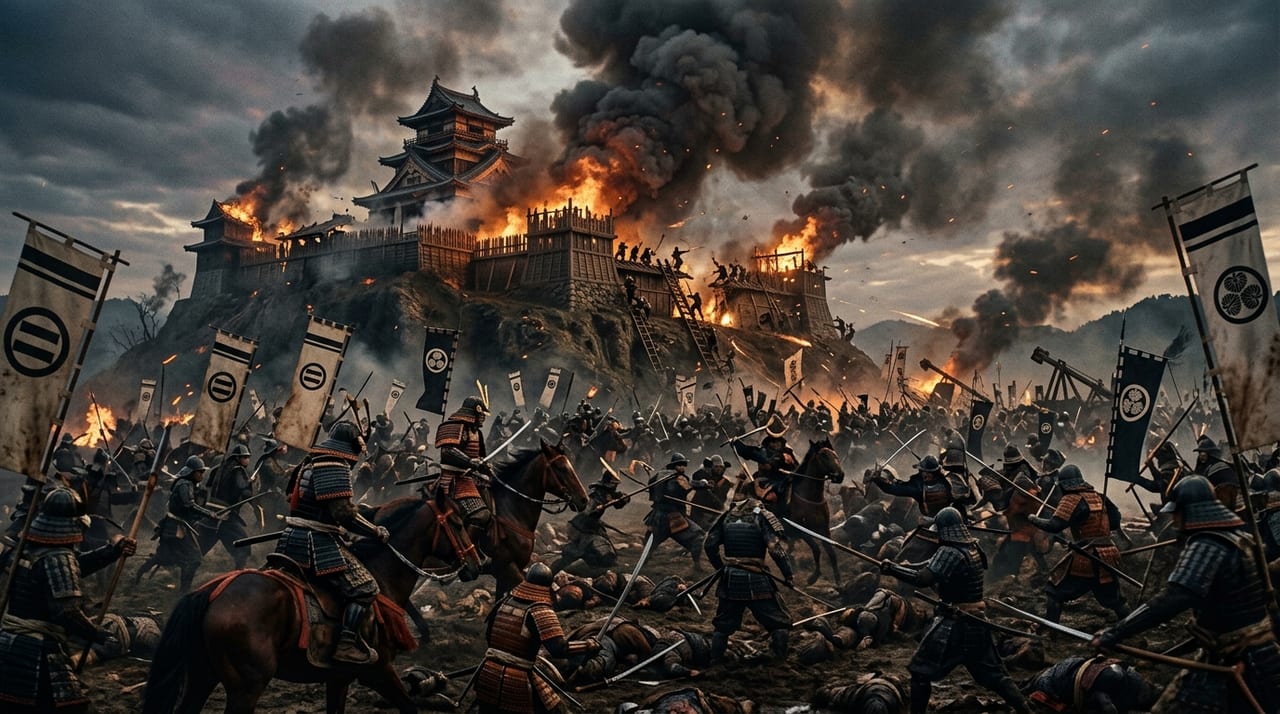
The Kyōtoku War was not the kind of conflict that could be settled in a single decisive battle. It was a war of attrition lasting 28 years, made up of intermittent fighting, siege warfare, and intrigue across the entire Kantō region.
The Yamanouchi and Ōgigayatsu branches of the Uesugi family both took part in the war against the Koga Kubō, but conflict also began to emerge between the two Uesugi houses. This was a foreshadowing of the later Chōkyō War (1487–). Over the course of this long war, the warrior society of the Kantō was fundamentally transformed. Blood and vassal ties were reorganized, and a more meritocratic order of "Sengoku type" began to emerge.
Most important among these changes was the groundwork laid for Hōjō Sōun (Ise Sōzui)'s advance into Izu and Sagami (beginning in 1493). The exhaustion of the Kantō and the power vacuum created by the Kyōtoku War opened the way to Sōun's rise and the founding of the Later Hōjō clan. Had there been no Kyōtoku War, one could say, neither the Later Hōjō's domination of the Kantō nor the prosperity of the five Hōjō generations that followed would have existed.
The impact of the Kyōtoku War on the history of Japanese swords appeared chiefly in the form of the movement and reorganization of swordsmith groups in the east.
Swordsmiths had existed in the Kantō since ancient times, but in the mid-Muromachi period the main centers of sword production were still Bizen, Yamashiro, and Sōshū (Kamakura). The Kyōtoku War dealt a direct blow to the Sōshū tradition of swordsmithing centered on Kamakura. When Shigeuji left Kamakura for Koga, Kamakura lost its function as the center of warrior culture. As the activities of Sōshū-tradition smiths were severely restricted, some of them fled the fighting and moved to other regions.
Meanwhile, the 28 years of warfare raised demand for weapons throughout eastern Japan. Warrior groups on both the Koga Kubō side and the Uesugi side required large numbers of swords, spears, and bows and arrows. To meet this military demand, practical "mass-production type" swords were made in various parts of eastern Japan. The shift in sword production from "famous works by great smiths" to "practical articles for the battlefield" was especially marked in the east after the Kyōtoku War.
Under the rule of the Later Hōjō, established after the Kyōtoku War, swordsmiths around Odawara became active. Smiths who forged blades in the Hōjō castle town of Odawara, such as Yasukuni and Yasuharu, are known as "Odawara Sōshū."
The historical significance of the Kyōtoku War is often underestimated, overshadowed by the Ōnin War. From the viewpoint of eastern Japan, however, the Kyōtoku War was the de facto starting point of the Sengoku period in the Kantō and the east.
Just as the Ōnin War promoted the Sengoku transformation in western Japan (the Kinai and western provinces), the Kyōtoku War promoted it in eastern Japan (the Kantō and the east). These two great wars became the twin pillars that pushed all of Japan toward the Sengoku period.
The consequences of the transformation of Kantō warrior society brought about by the Kyōtoku War, namely the establishment of the Koga Kubō, the rise and conflict of the two Uesugi houses, and the emergence of the Later Hōjō, formed the foundation of the history of the Sengoku east. This history led on to the Battle of Kawanakajima (Uesugi Kenshin vs. Takeda Shingen) and the Siege of Odawara (Toyotomi Hideyoshi's attack on the Later Hōjō). From the perspective of the history of Japanese swords as well, the Kyōtoku War should be more widely recognized as a "turning point in eastern sword culture."
Fudō Masamune
Masterwork of the Sōshū tradition, whose school was disrupted by the Kyōtoku War's destruction of Kamakura
Ishida Masamune
Named Masamune blade symbolizing the Kamakura sword tradition disrupted by the war
Daihannya Nagamitsu
Great Bizen blade representing the sword culture of the warring Kantō warrior leagues